.png)

A living legacy of ‘The Night Before Christmas’

When your good friend's ancestor wrote the holiday classic

By Katie Bausler
Twas the night before Christmas, and all through the house, not a creature was stirring, not even a mouse.
In a candlelit Ḵunéix̱ Hídi Northern Light United Church in Juneau, a cozy couple in matching jammies kick off a lovely performance of holiday music with a reading of a pillar of Christmas culture. The poem presented by actors Roblin Gray Davis and Elizabeth Pisel-Davis transports listeners to Christmases past, and memories of loved ones long gone.
When they credit the author of the most well-known and loved Christmas poem in American history, I feel a new sense of knowing, even pride at hearing the name, Clement Clarke Moore. I’m still grasping that my friend, ski buddy and fellow longtime Juneau resident Linda Ogden Squibb is a direct descendant of the author who penned what became "The Night Before Christmas" for his children nearly 200 years ago, in 1822.
I know Linda is a retired elementary school teacher and talented artist and gardener. Our kids grew up together, skiing and snowboarding mountains from Alaska to Japan. She was part of a group of a half dozen women who hiked hut to hut in the Dolomites for my 50th birthday. But over the years I somehow missed that Linda is the great-great-great-granddaughter of Clement Clarke Moore. And the great-great-granddaughter of his daughter, Mary Clarke Moore Ogden, who created and presented an illuminated manuscript of the poem to her husband, John Doughty Ogden, and their children for Christmas 1855.
Earlier this month I was one of three friends who joined Linda in New York City for a private viewing of the manuscript with its original title, "A Visit from St. Nicholas." It was donated last year by her family to the library of rare books and manuscripts created by the son of Victorian financier and philanthropist J.P. Morgan. The Morgan Library and Museum may be best known for its large, dark Victorian room packed with books floor to ceiling, and featured in movies like "Ragtime," or the well-received novel, "The Personal Librarian."

For our visit to the Morgan, some of us shed our practical Alaskan outerwear for more stylish coats. We stomp our feet in the brisk cold waiting for the doors to open for the day. As visitors finally stream into the airy entry area, we are warmly welcomed by a youthful curator wearing a sharp grey suit. Dr. Philip Palmer ushers us into a sparse and spacious wood-paneled room.
The hardwood floor is covered by an antique Indian rug, an outdoor-light-revealing floor-to-ceiling window perches on a corner of mid-town NYC. Carved panels flank mirrors on opposing sides of the room known as the north parlor, part of the original 19th-century brownstone. As the sounds of honking taxis and passing ambulances leak in, a giant chandelier looms over a gleaming table. The table’s south corner holds a modest book fanned open to the title page of "A Visit from St. Nicholas." Dr. Palmer tells us this is the first colored illustration of the poem, the first of countless "Night Before Christmas" books to this day.
We gingerly approach the treasure on a book stand in its original binding. Moore’s daughter, Mary Ogden, illustrated the tale in paintings and transcribed the poem in medieval Gothic font. The words framed by flowery filigree, a unique border on each page. The style, known as illumination, was a sort of medieval retro style popular with Victorian artists. A little scene in an oval at the top of the page depicts the section of the poem.
At first I am surprised it is not bigger, but the manuscript bears dimensions common to the mid-1800s, about 9x12 inches. Linda picks up the rectangular magnifying glass lying at its side, leans over this family treasure, and reads aloud:
When what to my wandering eyes should appear,
But a miniature sleigh, and eight tiny reindeer,
With a little old driver, so lively and quick,
I knew in a moment, it must be Saint Nick.

The poem introduced Santa’s reindeer and his “bowl full of jelly,” among other things associated with the jolly old elf. In the manuscript, St. Nicholas appears more like a trim prince wearing knickers and a crown as he fills the stockings by the fire.
Like millions of families around the world, my friend and middle child of three took turns reading the poem aloud on Christmas Eve. “Each of us would read a page,” says Linda. During the COVID pandemic, her father, David Ogden, led a Zoom reading with family members of all ages from all over the country. The practice is a continuation of a family legacy that began with Moore reciting the poem to his eight children on Christmas Eve in their Chelsea Manor home. A painting of the home under a full moon opens the manuscript transcribed and painted by his fourth child, Mary Ogden.
The moon on the breasts of the new fallen snow
Gave a lustre of midday to objects below,
The day we viewed the manuscript, a Supermoon rose over Manhattan, perhaps as bright as the evening that inspired the poem. According to Linda, the family story is that Moore’s wife asked him to go to the market to buy another turkey. They were one short for distribution to the poor who attended their parish. Out in his sleigh Moore observed the moonlit snowy roads of early 19th-century New York City. After dinner that night he drafted the poem and read it to his family, the children delighted by the rhyming verses.
Clement Clarke Moore was a poet, scholar and land developer. He was a professor of Oriental and Greek literature at the seminary of the Episcopal Church of New York City on land that he donated. He developed and subdivided this land inherited from his grandfather that eventually became West Manhattan’s coveted Chelsea neighborhood. He was born in 1779 at the Chelsea family estate, the grandson of, according to Wikipedia, “an English officer who stayed in the colony after fighting in the French and Indian War.”
The British connection explains the “Happy Christmas to All,” that ends the poem. David Ogden was born in Great Britain in 1924, apparently from the part of the family that did not make their way to the colonies in the late 1700s. He came to the U.S. in 1939 at the age of 15 and had a career as a financier. He is a veteran of the 10th Mountain Division skiing and climbing troops that fought in the Italian Alps in World War II.
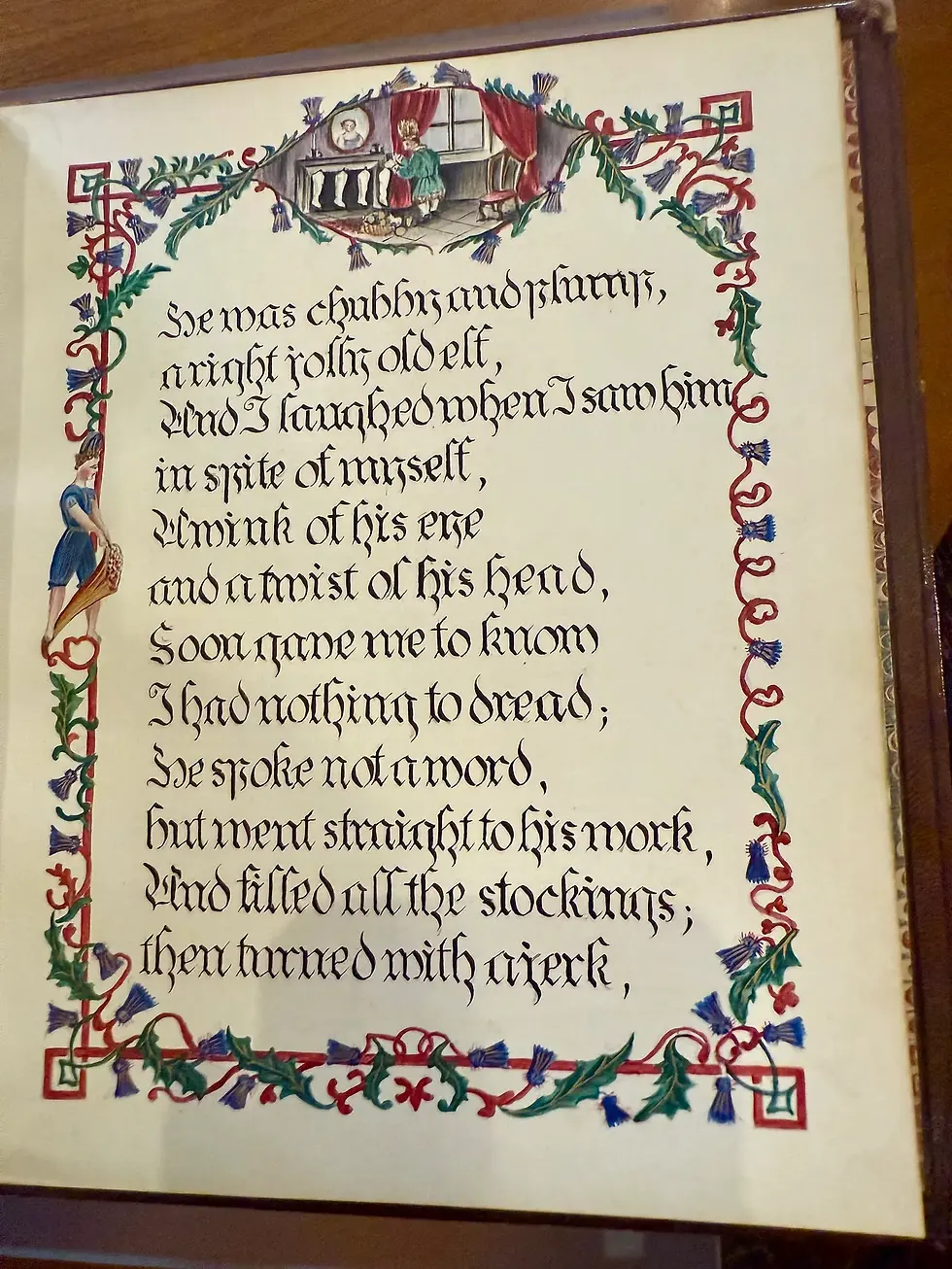
Linda’s dad did his best to keep the manuscript from deteriorating. For the better part of 20 years, he kept it stored in a dark, air-conditioned bank vault in Concord, Massachusetts. “It’s in really good condition,” notes Dr. Palmer. “Light and humidity are the worst things for books. Also, books with illuminations like this last longer because they are always closed.”
Linda recalls her father pulling the heirloom off the shelf occasionally. But like our grand twins are being trained to look but don’t touch the Christmas tree, it was a keep your grubby hands off situation. On Christmas Eve they’d read copies, not the cherished manuscript.
A couple years ago, as Linda’s dad approached his hundredth birthday, the family pushed to find a place to keep the manuscript in perpetuity. After some research they settled on the Morgan, with a team of conservators who specialize in books on paper and 24/7 security. "A Visit from St. Nicholas" lives along with hundreds of medieval and other treasures in a three-story subterranean vault.
Dr. Palmer points out that the illuminated manuscript took many hours to create, and was meant to be read and presentable as a family heirloom. “All of this was embodied in how it was made and how it was illustrated. I love how images of children reading are on the title page and the final page.”
Our fellow delegation member Stacy Sedgewick observes that like her great, great grandmother, Linda is also a detail-oriented artist. Her annual holiday gifts of homemade high bush cranberry ketchup or packets of collected nasturtium seeds are decorated with carefully drawn and painted leaves, berries, and blossoms.
Linda says Clement C. Moore didn’t feel like "A Visit from St. Nicholas" was his best work. Mary said the same of her illustrations. “That’ll make the rest of us feel better,” I quip. Moore apparently never wished for his poem to be published. A family friend sent it to a newspaper in Troy, New York, where it was published anonymously on Dec. 23, 1823. You might say the poem was so popular it went Victorian viral. Moore would not outwardly claim credit until 1844.

Along with the first page of "A Christmas Carol" by Charles Dickens, a page from the illuminated "A Visit from St. Nicholas" was in a glass case on display to the public for the 2024 Holiday season, which coincided with David Ogden’s 100th birthday and incidentally, the 100th anniversary of the Morgan. "A Christmas Carol" returned this holiday season. Dr. Palmer hopes to have "A Visit from St. Nicholas" back on display for visitor viewing in 2026.
• Katie Bausler is a writer, podcaster and radio host. She and her family live in Douglas. This article was originally published at Katie B.’s Chronicles.