


.png)

A salute to those who make Juneau beautiful at this year’s July 4 downtown parade

Updated: Jul 4
Cade Jobsis, 5, getting community-supported treatment for rare disorder, and cleanup activists Leticia McRae and Litter Free are grand marshals for 250th Independence Day

By Ellie Ruel, Jasz Garrett and Mark Sabbatini
Juneau Independent
The Juneau Fourth of July downtown parade will have a small grand marshal helping lead the charge this year — five-year-old Cade Jobsis.
The disabled youth is among three grand marshals in the parade beginning at 11 a.m. Saturday celebrating the 250th anniversary of the United States. The other grand marshals are community cleanup organizers Leticia McRae and Litter Free Inc. — the latter of whom will be at the rear of the parade picking up trash as usual, rather than in an honorary vehicle at the front.
All three are exceptional representatives of this year’s parade theme of “America the Beautiful,” said Alicia Nestler, chair of the Juneau 4th of July Parade Committee. She also said she believes Jobsis is the youngest grand marshal in the downtown parade’s history.
“He united the community in a way that really rallied everyone on a good purpose of supporting this child. And so we just thought that was a beautiful thing,” she said. The other two grand marshals “were nominated because of their beautification of Juneau and their contribution to the community of America.”
Cade Jobsis

Jobsis’ mother, Emma Jobsis, said she was initially unsure about the proposal, but realized it might be the safest way to experience the holiday festivities.
“At first, I was like, ‘Oh, we're trying to keep him away from large groups,’” she said. “But on evaluation, I was like, ‘This is probably the only way that we can enjoy the parade this year.’”
Cade was diagnosed with hereditary spastic paraplegia, SPG50, two years ago. It’s a rare neurodegenerative disorder that can lead to loss of cognitive and motor function and eventually more serious complications like epilepsy. In April, he was selected to receive a novel treatment, Melpida, to help express a functional copy of a gene.
“He's on immunosuppressants right now. That's probably our biggest hurdle, is just to try to keep him healthy,” Jobsis said. “It's similar to a liver transplant in that you take immunosuppressants so that your body doesn't reject the new gene.”
Since Cade is immunocompromised, riding in a car in the front of the parade will keep him safe from the crowd. It will be his second time participating in the parade.
“We've been pretty isolated since we've been home just trying to not be indoors with people, but we're still doing outdoor activities with friends and family,” Jobsis said. “Just trying not to do a lot of the indoor stuff that we previously would have done, which is challenging because our weather is not always cooperative.”
She recently completed a book about her experience fundraising $1.15 million for rare disease treatment which she said she hopes can act as a handbook for other medical parents. Jobsis hasn’t decided how she will publish and share that information yet, but said she’s become a sort of medical advisor for other families.
“I get a lot of emails and phone calls from families that have received diagnoses that are difficult,” Jobsis said. “So that has definitely changed our lives in being, you know, a family to call when people are in some of the worst moments of their life.”
After returning from Texas in April, where the therapy was administered, Jobsis said their family has been trying to settle back into a routine. Cade will have to return to Texas periodically for follow-ups and will be on immunosuppressants for two more years.
“Our life has definitely changed since then, but we are trying to get back into a routine,” she said. “We still have to go back to Texas one more time this year, and then it will be annually after that. About getting back to a more normal life and trying to kind of figure out what's next for us.”
Jobsis said she’s still trying to figure out how to continue sharing Cade’s progress on social media, joking that it feels like the community has bought a subscription to their lives. She said the parade is an opportunity to thank the community for their support.
“It's probably the best, one of the best holidays here in Juneau, to celebrate,” she said. “Everybody gets so excited.”
The Juneau Festival Association announced Cade’s selection as a grand marshal in early May.
“Cade’s journey is a testament to what a community can accomplish when it comes together with purpose and heart,” the festival association’s website states. “In Juneau, Alaska, friends, neighbors, small businesses, and even strangers rallied in an extraordinary way.”
Leticia McRae

Another grand marshal has been leading the charge on volunteer efforts to keep Juneau beautiful for the past decade.
Leticia McRae, who moved to Juneau from California in the late 1980s, has made it her mission to raise awareness of the capital city’s litter crisis.
“We should care. Look how lucky we are,” she said. “I mean, this is the most beautiful place to live and it deserves better treatment.”
She began her Facebook page “Community Clean Up In Progress” to document trash that she often loaded in her pickup truck and paid out of pocket to dump. On average, McRae said she picks up about two tons of trash a year.
“It's nice to know that people recognize it, they see it, they notice it,” she said. “Awards and accumulations are really great, but what I really, really want is a clean environment and change.”
Her page has grown to 1,700 followers in the last 10 years, but so has the problem, McRae said.
“In 10 years I've documented the problem, I've showed the before and afters, I've showed the work it takes,” she said. “I've documented it for 10 years: nothing, no changes, nothing. Nothing has changed except our dump rates have increased, so the dumping in the community increases, and there's not enough volunteers to clean it all up. It's getting harder and harder every year.”
She said littering has reached a point beyond volunteer efforts and annually scheduled cleanups by Litter Free Inc. — another grand marshal — and the Southeast Alaska Land Trust. McRae attributed this to increased dump fees in recent years driving more people to dump their trash out the road.
McRae added she can no longer load her truck and take it to the dump.
“I have kind of had to change the way I do what I do due to the dump increase fees, and there are new rules, and it just makes it harder,” she said. “They're not new rules — they're old rules that they've just decided to really start implementing, like lead testing for construction materials.”
McRae said this spring, she’s noticed more construction debris. She and her friend pushed several tires that had been thrown off the edge of the road back up the beach to dispose of them.
She said this year, she’s shifted to filling a large bear-proof trash container once a week due to heightened costs, personal health and scheduling limitations.
“In prior years I worked for myself so it was easy — ‘Oh, it’s a sunny day, let’s go pick up litter,” she said. “I haven't given up. It's just that this year is a little harder than past years to get it done.”
She said she hoped starting her page would prompt more action from the city and state, and suggested picking up litter could provide multiple jobs.
Still, McRae said she thinks her page has been a success due to how it’s inspired other community members to clean up.
“That’s why I keep going,” she said. “It doesn't matter if you spend half an hour picking up trash — doesn't matter if you spend three hours picking up trash — every effort makes a difference.”
McRae is already planning to clean up North Douglas before and after the Fourth of July. She said fireworks, bottles and cans are discarded, mostly at the boat launch and False Outer Point, and asked for those celebrating to bring a trash bag with them.
“I have to go out there with a push broom because it's all little pieces from what’s exploded,” McRae said.
She said litter is a problem all over town, but especially persistent on North Douglas, out the road and on the highway.
McRae posts planned cleanups on her Facebook page and said anyone is welcome to join her. She said she will aim to schedule her next community cleanup in August. McRae also started a small craft business to help offset personal expenses of fuel and cleanup supplies last year.
“It’s just getting harder to do with the economy the way it is,” she said. “It’s hard to ask people to volunteer when they're struggling to pay their bills and trying to work enough to get by.”
But she said she’s not quitting.
“We are the capital of Alaska,” McRae said. “We could be setting an example of how to keep our city green and clean. We should be an example. We should want to keep Alaska as The Last Frontier, and clean and wild.”
As for her role in the parade Saturday, McRae traded her trusty truck for a 2026 Chevy Colorado from Juneau Auto Mall — just for the holiday. She encourages people to pick up after themselves this Fourth of July weekend.
McRae said parade-goers often leave party poppers and candy wrappers behind, but thankfully, Litter Free began helping clean downtown streets three years ago.
Litter Free Inc.
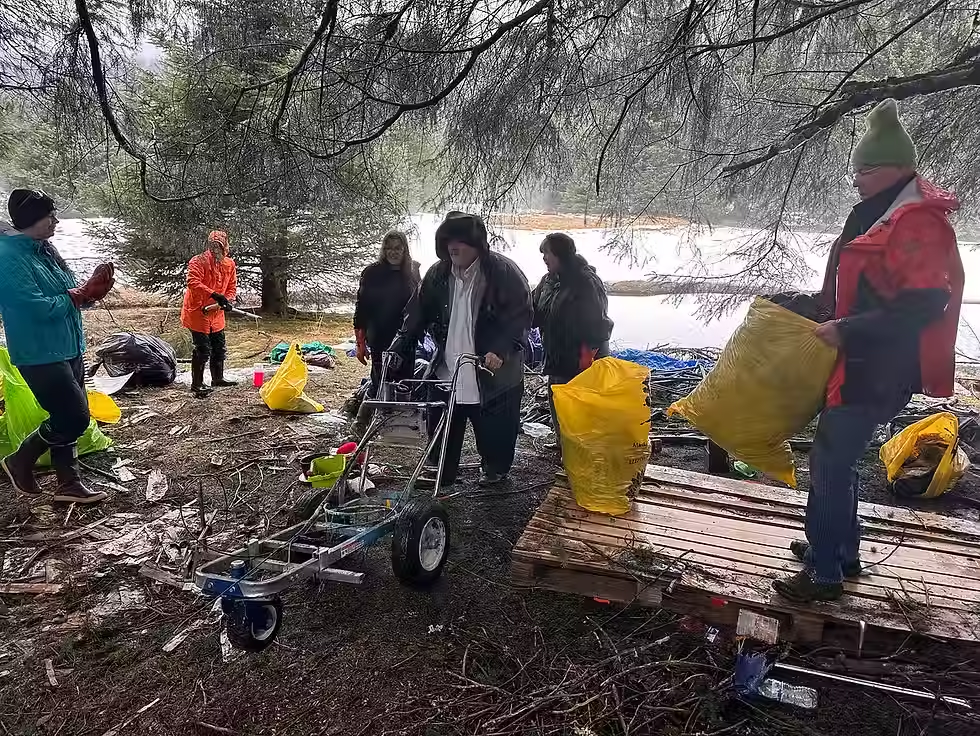
John King, president of Litter Free’s board of directors, says he’s honored his nonprofit organization is among those selected to lead this year’s Fourth of July parade, but its members will be at the rear picking up trash for a fourth straight year.
“The other grand marshals will be in the front, but we wanted to be able to make as much of a difference as we could with our mission of cleaning up,” he said.
In another unusual move, if anyone is interested in marching along with a parade grand marshal “we're looking for folks to join us,” King said.
Litter Free, which partners with Alaska Waste for the parade pickup, has nine board members who are all volunteers. King said in addition to seeking more volunteers via social media to help with the cleanup, participants will be working to get the crowd involved.
“I will also be going through along the crowd before the parade starts and handing out some some bags to folks with a little flyer on them asking them to use that bag to help clean up around the area and to share it with other folks to make new friends, and challenge kids to pick up five pieces of trash if they are getting bored and antsy,” he said. “And so the folks along the edges of the crowd will be able to give us those bags as well when we go by.”
King said he doesn’t know how much trash is picked up each year during the parade, but the challenge is about the type of things scattered on the street as well as the volume.
“I can tell you there's a lot of saltwater taffy that gets run over by the vehicles in the parade, and it's difficult to clean up,” he said.
Litter Free was founded in 1988 and is perhaps best known for its one-day annual Juneau Community Cleanup in spring that during a typical year involves several hundred people picking up tens of thousands of pounds of trash and recyclables. This year 755 volunteers brought more than 32,000 pounds of trash to Juneau’s landfill and collected about 200 pounds of recyclables.
Its most extensive effort is its Youth Litter Patrol program that during summer and fall pays youth groups $12 per hour per person — with a cap of $1,200, for cleanups of public areas. Litter Free’s website states 320 youth and adult volunteers spent 500 hours picking up trash in 2025.
King, a Juneau resident for the past 14 years, said trash throughout the city has always been a problem due to it being scattered by people, wildlife and weather.
“I think that we're more connected now through social media, and so I think that folks are maybe aware of dumping more,” he said.
That means more residents may be upset by images of trash dumped along roadsides or abandoned homeless encampments, for instance, but also provides more awareness of cleanup efforts being undertaken by individuals and groups.
King said there are further efforts residents can participate in, including the Adopt-a-Highway program since Juneau has plenty of stretches of road that aren’t adopted.
“I think something that would be really neat is if folks got people together that all wanted to see a change in a certain spot and adopted the highway,” he said. “Because then they can go out, they can get the signage, they can get the safety equipment, and then the (state) DOT comes and picks up the bags after their set time.”
King said that in addition to doing Litter Free’s usual July 4 duties in the downtown parade, he’s planning a typical holiday weekend for America’s 250th birthday.
“I'm going to be downtown for the third — the fireworks at midnight, and then I'll be in the parade on the fourth, and then probably down in Douglas to enjoy it with my friends,” he said.
Juneau-Douglas High School Class of 1966

The Douglas 4th of July Committee chose the Juneau-Douglas High School class of 1966 as its grand marshal this year.
“The invitation reflects not only the class’s milestone anniversary, but also its enduring bond with Douglas and Juneau over the decades,” the committee website page states. The class that had more than 200 graduates marks its 60th reunion July 4–7.
“Their class motto, ‘Catch Us If You Can” is exemplified by the many graduates that have gone on to make their mark in various walks of life — commercial fishing and business, public service and politics, education and civic leadership, the arts and community volunteering — while continuing to support, and often return to, the community that launched them,” the committee description says.
The class of 1966 will head the Douglas parade on Saturday, one of many events celebrating the 250th anniversary of the United States this weekend.
Events
Note: Juneau’s fireworks show has been rescheduled from its traditional time of 11:59 p.m. July 3 (Friday) to the same time on July 4 (Saturday) due to weather.
Friday: The Douglas 4th of July Committee will host a soapbox car show from 5 to 5:30 p.m. on St. Ann’s Ave., with trials, registration and a challenge heat from 5:30 to 7:30 p.m (the final soapbox challenge is 3 p.m. Saturday at St. Ann’s Ave). A community picnic also takes place Friday with the traditional watermelon-eating contest from 6 to 8 p.m. at Sandy Beach, with food and drinks provided.
Juneau Community Bands will perform traditional Independence Day songs at 7 p.m. at Sealaska Plaza.
Saturday: The Juneau Festival Association will host its annual downtown parade beginning at 11 a.m. at 8th Street and Egan Drive.
The Douglas parade is at 2 p.m. with lineups at Sayéik: Gastineau Community School. There is parking available 2 to 6 p.m. at the Douglas Boat Harbor, one-way streets, 4th St. to South and 2nd St. to North. No parking is allowed from Sayéik: Gastineau Community School to Summers St.
Performances by the Society for Creative Anachronism will take place from 10 a.m. to 5 p.m. at Savikko Park Field #4. The Douglas Community United Methodist Church will host a kids’ fun fest from 10:30 a.m. to 2 p.m. The Douglas Volunteer Fire District will host a hot dog sale at the Douglas Fire Hall. The Olde Time Firemen’s Hose Race will take place in front of the fire hall at 3:30 p.m.
There is also an annual sandcastle challenge planned at Sandy Beach, with registration beginning at noon and various field events at Savikko Park Field #1 beginning at 3 p.m.
From 3:30 to 9 p.m., Alaska Music One will present “Bands on the Beach,” weather-permitting.
More information on Douglas events can be found here.
• Contact the Juneau Independent team at editor@juneauindependent.com.


_edited.jpg)


