


.png)

Alaska legislators prepare to consider veto overrides in special session — but which ones?

Leading lawmakers say they only expect to meet briefly when the special session opens on Saturday in Juneau
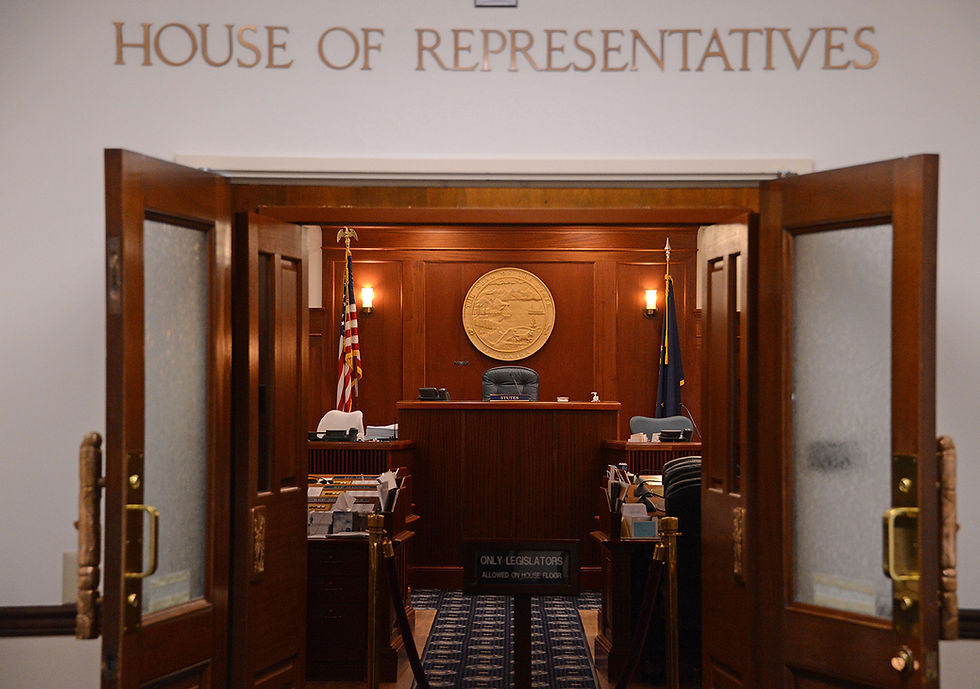
The Alaska Legislature is scheduled to meet Saturday for a special session called by Gov. Mike Dunleavy, but lawmakers are expecting to eschew the governor’s agenda in favor of votes to either override or sustain some of his vetoes from earlier this year.
The special session could last for 30 days, but legislators believe they won’t need that much time to act.
“I believe it’ll be short,” Senate President Gary Stevens, R-Kodiak, said during a July 25 legislative meeting. “We go in Aug. 2, and we leave.”
In an opinion column, Stevens and Speaker of the House Bryce Edgmon, I-Dillingham, said they see the most pressing issues in the special session to be overriding two of the governor’s vetoes — one of about $50 million in public education funding, and another of Senate Bill 183, which that would compel the Alaska Department of Revenue to produce specific reports about tax settlements paid by oil companies to the state.
Several legislators said they think additional vetoes could be taken up as well, but that would be decided only when all lawmakers are in Juneau.
“From my understanding, we’re going to do a ‘temperature check’ after considering an override on the education funding appropriations and SB 183,” said Rep. Robyn Burke, D-Utqiagvik.
Sen. Bill Wielechowski, D-Anchorage, said that “if there’s success on those things, and there’s a desire to go forward, maybe it changes, but at this point, it’s those two things.”
Dunleavy has asked legislators to consider education policy issues and the proposed creation of and an Alaska Department of Agriculture.
Legislators rejected the governor’s proposals this spring.
“The governor, I think, is asking for that to be rethought,” Rep. Justin Ruffridge, R-Soldotna, told the Kenai and Soldotna chambers of commerce this week.
Legislators are preparing to turn down the governor’s request for reconsideration but are advancing alternatives. They have created an education task force to discuss some of the policy changes the governor has proposed. That task force, formally dubbed the Task Force on Education Funding, will hold its first meeting Aug. 25 in Anchorage.
“Yes, the name implies funding, but they will be taking up open enrollment and there are all sorts of policy things that will be on the agenda,” said Mike Mason, chief of staff to Sen. Loki Tobin, D-Anchorage, one of the co-chairs of the task force.
In a written statement, Senate Majority Leader Cathy Giessel, R-Anchorage, said lawmakers will consider creating a Department of Agriculture, but via legislation during the 2026 regular session, not during the special session.
Lawmakers introduced Senate Bill 128 to expand the governor’s original proposal, which had been enshrined in an executive order. Lawmakers voted to prevent that order from coming into effect, citing gaps in the governor’s proposal.
“During the last legislative session, we listened to the public and incorporated their feedback into a stronger, more comprehensive bill,” instead of an executive order that could not be adapted to fit the real needs of Alaska’s agriculture industry,” Giessel said in the statement.
She is chair of the Senate Resources Committee, which held three hearings on the bill earlier this year.
Shortly after announcing the special session, Dunleavy asked conservative Republican legislators to stay away from its first five days. That’s when the Alaska Constitution requires lawmakers to vote on vetoes. An absent lawmaker is the same as a “no” vote.
In a constituent newsletter, Giessel said she opposes the governor’s request.
“When we (legislators) campaigned to convince you to hire us for this job, we made all kinds of promises,” she wrote. “Voters decided to trust that we would do the job of showing up for work. It’s disturbing that the Governor asked the Republicans to break trust with Alaskan voters. (Perhaps we could construe that he doesn’t value trust and integrity, based on his action in making that request of Republicans.)”
Public polling results published Thursday by Data for Progress show Alaskans overwhelmingly favor an education veto override, with 91% of Democrats and 65% of independents and third-party voters in favor of an override. Only 35% of Republicans said they support an override. The polling firm works with progressive organizations.
Initially, several Republican legislators said they would follow the governor’s request.
However, on Monday Dunleavy called on legislators to hold committee meetings starting on Sunday. And on Wednesday, some — including Reps. Jamie Allard, Cathy Tilton, Kevin McCabe and Rebecca Schwanke — said they had reconsidered their plans and will attend in order to vote against overrides.
Budget vetoes are sustained unless at least 45 of 60 state lawmakers vote for an override. Policy vetoes are sustained unless at least 40 lawmakers vote to override.
Initially, Sen. Forrest Dunbar, D-Anchorage, was expected to be absent from the special session because of military service. Last week, he was able to obtain special leave and is now expected to be in Juneau on Saturday.
That matters because 46 of 60 lawmakers voted in May to override a prior Dunleavy education veto. If Dunbar was absent, only 45 of those lawmakers would have been present, at most. A change by any one of those pro-override legislators would sustain the governor’s decision.
Rep. Calvin Schrage, I-Anchorage and a member of the House majority, said he’s not certain what will ultimately be on the agenda for Saturday’s joint session. That will be determined in talks between the leaders of the House and Senate, he said, possibly as late as Saturday morning.
Wielechowski and House Majority Leader Chuck Kopp, R-Anchorage, said that’s their understanding of the plan, too.
A bill sponsored by Schrage, HB 70, was one of five policy measures vetoed by the governor between the end of the regular session and the start of this special session, meaning that if lawmakers don’t override the veto now, it will be sustained.
That bill would allow ambulance crews to help police and rescue dogs in the event of an injury.
Burke, too, has a vetoed bill — House Bill 174, dealing with teacher housing and the state-operated Mount Edgecumbe boarding school.
“I’m hopeful that we’ll consider an override of HB 174,” she wrote by text message from Kivalina.
“HB 174 passed with a total of 54 yeas, 5 nays and 1 excused,” she wrote. “There are two other bills that were vetoed that received 50+ yeas out of both bodies; I hope we’ll have an opportunity to consider those bills, too.”
There’s also the possibility that lawmakers could bring up other budget vetoes, too. Dunleavy vetoed a significant chunk of the major maintenance budget for public schools and a substantial number of road construction projects. The latter vetoes were because the governor disagreed with the funding mechanism used by the Legislature.
In a hearing of the House Transportation Committee last week, legislators said hundreds of millions of dollars in projects were endangered by the governor’s veto.
The governor’s legislative liaison, Jordan Shilling, commented on Facebook that lawmakers were to blame for writing a faulty method for funding those projects.
By text message from Kivalina, Rep. Ashley Carrick, D-Fairbanks and chair of the transportation committee, said that while overriding the transportation funding veto is “a priority issue for me and for many communities across the state … my focus this special session is on education funding, as this is the No. 1 issue my constituents and Alaskans have contacted me about.”
• James Brooks is a longtime Alaska reporter, having previously worked at the Anchorage Daily News, Juneau Empire, Kodiak Mirror and Fairbanks Daily News-Miner. Alaska Beacon is part of States Newsroom, the nation’s largest state-focused nonprofit news organization.


