.png)

Alaska Native corporation seeks OK to build winter roads in ANWR

Kaktovik Iñupiat Corp. says a seasonal ice and snow road link is unrelated to oil, but needed to reduce costs and improve life in the isolated village

By Yereth Rosen
Alaska Beacon
An Alaska Native corporation is seeking permission from the Trump administration to build seasonal roads that would cross through part of the Arctic National Wildlife Refuge for the next two decades.
The Kaktovik Iñupiat Corporation has applied for a 20-year right-of-way that would allow construction of ice and snow roads connecting the village to Deadhorse, an industrial community at the edge of the Prudhoe Bay oil field and located about 120 miles to the west.
Proposed routes include two segments, about 43 and 50 miles each, that would cross land or waters within the national wildlife refuge, according to a draft environmental assessment released on Jan. 23 by the U.S. Fish and Wildlife Service. A public comment period ends on Feb. 9.
KIC, a for-profit corporation owned by the Inupiat people from the village of Kaktovik, has campaigned for decades in favor of oil development in the refuge coastal plain. Kaktovik lies at the far northeastern corner of Alaska, on the Beaufort Sea coast and at the northern edge of the Arctic refuge. The corporation owns about 92,000 acres within refuge borders that it has long attempted to open to oil development. The Arctic Slope Regional Corp., one of the 13 regional for-profit corporations created by the 1971 Alaska Native Claims Settlement Act, owns the mineral rights to that KIC land. ASRC has also been a prominent supporter of ANWR oil development.
Just this month, the Trump administration has cleared the way for ANWR oil development, with new lease sales planned as early as this winter.
But Charles Lampe, KIC’s president, said the winter road proposal is unrelated to any oil ambitions.
Instead, it is about allowing goods, fuel and equipment to be transported more readily, giving people better access to emergency services if they need them, lowering costs and improving living conditions in general, Lampe said.
It is important to separate it from the heated debate over oil development in the refuge, and any link is a “misconception,” he said.
“This road isn’t designed for oil and gas. It has nothing to do with tying into oil and gas,” he said. “People who are trying to tie this into oil and gas and that are really doing a disservice to our community.”
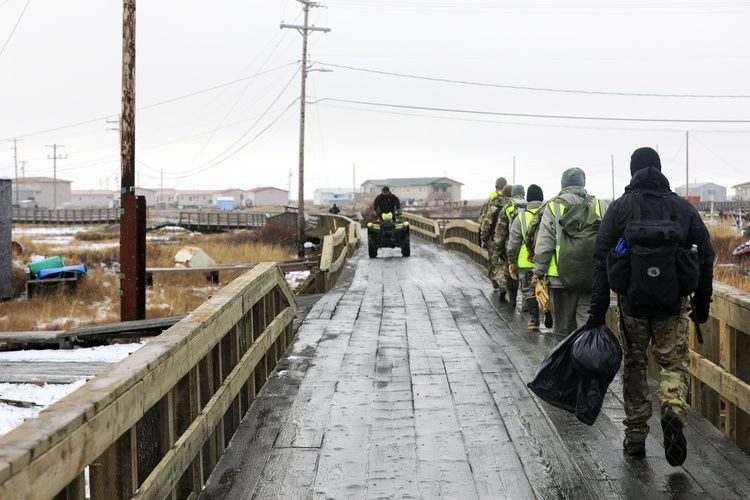
No permanent roads connect the North Slope’s communities, including Kaktovik, he noted. So snow and ice roads, which are built in the winter but melt away in the summer, are routinely used by the oil industry and, increasingly, by communities. The North Slope Borough has an “amazing” program that funds the construction of those seasonal roads, he said.
“Ice roads and snow roads play a vital piece in trying to help us lower the cost of living for each of our communities,” Lampe said.
If KIC receives the right-of-way, that does not mean winter roads would be built every year for two decades, he said. Building roads would require proper snow conditions, and those may not emerge every year, he said.
Still, there is value in having a right-of-way that extends to 20 years, he said. “With that 20-year right-of-way, that just saves us a headache of trying to reapply every year or every couple of years for a federal permit to access our land,” he said.
KIC approached the Biden administration with the idea of a 20-year right-of-way, but that administration advised pursuit of a 5-year plan instead, Lampe said.
Despite Lampe’s statements separating the proposed winter road system from oil activity, the Fish and Wildlife Service’s draft environmental assessment makes a connection in its discussion of cumulative impacts.
“Over time, it is reasonably foreseeable that trail use could persist beyond the life of the project. In this case, continued winter access by personal vehicles could extend the disturbance footprint, increase soil compaction, and affect wildlife and vegetation in previously less-accessible areas. In addition, it is reasonable to assume that this trail may be used as a primary route for oil & gas related overland travel that would allow further access to individual leases,” the assessment says.
Opponents to ANWR oil development have also made the connection.
A Jan. 23 statement from the Gwich’in Steering Committee, which represents Gwich’in Athabascan tribal members in northeastern Alaska and northwestern Canada, said the road proposal “appears to be the first step in permitting roads across the coastal plain, which could be used to facilitate oil and gas exploration and development in the future, which the Gwich’in Nation firmly opposes.”
Environmental concerns about winter roads
Even if it is unrelated to oil development, the road project could cause environmental damage, the Gwich’in Steering Committee statement said. Snow cover on the refuge coastal plain is scarcer than in other parts of the North Slope, raising the specter of damage to the tundra, and road traffic could disrupt the region’s Porcupine Caribou Herd, the statement said.
“As Indigenous people with villages in remote parts of Alaska and Canada – many of which are only accessible by boat or plane – the Gwich’in understand the desire for more affordable access to remote communities,” Kristen Moreland, the committee’s executive director, said in the statement.
“However, we cannot overlook the potential for short and long-term damage to fragile ground in the coastal plain and to the porcupine caribou herd that would result from the construction and use of a road,” she said.
The debate over ice and snow roads in the refuge coastal plain is not new.
Seven years ago, when the first Trump administration was working toward approval of a seismic survey in the area, scientists from the University of Alaska Fairbanks issued a white paper detailing the risks of the ice and snow roads that would be used for such work.
The refuge coastal plain, wedged between the Brooks Range and Arctic Ocean, is scarce on the materials needed to build winter roads strong enough to prevent damage to the tundra and the permafrost below, the scientists warned. The area is more wind-scoured than the rest of the North Slope and it has little freshwater that would be available for roads, they said.
Seismic surveys use sound waves to help map out possible oil and gas resources within geologic formations. The equipment is transported by heavy vehicles that crisscross terrain.
KIC was the proponent of that seismic plan, which was to have been carried out by contractor SAExploration. It got preliminary approval at the end of the first Trump administration but was rejected by the Biden administration.
The Alaska Industrial Development and Export Authority, which holds seven leases in the refuge coastal plain, has revived plans for seismic surveys. The state economic development authority in July formally solicited bids from potential contractors to conduct surveys over several years.
• Yereth Rosen came to Alaska in 1987 to work for the Anchorage Times. She has been reporting on Alaska news ever since, covering stories ranging from oil spills to sled-dog races. She has reported for Reuters, for the Alaska Dispatch News, for Arctic Today and for other organizations. Alaska Beacon is part of States Newsroom, the nation’s largest state-focused nonprofit news organization.




_edited.jpg)


.png)

.png)