.png)

At Alaska forums, US senators warn Greenland tensions are straining Arctic alliances

Murkowski, Welch point to diplomacy gaps, shifting U.S. strategy

By Jenni Monet
Alaska Beacon
On Friday afternoon in downtown Anchorage, Sen. Lisa Murkowski, R-Alaska, arrived at the Arctic Encounter Summit at the Dena’ina Convention Center, an annual gathering of policymakers, business leaders and international officials focused on Arctic strategy.
A day after welcoming news that two additional U.S. Coast Guard icebreakers would be homeported in the state — a development she has sought for decades – Murkowski struck a tempered tone.
“We got what we wanted,” she told an audience at a luncheon. “But not in the way that we wanted it.”
From this ballroom, not far from where polar ice melt is outpacing earlier scientific expectations, Alaska’s senior senator rattled off a litany of concerns — from repeated Russian incursions in the U.S. airspace to President Donald Trump’s musing about leaving NATO. Murkowski also pointed to tensions over Greenland, which have strained relations between the U.S. and its Arctic allies, troubling a region long recognized as a “zone of peace.”
Since taking office, President Trump has pushed for the United States to take control of the semi-autonomous Inuit island under the Kingdom of Denmark, at times suggesting it could be acquired by force, despite repeated rejections from Greenlandic and Danish officials. Last week, Greenland Prime Minister Jens-Frederik Nielsen told NBC News that many Greenlanders “don’t feel safe” amid Trump’s repeated rhetoric to claim the territory.
As these tensions test alliances, new questions were raised at the conference about U.S. strategy in the Far North. Senator Murkowski, arguably the leading congressional voice for establishing U.S. Arctic power, has cast a steady light on the Greenland crisis alongside what she sees as the Trump Administration’s imbalanced Arctic strategy. Despite the administration’s historic investments that are closing the gap on U.S. Arctic engagement — mostly in the form of military and Coast Guard spending — Murkowski expressed concern.
“We’re all in on defense,” she said, “But we haven’t prioritized what we need to do with the diplomacy side of things, or the science and research side.”
In January, Murkowski led a bipartisan congressional delegation to Denmark with Sen. Angus King, an independent from Maine, followed by a visit to Greenland the next month. The effort to ease rising Arctic tensions would typically fall to the U.S. Ambassador-at-Large for Arctic Affairs. But for more than a year, the position has remained vacant.
Meanwhile, changes within the U.S. Arctic Research Commission, including the recent appointment of Alaska Gov. Mike Dunleavy, reflect a broader shift in federal priorities as the agency pivots from its longtime focus on environmental science toward greater emphasis on military and commerce. This shift is one of many now testing the concept of “Arctic exceptionalism,” the region’s long-standing norm of peaceful cooperation, which some speakers at the Anchorage summit say may already be unraveling.
For 13 years, former Murkowski staffers have organized the Arctic Encounter Summit, branded as “North America’s premier Arctic policy and business convening.” Drawing on a network of high-profile colleagues — Sen. Joe Manchin, D-West Virginia, attended in 2022 — Murkowski has used the annual gathering to advance U.S. Arctic policy, share the stage with international leaders and offer updates from Congress. She has even taken attendees to Utqiaġvik, the nation’s northernmost community and hub for Arctic research and strategy.
More broadly, the summit reflects a policy legacy she has carried forward from Alaska’s past — building on the work of previous Alaska Republican Senators like her father, former Sen. Frank Murkowski, and the late Sen. Ted Stevens. Both helped elevate U.S. Arctic interests through science, research and maritime policy.
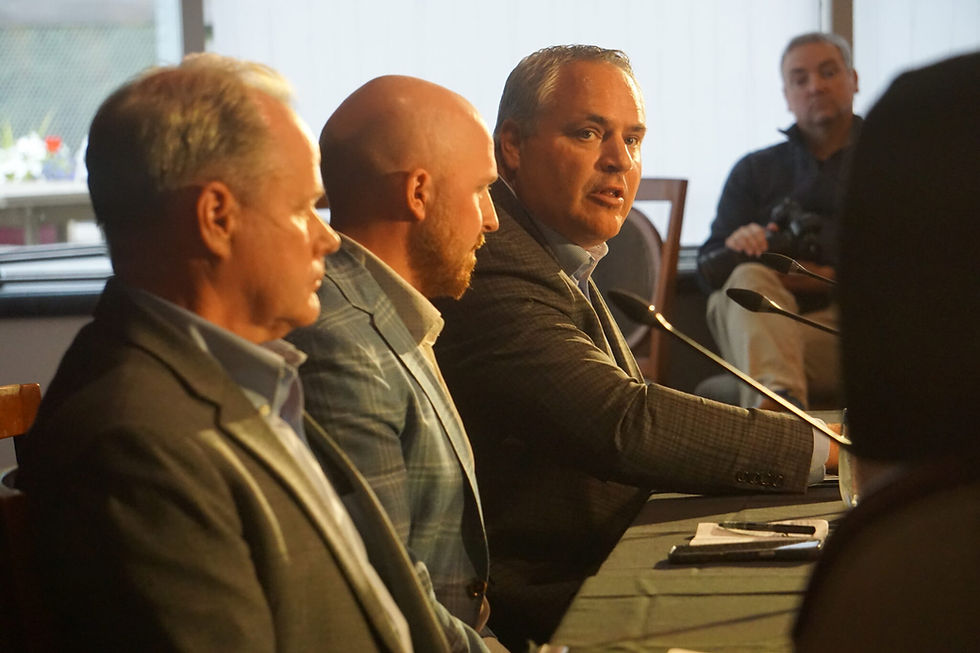
This year, Senator Peter Welch, a Democrat from Vermont who traveled to Denmark with Murkowski, joined an international group of Arctic parliamentarians. Together they huddled with the Alaska senator for an afternoon of panel discussions on the last day of the Arctic Encounter.
For months, Murkowski has worked mostly with congressional Democrats like Welch to push back on the president’s Greenland bid in an effort to preserve stability in the Arctic. As a founding member and co-chair of the Senate Arctic Caucus formed in 2015, she has also noted that neither the White House nor the State Department has sought the group’s input on the issue.
“I think that is a disadvantage to them because we do have a level of connection through the Arctic Caucus,” she said at the luncheon. “I think we should be viewed as a valued asset.”
Welch is a member of the Arctic Caucus and also the Senate Finance Committee. Recently, he pushed back on Trump administration tariffs, including those threatened against NATO allies that sent troops to Greenland in a symbolic show of support for its sovereignty, last January. After his trip to Denmark, he introduced a resolution to block the tariffs targeting the eight Arctic nations. The effort, while not formally passed, helped prompt the administration to back down.
“What’s so disturbing to me is that even many of our NATO allies are internalizing that they can’t count on the United States, and that’s upsetting to me, because we have been so benefited by that level of cooperation,” said Sen. Welch at the conference. “What Russia is doing now in Ukraine is just so violent and vicious and terrible that we can’t afford to be having any friction that is self-made amongst allies who have a shared interest in standing up for the independence of a sovereign nation.”
At the same time, Welch is co-sponsoring the Arctic Refuge Protection Act of 2025 which directly challenges Sen. Murkowski’s long-game ambitions to open the Alaska National Wildlife Refuge’s Coastal Plain to oil drilling. To her, the effort represents the “Holy Grail of Alaska politics.” But supporters of the bill describe the extraction plan as a “fictional financial windfall,” citing weak lease sales in 2021 and 2025.
Despite those differences, the two senators united at the summit in their support for maintaining Arctic cooperation and strengthening alliances — a bipartisan approach Murkowski is known for. Days later, they appeared again in Fairbanks for talks hosted by the Conference of Parliamentarians of the Arctic Region, a biennial forum of eight Arctic nations. Murkowski serves as vice chair of its standing committee, while Welch attended as part of the U.S. congressional delegation.
In Fairbanks, Murkowski stopped short of declaring an end to Arctic exceptionalism, instead broadening the definition of security in a changing North — even as she promotes recent military investments for Alaska, like the future commissioning of the U.S.S. Ted Stevens, a missile destroyer. “Security isn’t just military,” she said, pointing to what she described as other forms of security critical to the Arctic: food, family, education and environmental and energy stability.
A key voice for Welch in that discussion was the Inuit Circumpolar Council, an international organization representing about 180,000 Inuit across Alaska, Canada, Greenland and Chukotka, Russia. At the summit, its Alaska branch released an Arctic Strategy outlining priorities for Indigenous self-determination and governance in the region. Murkowski also invited ICC Alaska delegates to take part in the high-level talks in Fairbanks.
“Their whole culture couldn’t survive without a basic consensus‑oriented and cooperative approach,” Welch said, arguing that Indigenous perspectives must remain central to Arctic governance. And he warned against any agenda that sidelines the Inuit. “There’s an immense amount of anxiety about the new interest in the Arctic where the interests and the values of the Indigenous peoples and everyday Alaskans can be imperiled.”
Murkowski echoed that view, aligning with Welch on the importance of Indigenous leadership in shaping the Arctic’s future.
“Right now, we’re not talking to Russia,” said Murkowski, explaining the impasse as a symptom of the ongoing assault on Ukraine. But she drew attention to how the ICC is still able to maintain dialogue with Chukotka, the Russian region home to the Inuit diaspora there. “They are the only entity that is able to keep a connection with people in Russia – Indigenous people at that level. This is noteworthy,” she said.
Though Murkowski often draws criticism for her middle-way approach in balancing environmental priorities with support for military spending and resource development – a contrast reflected by the League of Conservation Voters, which gives Welch a lifetime score of 95% against Murkowski’s 20% – the senator, nonetheless, described his colleague as an important bridge between Alaska’s old Arctic power brokers and a new generation of leaders. “Your father, Ted Stevens — there’s a real through line,” Welch said.
Across their conversations, the lawmakers seemed to imply that a more assertive congressional role — through funding, diplomatic appointments and Arctic engagement — will be key to restoring stability in the Arctic after the Greenland crisis and shaping whether the region will be governed by cooperation or coercion. That includes the Ambassador-at-large for Arctic Affairs, a position Murkowski codified in the 2026 National Defense Authorization Act, elevating it to a permanent diplomatic post.
“The role of Congress has to be much more aggressive, assertive and independent,” said Sen. Welch. “What we need is more Lisa Murkowskis who are pushing actively through the appropriations process to do something.”
• Jenni Monet is an Alaska-based freelance journalist. Alaska Beacon is part of States Newsroom, the nation’s largest state-focused nonprofit news organization.


_edited.jpg)




.png)

.png)