


.png)

Begich asks Alaska Legislature to act quickly on Trump’s agenda in annual address

First-term U.S. House member says ‘window of opportunity for Alaska will not remain open forever’ on oil, fisheries and other industry growth

By Mark Sabbatini
Juneau Independent
U.S. Rep. Nick Begich III, R-Alaska, mixed a year of Trump administration review with some specific policy action requests for the Alaska Legislature during his annual address to a joint session at the Alaska State Capitol on Tuesday.
Begich, serving his first term as the state’s lone U.S. House member, reiterated his support for President Donald Trump’s overall agenda, focusing particularly on state-specific natural resource development efforts. The congressman also said he supports the war against Iran and large-scale immigration enforcement that as of last October had lowered illegal border crossings from Mexico to their lowest level in more than 50 years.
The 45-minute speech was less overtly partisan than last month’s appearance by U.S. Dan Sullivan, R-Alaska, but Begich did repeatedly refer to favorable political conditions with Republicans controlling the White House and both chambers of Congress.
"In just over a year we have moved real legislation," Begich said. "We have reopened access. We have accelerated permitting. We have secured historic Arctic and defense investments. We have opened new doors for rural health. The federal barriers are coming down. Permits are moving. The investment is flowing. But this window of opportunity for Alaska will not remain open forever."
That means state lawmakers need to act quickly, he said, leaving unspoken that elections in November could change control of the narrowly divided House and Senate.
"The pace of the last year was fast because we made it fast," Begich said. "Now I'm calling on this legislature to continue the fight, and do the job Alaskans deserve and respect."

He singled out as his first priority the North Pacific Fishery Management Council, noting six of 11 voting members are chosen by Alaska’s governor "with no state-level statutory criteria for who fills which seat." In an interview with reporters after his speech, Begich said he believes "every major user group needs to have a voice at the table."
"What I'm envisioning at the federal level is at minimum a seat for sports, at least one seat for rural subsistence, at least one seat for urban subsistence, at least one seat for small commercial, right?" he said. "Because these are different interests, but these are the Alaskan interests, and I want to make sure that with the seats that we have on the council every user group is adequately represented. And I don't think that's been the case over the history of the council."
The Alaska governor’s race is also on the November election ballot since Republican Mike Dunleavy, a strong Trump supporter, cannot run for a third consecutive term. Seventeen candidates including 12 Republicans, three Democrats and two nonpartisans are seeking the seat.
The second state legislative priority cited by Begich was workforce development, a key issue since a recent study found nearly 25% of Alaska’s workers don’t live in the state. Referring to Trump-infused actions on oil, mining, timber, military, fishing and other industries, Begich noted "all of it requires trained Alaskans."
"That means investment in vocational and technical education, partnerships with the University of Alaska, AVTECH (Alaska Vocational Technical Center) and industry aligned programs," he said. "That development path only works if Alaskans are ready to do the work."
Begich also said it's important for legislators to ease the way for the Alaska LNG project. However, the long-proposed natural gas pipeline is encountering skepticism from legislative leaders about the realism of claims being made by the company developing the project.
That skepticism is part of a larger divide between what Trump — and Alaska politicians backing him — is claiming about the lucrative potential of future natural resource projects in the state, which are in contrast with the state’s current fiscal struggles and some of those projects failing to show promise so far.
Begich, for instance, touted in his speech new oil and gas lease sales authorized by the U.S. Bureau of Land Management, including the first sale in the National Petroleum Reserve-Alaska being offered later this month. However, a lawsuit has been filed over the Trump administration’s stripping of habitat protections in the region. Also, earlier this month the first in a series of newly mandated leases for federal waters in Cook Inlet received no bids, according to the U.S. Bureau of Ocean Energy Management.
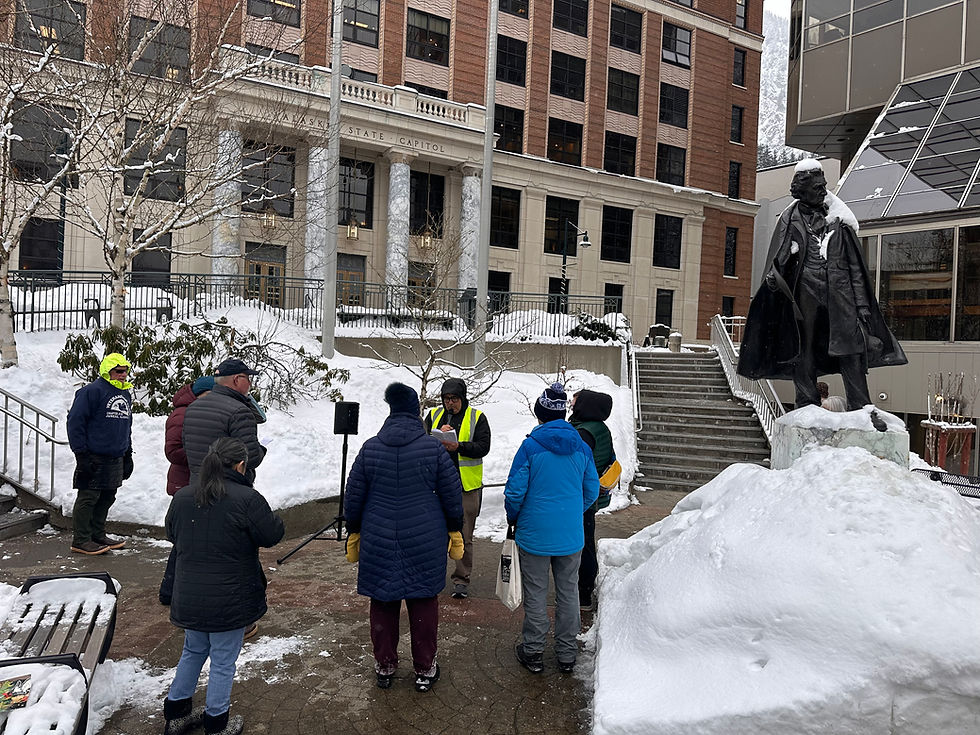
People with divided opinions also greeted Begich in the hallway outside the House Chamber before his speech, with supporters waving "thank you" and other signs while people protesting him holding signs such as "stop the war." Some of the latter were part of a small group of people who met in the Dimond Courthouse plaza across from the Capitol to read the U.S. Constitution aloud before Begich’s speech.
Begich also spent about 30 minutes after his speech answering questions in the House Chamber from legislators, with the questions generally reflecting the partisan bent of the person asking. State Rep. David Nelson, R-Anchorage, for instance, asked Begich how he managed to navigate a "political quagmire" while being "arguably one of the most effective freshman legislators of all time."
Tougher questions came from members of the bipartisan legislative majorities. State Sen. Jesse Bjorkman, R-Nikiski, asked about people losing health insurance or otherwise unable to get care due to Trump-led cuts. Begich’s response invoked Robert F. Kennedy Jr.’s highly controversial "Make America Healthy Again" proposals that critics say largely reject traditional health care methods and data.
"The MAHA movement is not just a slogan," Begich said. "There's a real reason why we need to be healthier, because if we can lower demand on the healthcare system we will lower the cost for everyone. Insurance rates will come down. The cost of care will come down. The system will be less stressed. And that is not always desirable for people to talk about because it requires us to make decisions individually."
Begich, declaring during his speech that 11 bills he’s been the primary sponsor on have passed the House and five of them have been signed into law by President Donald Trump, noted he has introduced another bill to exempt Permanent Fund dividends from federal income taxes.
However, Trump in recent days has stated he will not sign any legislation — except possibly ending a partial government shutdown — until Congress approves a bill known as the "SAVE America Act," which would impose broad election changes including requiring proof of citizenship and photo ID to vote. Critics in Alaska have said the bill, which Begich supports, would disenfranchise many rural residents since, among other things, proof of citizenship would have to be presented “in person to the office of the appropriate election official," with such offices not existing in many communities.
Begich, during his remarks to reporters after his speech, said he doesn’t support putting legislation on hold in Congress until the SAVE bill is sent to Trump.
"My view is that we need to continue the legislative business of Congress and I'm going to continue to do that, regardless of what the President decides he's going to do in the executive branch," Begich said. "I'll continue to move bills forward. I'll continue to vote on bills. My intention is to create such a stack of legislation over in the Senate that's ready to go that they'll be able to make a decision as to whether to move or not. But my work in the House is not going to be impacted by what the president has chosen to do on that issue."
• Contact Mark Sabbatini at editor@juneauindependent.com or (907) 957-2306.





_edited.jpg)


