.png)

Building the Capitol on a solid foundation

Remembering those who made the Capital Complex

Editor’s note: This is part of the Juneau Independent’s 2026 Guide To The Alaska Legislature, which will be published online on the first day of session, Tuesday, Jan. 20, with a print edition distributed subsequently. The online version will be updated as the session progresses.
By Laurie Craig
Juneau Independent
Lawmakers who serve Alaska with particular distinction are recognized by their names being added to House or Senate committee rooms in the Alaska State Capitol. Several people have received this honored designation.
Two legislators stand out, however, with entire buildings bearing their names: former Senate President Terry Miller of North Pole and former Judge Tom Stewart of Juneau.
To serve Alaskans better as the state capital, additional space was needed for offices, constituent services and technology to augment the 1931 Alaska State Capitol. Nearby facilities were tapped to provide accommodations adjacent to the marble-columned Capitol.

The Terry Miller Legislative Office Building is named for Alaska’s lieutenant governor from 1978 to 1982. Miller had a distinguished career as the youngest elected city council member at the age of 21 in North Pole. The Santa Claus-themed community centered around the year-round Christmas business his parents developed on the Richardson Highway east of Fairbanks. In 1966, Miller was elected to the House of Representatives from Fairbanks. He was drafted into military service and spent several years as a member of Alaska’s National Guard. From 1969 to 1977, Miller served in the Alaska Senate and was Senate president during the 1973-74 session. Miller died of cancer in April 1989 at age 46.
Today’s Terry Miller Legislative Office Building was built in 1928 as Juneau High School. Students relocated to Glacier Avenue when Juneau-Douglas High School opened in 1958.

The Miller office building is conveniently located across the street and uphill from the Capitol. It is adjacent to Main Street between Fifth and Sixth Streets. From 1958 to 1997, the former Juneau High School became Capital Elementary School. It was used for younger students until the late 1990s when Riverbend Elementary School (now Kax̲dig̲oowu Héen Elementary School) opened in Mendenhall Valley.
Downtown neighbors proposed uses for the empty building as a charter school, offices for nonprofit organizations and a gym for community recreational use. Instead, the city offered the building free of charge to the Alaska Legislature to consolidate legislative functions into an area concentrated around the Alaska State Capitol.
Under the guidance of the Legislative Affairs Agency, Capital School was remodeled and upgraded. In 1999, it was named the Terry Miller Legislative Office Building. Today, it houses the Legislative Affairs Agency, which supports legislative operations, and the Legislative Information Office, which coordinates 22 statewide communications sites for live constituent testimony at meetings.
Thomas B. Stewart
A three-story concrete building on Fourth Street adjacent to the Capitol became the Thomas B. Stewart Legislative Office Building in 2009, adding another structure to the Capitol Complex.
Thomas Stewart was very much a homegrown Juneauite. Through much of his long life, he lived in the house his parents built in 1916, located on Calhoun Avenue near the Governor’s House.
Stewart’s accolades are numerous. He served in World War II, where he was awarded the Bronze Star and the Silver Star. He spent some time in the Aleutian Islands, where Japanese forces occupied American soil, a fact Alaskans know but which is not familiar to many other U.S. citizens.
According to a bronze plaque prepared by the Legislative Council, Stewart was “Secretary of the Alaska Constitutional Convention, member of the Territorial House of Representatives, Senator in the first state legislature, superior court judge, war hero, skier, opera singer, storyteller and father of seven children.”
“It is fitting that Alaska lawmakers continue their work in a building named for a man who helped ensure the creation of the 49th state,” the plaque concludes.

Stewart was a man of the people. After a long public service career, he was often seen around Juneau, proudly showing dignitaries the sights. In the mid-2000s, Stewart escorted retired U.S. Supreme Court Justice Sandra Day O’Connor and her husband through the exhibits at Mendenhall Glacier Visitor Center, adding his personal perspective on meaningful features depicted on the large relief map. Stewart died in 2007 at 88 years old.
Two examples of his local legacy stand out. He helped establish Juneau’s first ski area in a natural bowl on Douglas Island, now known as the Dan Moller Trail. Stewart had purchased a surplus rope tow for $50 to get skiers to higher elevations on the slopes.
Another effort was closer to his own backyard: developing Evergreen Bowl into a recreational area for swimmers and eventually tennis players. It’s now known as Cope Park.
Stewart served in the renowned 10th Mountain Division in World War II. Commemorating 52 years since D-Day, Stewart returned to Italy and retraced the route he’d taken in combat. He was accompanied by Juneau’s Walter “Bud” Carpeneti, who is now a retired chief justice of the Alaska Supreme Court.
Carpeneti described their October 1996 journey in a phone interview on Jan. 12, 2026. As background, he spoke of a bold move during the war, and how Stewart’s unit scaled a steep 2,000-foot vertical wall at night to surprise German soldiers and rout the Nazis in an unsuspected attack.

There were villages Stewart wanted to revisit 50 years after this incident and subsequent battles. When he and Carpeneti entered an Italian community they remembered, the two ventured into the town square and searched for someone of an age similar to Stewart’s, then in his 70s.
In one town, Carpeneti found an older woman coming out of the post office and said, “My friend fought here with the American army in World War Two.”
Within 10 minutes, the Alaskans were surrounded by a group of similar-aged Italians who hugged Stewart, kissed both his cheeks and greeted him as a war hero.
This behavior was repeated in town after town through northern Italy. The Italians shared their own stories of the war, one man weeping as he recalled his childhood experience of his father’s death after a particularly tragic fight.
Carpeneti recalled Stewart fondly as a superior court judge.
“He was the person that I think practically every lawyer that I knew or met in town (Juneau) used him as a model of how one acted as a judge,” he said. “I was on the bench 17 years and I thought about him more than anyone else when I had really difficult cases or difficult situations. It’s like, ‘How would Tom Stewart have handled this?’”

Stewart played a pivotal role in formulating Alaska’s constitution as the convention secretary in 1955-56, Carpeneti said. Stewart traveled through the Lower 48 at his own expense to consult with university scholars and experts to investigate the strengths and weaknesses of other states’ founding documents. He hired advisors to assist convention members in deciding on provisions during the Fairbanks gathering. Alaska became the 49th state in 1959.
“He had a huge role in setting up the court system,” Carpeneti added.
“He was the most wonderful person I ever met in many ways,” Carpeneti said of Stewart, who died in 2007.
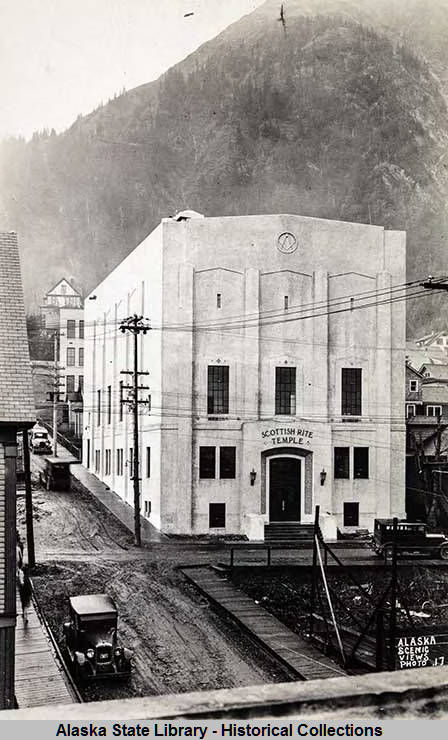
In 2009, the former Scottish Rite Temple on Fourth Street was renamed the Thomas B. Stewart Legislative Office Building. Like the Terry Miller Legislative Office Building, the original structure was built in 1928 when Seward Street was still muddy, as evidenced in a photo of the time.
The building was designed with Egyptian-style architectural accents, which were typical of the Masonic fraternal organization, according to the City and Borough of Juneau’s Townsite Historic Structures Inventory, available online with more details.

In the building once used for private events, today the concrete structure houses legislative offices, a small public lounge and a childcare center. The Stewart building is connected to the Capitol with an enclosed skybridge spanning Seward Street. It was designed by local architects Jensen Yorba Lott/Wall in conjunction with the remodeling of the Scottish Rite Temple for legislative usage. The remodeling preserved some of the temple’s wooden dance floor, which is now installed in the chief clerk’s office.
“The key to making the whole thing work is the addition of the skybridge,” said principal architect Wayne Jensen in an interview on Jan. 9.
“Adding the Terry Miller Building and the Scottish Rite Temple really made the Capital Complex,” Jensen noted.
• Contact Laurie Craig at lauriec@juneauindependent.com.