.png)

Closing city museum won’t save money, but will destroy an institution that has served Juneau for decades


By David Noon
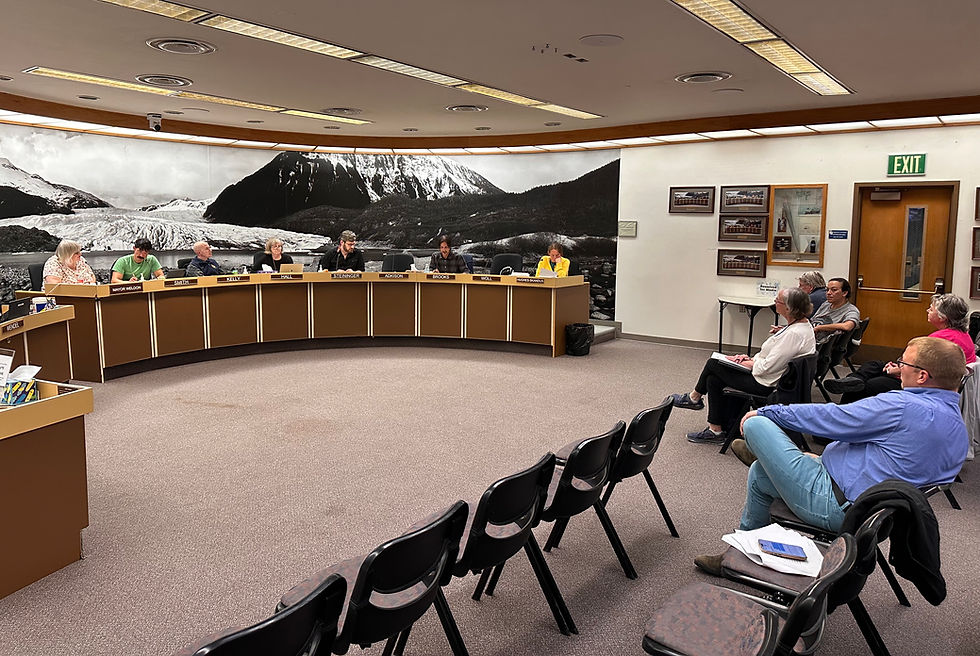
On May 13, a majority of the CBJ Assembly voted to consider closing the Juneau-Douglas City Museum as a budget-cutting measure. Along the way, several members offered remarks revealing a glaring indifference to what museum staff and volunteers have done to preserve the past.
One member declared that this work no longer "warrant(s) public investment" and suggested it represented a misguided effort to be "all things to all people." Another mused that because the museum does not inspire people "to come here and stay here," it "simply falls lower on the list" of priorities. Only one member bothered to articulate a defense of the museum's existence.
As an historian and vice president of the Board of the Friends of the Juneau-Douglas City Museum, I cannot overstate the seriousness of the mistake the Assembly is pondering.
The museum is an invaluable local institution. We reach nearly 40,000 visitors annually; perform outreach to local schools with educational kits about the histories and cultures of this area; provide opportunities for community artists to exhibit their work; provide grants and awards to local historians and artists; host arts, history, and educational programming (including walking tours of the Capitol, Evergreen Cemetery, and downtown Juneau) that reaches thousands of community members and visitors each year; and offer volunteer opportunities to dozens of local supporters. For the past several years, we have awarded the Marie Darlin Prize to important local writers, playwrights, artists, and educators like Ernestine Saankaláxt Hayes, Maureen Longworth, Lily Hope, Scott Burton, and Guohua Xia.
An April 20 memo from the city manager described the museum as "the only facility where we could easily divest the property." These words have been quoted repeatedly in news coverage but have received zero scrutiny. I have absolutely no idea what the city manager means by this, nor can I comprehend how such a conclusion could make its way into an official document intended to shape Assembly action.
Dissolving a museum is nothing like liquidating surplus equipment or selling off a city-owned vehicle fleet. It is a complex professional undertaking governed by strict legal mandates and ethical standards, and it would take years to complete responsibly.
The JDCM stewards approximately 100,000 items — 9,305 three-dimensional objects, 24,277 photographs, and over 6,000 archival records — along with a backlog of 4,000 unprocessed items. Professionally cataloging that backlog alone is a legal prerequisite for dispersal and would require as many as three years of dedicated full-time work. Complete dispersal of the museum's collections would take five to 10 years. Every item must be individually researched, appraised, and legally cleared for transfer. Failure to follow proper procedures exposes the city to legal action with unpredictable financial consequences.
Closing the museum would also require the city to hire at least two additional full-time professionals with specialized museum experience to manage the dispersal. Labor costs, combined with packing, conservation, and shipping expenses, routinely run into the hundreds of thousands of dollars annually for mid-sized museums undergoing this process. These costs would devour most — if not all — of the savings Assembly members believe they are capturing.
The legal complications run deeper still. The museum is legally bound by the Native American Graves Protection and Repatriation Act (NAGPRA), which requires ongoing coordination with Indigenous partners and federal agencies regarding sensitive items like the 700-year-old fish trap in the collection. The museum also houses items belonging to other entities that must be legally returned: 29 items from the U.S. Navy, materials from the U.S. Forest Service, and over 200 pieces of art from the Morris Collection. These obligations require sustained commitments from CBJ staff and legal counsel — costs that have not been factored into any public deliberation.
A recent memo to the Assembly suggested that museum collections might be treated under the city's standard surplus property provisions. They cannot. Those procedures were designed for equipment and real estate the city owns outright. Museum collections are a fundamentally different legal category — held in the public trust, not owned in any conventional sense. Attempting to liquidate them as surplus property will almost certainly result in legal challenges.
And then there is the building itself. The Veterans' Memorial Building was placed on the National Register of Historic Places in 2006, complicating any future sale or change of use. If the facility's climate controls are shut down during a five-to-ten-year dispersal period, collections will deteriorate rapidly. Objects require daily monitoring for water intrusion, pests, and mechanical failures. The savings disappear; the losses do not.
All of this speaks only to the practical case. The moral case is no less compelling.
Local museums are not amenities. They are not discretionary luxuries to be trimmed when budgets get tight. They are the institutions through which a community maintains its relationship with its own past — with the people who came before, who do not pay taxes or vote in local elections, but who remain our silent constituents nonetheless. The Juneau-Douglas City Museum preserves the evidence of why people have come to this place for thousands of years. We owe our forebears — those who lived in Lingít Aaní, who established Juneau and founded Douglas — a debt that we continue to repay by preserving what they saw, what they created, how they lived, and what they knew.
Closing this museum would not save Juneau money. It would saddle us with years of legal exposure, staffing costs, and professional obligations that no one in City Hall appears to have considered. And it would permanently destroy an institution that has served this community well for decades.
We urge the Assembly to continue fully funding the Juneau-Douglas City Museum, to abandon any consideration of closure, and to consult qualified museum professionals before taking any further action affecting its future. The stories this museum preserves belong to all of us. So does the responsibility to keep them.
• David Noon is a board member of the Friends of the Juneau-Douglas City Museum, professor of history at the University of Alaska Southeast and a member of the Juneau Board of Education.


_edited.jpg)



.png)

.png)