


.png)

Conservation of 58-year-old totem pole at city museum begins

Museum staff hope repair will maintain renowned Lingít carver’s knowledge and themes

A conservation project began Wednesday on Harnessing of the Atom, a totem pole that has stood outside what is now the Juneau-Douglas City Museum for almost 50 years.
The totem pole was laid down on the grass in front of the city museum by an Alaska Electric Light and Power team. In addition to free moving service provided by AEL&P, the project is receiving financial support from the Juneau Rotary Club, Friends of the Juneau-Douglas City Museum and individual donors.
Harnessing of the Atom was carved in 1967 by Jeet Yaaw Dustaa Amos Wallace of the T’akdeintaan Clan of the X’aakw Hit (Freshwater-marked Coho House). It is one of four totem poles in the city museum’s collection.
Ray Watkins, artist, carving teacher and onetime student of Amos Wallace, will be doing the conservation care on the totem pole. He said at the end of the process the totem pole will still look like it was made 58 years ago, just cleaner and more stable.
“We're following some guidelines that are put out by the conservationists at Alaska State Museum,” Watkins said. “So it starts with a cleaning, scraping off all the moss and growth, and then it would be figuring out what spots need to be removed and replaced, especially at the bottom, with the dry rot. And then it's soaking it down with fungicide and then a water repellent as a final step.”
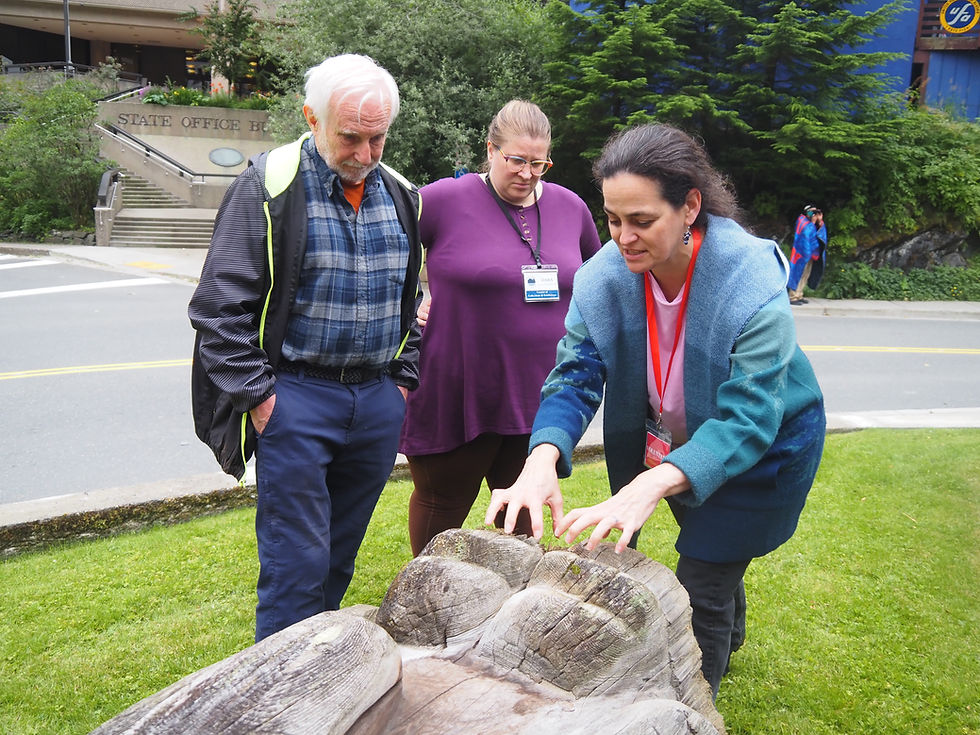
Ellen Carrlee, former curator of collections and exhibits at the city museum and current conservator at the Alaska State Museum, stood with Watkins near the base of the totem pole, examining the exposed dry rot inside the wood.
“It’ll be a conversation between you and the pole,” she told Watkins. “And then as you get going, the pole will be like–”
Carrlee, pretending to be the totem pole, wagged her finger disapprovingly.
“It’ll have its own things to tell you,” she said.
Amos Wallace was a renowned Lingít artist and carver, whose totem poles were displayed across the United States. He passed away in 2004, but his son Brian Wallace recalled watching his father begin work on Harnessing of the Atom.
“Down at Harris Harbor is where the log was unloaded and dad was peeling off the bark,” Brian Wallace said. “My one contribution was trying to wrestle off some of the bark, but it was too hard for me.”
Harnessing of the Atom represents four different themes that have influenced the Lingít. The bald eagle on top represents the U.S., followed by the Russian Orthodox Priest representing Russian and Christian influence. A man holding the sun characterizes science, and finally the raven at the base of the pole stands for the carver’s Lingít moiety, as well as Raven’s role in relation to daylight and energy in Lingít stories. The totem pole highlights the parallels between Lingít stories of how light was created and the development of nuclear energy.
“I think the main inspiration behind it was my mom,” Brian Wallace said. “I was pretty young at the time, but she came up with the idea of either solar or nuclear energy for it. She was kind of like a muse for a lot of dad's projects.”
The totem pole was installed in 1976 at what is now the Juneau-Douglas City Museum. In 2003, the buried wooden base that traditionally held the totem in place was removed and replaced with an aluminum support mounted on a concrete base after the pole had begun to lean to the side.
In addition to cracks and rot due to natural weathering, Harnessing of the Atom has been impacted by its location in the tourist hub of downtown Juneau. In June 2024, the totem pole was hit by a tour bus doing a three-point turn in the museum’s loading zone. Lohnes-Davies said the museum alerted Brian Wallace when the Harnessing of the Atom was dented, beginning a conversation between the museum and Brian Wallace about undertaking conservation work on the totem pole.

Traditionally, a totem pole that had leaned and fallen would generally be allowed to decompose. Conservation efforts like this project are a newer undertaking.
Museum curators also note the totem also now has a role in telling history as part of the museum’s collection.
“These things have a longer lifespan than we do, you know?” Carrlee said. “So they have been here, and experienced things and represent things that we want to be remembering, and so there is some cause to be keeping things and taking care of things to make available for people to reach back into the past, and connect with the past through material culture as well as words and books and videos.”
Ray Watkins noted the utility of historical totem poles like Harnessing of the Atom for learning carving.
“For me, learning the art form was going to museums and studying the old stuff, there's nothing better to learn from than that and, if these things go away, then that opportunity goes with it,” Watkins said. “That's why I believe they should have some sort of restoration process.”
For Brian Wallace, there is a more personal reason for this project.
“Some people believe once they get to this point, they should just take it out into the woods, let it lie in state and let nature take it back. But it's something that my dad created and I'd be happy if it lasts another two, 300 years, if not longer,” he said.

Curious passersby gathered to watch the totem pole move across the city museum lawn. Watkins is unsure of how long the conservation process will take. While the totem pole is being restored in front of the museum, Dara Lohnes-Davies, curator of collections and exhibits at the museum, welcomed the public to ask questions and observe. However, she also encourages onlookers to respect the totem pole while it is down.
“If you were laying down in a hospital bed, how would you want to be treated? And think about it like that,” Lohnes-Davies said.
Watkins, who has restored totem poles in Juneau in the past, wondered how other totem poles in Juneau might also be conserved.
“It's something that's definitely needed, but there's several poles in the area that need it, that could use it, so maybe we're starting something here,” Watkins said. “We’ll see what happens.”
• Contact Natalie Buttner at natalieb@juneauindependent.com.


