


.png)

Governor’s proposed budget for next year: $1.5B deficit, $3,650 PFD, mystery plan to generate $15B in revenue over next 10 years

Updated: Dec 11, 2025
Dunleavy bypasses press conference for final proposed spending plan, offers brief statement on social media
By Mark Sabbatini
Juneau Independent
This is a developing story.
Gov. Mike Dunleavy released a proposed budget for next year on Thursday that, much like other proposals in recent years, contains a massive deficit due to a so-called "statutory" Permanent Fund Dividend — both of which have been quickly rejected as unrealistic in previous spending plans ultimately approved by the Alaska Legislature.
The governor also released a 10-year budget plan that projects roughly $15 billion in "new revenue" — with Dunleavy and administration officials offering no specifics of where the money will come from, aside from saying he will reveal them next month. Without the unspecified revenue, his budgets would continue to incur annual deficits of $1.5 billion to $1.7 billion.
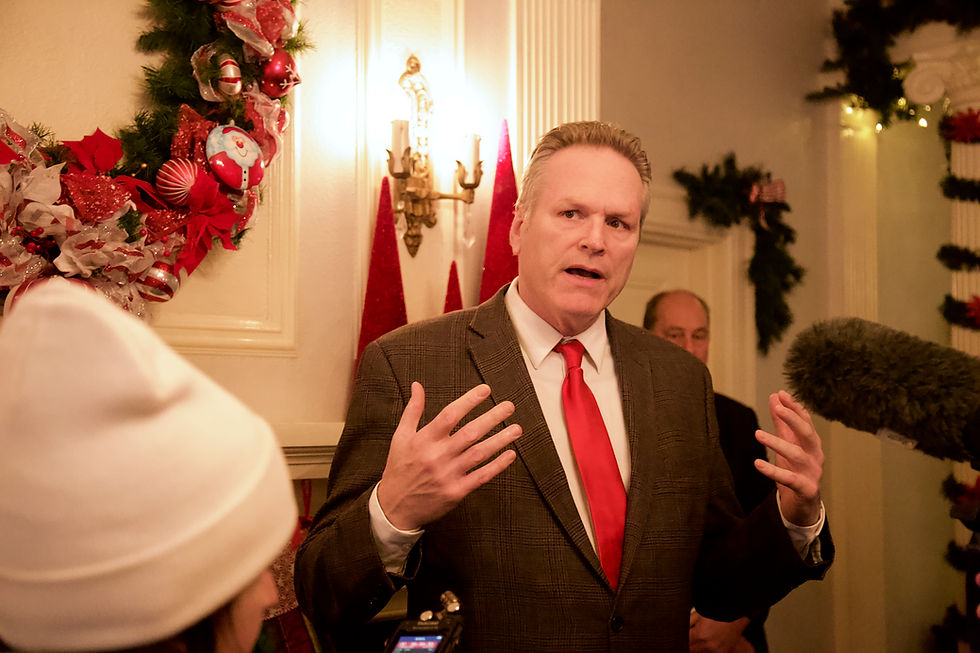
The governor, now in the final year of his second term, released his final proposed spending plan without holding a press conference — a break from tradition — instead posting a short message on his official Facebook page.
"We will be talking with the Legislature about a sustainable, long-term fiscal plan that will hopefully get Alaska out of this yearly idea of taking money from savings or taking money from the PFD, but really give us a long runway so that we can have security," he said in his Facebook message. "We can have a sense of assuredness that our budget process is going to work for the long term."
Dunleavy’s proposed budget has a $1.5 billion deficit, which would consume more than half of the $2.9 billion Constitutional Budget Reserve. Also, more than $300 million in additional funds will likely be needed this year to cover a deficit caused by lower-than-expected oil prices and other factors.
Legislators in both parties have said they are not willing to drain the reserve that quickly — and indeed, have sought to avoid any deficit spending — due to what are projected to be rough economic times for the state for at least the next few years.
"We have to write a budget in reality and we're not going to do that," said Sen. Jesse Kiehl, D-Juneau, a member of the Senate Finance Committee, referring to the deficit in Dunleavy’s budget. And I think we all know that, so that puts the work in the Legislature's hands to write the budget."
Kiehl said the ongoing drain means the state is facing a precarious financial situation in the coming years unless meaningful proposals are acted upon.
"I worry that the state will limp along on a crutch with crummy public services and barely adequate schools and never live up to our potential," he said. "And if I also worry that some people are content to have to crash at the bottom of a cliff before they're willing to do anything hard, and neither one of those things will serve Alaskans well."
Senate Rules Chair Senator Bill Wielechowski, D-Anchorage, while expressing similar concerns to Kiehl, noted in a social media post that Dunleavy’s budget "does include some critically important items like funding for disaster relief, education, the University and the PFD."
The deficit in Dunleavy’s budget is due to a "statutory" proposed PFD of $3,650, which would drain nearly $2.4 billion from state coffers. This year’s actual dividend of $1,000, the lowest-ever when adjusted for inflation, cost the state $685 million.
Dunleavy has said he is following the PFD formula defined in state law; however, that formula hasn’t been followed since 2016 as state lawmakers have approved lower amounts due to fiscal challenges. The Alaska Supreme Court ruled in 2017 the formula isn’t obligatory for calculating dividends because it’s not in the state Constitution.
The 10-year budget plan is also in state law, with the statute noting it "must include sufficient details to identify…significant sources of funds" as well as the use of those funds. The governor’s office did not immediately respond to an email inquiry from the Juneau Independent about whether Dunleavy believes the unspecified "new revenue" in his plan meets the requirement.
The governor has until Dec. 15 to submit a proposed budget and 10-year plan that fulfill the requirements defined by state law.
Kiehl said a long-term fiscal plan will be among the key things the Legislature discusses during the coming session, but questioned how much value Dunleavy’s proposal will have as a starting point.
"If the budget is imaginary, will the fiscal plan be serious?" Kiehl said. "That's the question that worries a lot of us."
Dunleavy’s 10-year plan published Thursday offers six vague bullet points defining its parameters:
• Creating a business climate that brings new investment and good jobs.
• Developing new opportunities to make the most out of the state’s natural resources.
• Ensuring key projects such as the Alaska Liquified Natural Gas project continues to move forward.
• Growing the Permanent Fund.
• Putting measures in place to make sure any growth of state government is small and responsible.
• Creating a pro-investment environment to ensure Alaska can compete for investment capital.
Dunleavy notes the projections in past 10-year plans often have differed considerably from what actually occurred.
"There is significant uncertainty inherent in any attempt to project over a 10-year forecast period," the plan states. "A review of the 10-year plans published by the Office of Management and Budget (OMB) in prior years would show far different views of the future than what ultimately came to pass. Revenue projections can scarcely predict geopolitical events like war or pandemics, and expenditure projections based solely on inflation ignore the ever-changing needs of Alaskans that are thoroughly debated through the budget process."
The budget proposal he released in December of 2022 contained a long-range plan that relied on generating up to $900 million a year in carbon credits, but subsequent projects resulting from the proposal are still in the works with far smaller revenue projections.
The release of next year’s proposed budget occurred shortly after the Alaska Department of Revenue issued its fall forecast, which projects oil prices to average $62 a barrel next year. The budget for the current fiscal year that ends June 30, 2026, has a break-even point of $64, meaning a status quo plan next year would need further cuts under the revenue forecast.
Wielechowski stated one way for state lawmakers to address long-term financial needs is passing legislation from past years that would end some oil company tax breaks — although critics have said such actions might discourage new investments by those companies. He also suggested passing legislation that requires companies doing business online with people in Alaska to pay sales taxes.
• Contact Mark Sabbatini at editor@juneauindependent.com or (907) 957-2306.



_edited.jpg)


.png)

.png)




.jpg)

.png)