.png)

Municipal, state officials mobilize to welcome hundreds of storm evacuees to Anchorage

The state of Alaska has requested a federal disaster declaration; in the meantime, the state is bearing the cost of aid, response and cleanup
By James Brooks
Alaska Beacon
The state of Alaska is appealing to the federal government for help as it copes with its largest disaster in years.
On Thursday, Gov. Mike Dunleavy formally requested a federal disaster declaration for parts of western and northwestern Alaska after a pair of devastating storms flooded Kotzebue and nearly destroyed a series of coastal villages on the Kuskokwim River delta.
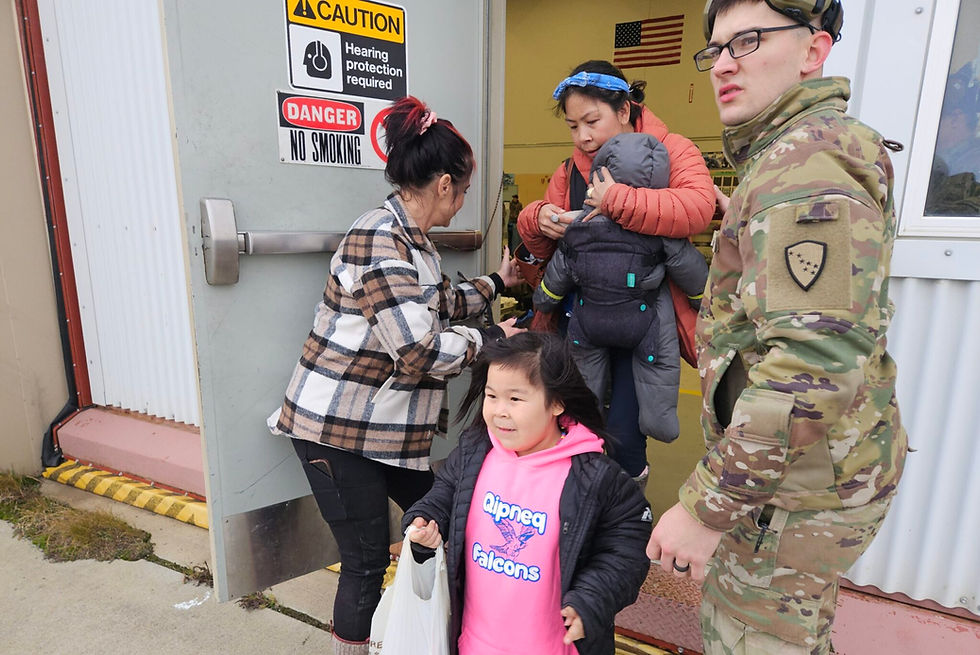
“It is anticipated that more than 1,500 Alaskans will be evacuated to our major cities, many of whom will not be able to return to their communities and homes for upwards of 18 months,” the request letter reads in part.
The disaster declaration would cover the Northwest Arctic Borough, Lower Yukon Regional Education Attendance Area and the Lower Kukokwim Regional Attendance Area, places hit by the remnants of Typhoon Halong.
“Due to the time, space, distance, geography and weather in the affected areas, it is likely that many survivors will be unable to return to their communities this winter,” the letter said, explaining that local and state officials are developing temporary housing plans “until permanent housing plans can be developed and executed over the next year.”
How to help
The Alaska Community Foundation is coordinating relief with multiple partner organizations and providing support as a central clearinghouse for financial aid.
The Association of Village Council Presidents, a group of Yup’ik tribal governments, is coordinating requests for support and donations across the region.
GCI has donated $100,000 to that relief effort and is collecting relief supplies at stores in Anchorage, Wasilla and Fairbanks through Oct. 27.
In Anchorage, the Alaska Federation of Natives is collecting donated items during its ongoing conference.
Bethel Friends of Canines is collecting donations to charter flights and continue evacuation efforts for pets abandoned during refugee flights.
The state is requesting the federal government fully fund individual assistance and public assistance programs for 90 days.
In Anchorage, where many evacuees are expected to live temporarily, municipal officials waived their normal requirements in order to declare a disaster during a special meeting Friday afternoon.
“We have been told to prepare for up to 1,600 evacuees being relocated here,” said Anchorage Mayor Suzanne LaFrance. “We know at least 572 have arrived in the last two days, and more will be coming. It’s a huge undertaking to find emergency shelter for so many people, but we have so many amazing partners who have come to the table, and we take pride in doing our part.”
In a news conference after the meeting, municipal officials said they have opened the Egan Civic and Convention Center to evacuees. On Thursday night, 119 people slept there; the building has a capacity of between 400-600.
At the Alaska Airlines Center on the campus of the University of Alaska Anchorage, dozens of cots filled a space normally reserved for sports and concerts.
Community rec centers are also available if additional space is needed, municipal officials said, and they’re working on long-term housing for evacuees.
State Rep. Nellie Jimmie, D-Toksook Bay, represents the hardest-hit area and endured the storm herself before departing for Anchorage.
She and other officials visited the Alaska Airlines Center to speak with the evacuees.
“Just to share a very hard story,” she said, recounting to the Anchorage Assembly a story she was told, “a grandfather had no choice but to walk in the storm in high waters, holding one grandchild and pulling another and fighting against the wind. He didn’t realize his own grandchild was face down in the water. She had passed out, so he raised her up and started shaking her, and she came to, and thankfully, they got to safety right away. There’s going to be more stories that are going to be shared,” Jimmie said.
To date, the state has funded disaster recovery itself. No cost estimates have been published so far.
“Response and initial recovery costs associated with this disaster in rural, remote, and insular regions of Alaska are exponentially higher than a traditional response along the road system in the Lower 48 states not in the U.S. Arctic,” the letter said.
The letter also includes preliminary damage assessments. In Kipnuk, a community of 714 people that was the hardest-hit by the remnants of Typhoon Halong, “90 percent of all structures are destroyed, including critical infrastructure/lifeline facilities and residential structures.”
In Kwigillingok, a nearby village of 377 people, “35 percent of all structures are destroyed.”
At Napakiak, a village of 325 people, a quarter of all homes were shifted from their foundations by flooding, local officials told KYUK Public Media. Of those that didn’t drift, many were inundated and damaged.
Kotzebue and Deering, in northwest Alaska, were hit by a storm days before Halong’s remnants arrived. There, “more than 50 homes have been compromised, and emergency measures must be taken to rapidly repair homes to make them safe, sanitary, and habitable prior to winter,” according to the state’s federal disaster request.
The day after Dunleavy’s request, Alaska’s three-person congressional delegation sent a joint letter to President Donald Trump, urging him to approve the disaster declaration quickly.
Dunleavy was scheduled to tour the storm-hit region on Friday before returning to Anchorage for further work.
Speaking to reporters in Bethel, Dunleavy said he’s heard from a lot of people asking what they can do to help.
“Donate money, donate your time, because that’s what we’re going to need right now,” the governor said. “Then, all of the agencies that we’re working with here in the region, here statewide, here federally, I think we’ve got the resources. We just need make sure we pull it all together like we have in other disasters. And I think people will start to see lights going on, houses being put back on their foundations, insulation dried out, and you’re going to see people moving back to their homes.”
• James Brooks is a longtime Alaska reporter, having previously worked at the Anchorage Daily News, Juneau Empire, Kodiak Mirror and Fairbanks Daily News-Miner. Alaska Beacon is part of States Newsroom, the nation’s largest state-focused nonprofit news organization.