.png)

Myths regarding Telephone Hill redevelopment

By Larry Talley and Mary Alice McKeen
We have lived in Juneau for a combined total of 95 years. We love downtown Juneau (and other parts too). We believe the city is on the verge of making a big mistake demolishing all the buildings on Telephone Hill.
Here are eight myths that are driving us off this cliff. There is still time for the Assembly to correct course.
1. Telephone Hill Redevelopment will improve housing availability in Juneau soon – myth. Telephone Hill Redevelopment will demolish 15 housing units (seven houses, three of which are multi-family). After reducing housing availability, CBJ will initiate demolition and site prep. After site prep CBJ will seek a developer to build high-density housing on a difficult site in challenging market conditions. CBJ’s Juneau Telephone Hill Market Analysis, Feasibility Analysis and Development Strategy (https://juneau.org/wp-content/uploads/2024/06/THill_Market-Analysis.pdf) states “both the specifics of the site and the general state of development in Juneau make it a very expensive place to develop.” If/when a willing developer secures funding, design and engineering will commence, followed eventually by construction. After site prep, finding a developer, and securing funding, a high-density housing project on a typical site can be expected to be complete in two to four years. On this site it may take longer.
2. Telephone Hill Redevelopment will provide low-income housing – myth. This project is not envisioned as low-income housing. There is no reason to believe that low-income housing will be provided on a site which will be “a very expensive place to develop.” CBJ’s market analysis states “A new, high-quality apartment unit on Telephone Hill, where there is a commanding view of the harbor and mountains, could potentially rent for a premium over existing housing stock.”
3. Telephone Hill Redevelopment will be self-supporting – myth. CBJ’s market analysis states ”Despite the assumption that market rent would be significantly higher than is typical in the Juneau market, there is still quite a large feasibility gap in most scenarios. Assuming development costs between $450 and $550 per square foot, there is no scenario that breaks even. However, there are some scenarios that result in a funding gap of less than $100,000. In the scenarios that include short-term rental units, the gap is less than $50,000 in higher-rent, lower-cost scenarios. At rents affordable to 60% AMI, the affordable and mixed-income scenarios would require subsidies beyond the Housing Trust Fund. To attract a developer, the CBJ may need to provide a subsidy even for market rate apartments, unless the developer is confident that they can achieve rents higher than those modeled in the Market Rent – High scenario shown previously.”
4. Telephone Hill Redevelopment will provide housing for the expected influx of Coast Guard families – myth. CBJ’s Market Analysis is based on a 155-unit development with 100,459 square feet of residential space distributed among 469-square-foot studio, 728-square-foot one-bed, and 947-square-foot two-bed apartments, with 25% of the units to be short-term rentals (in order to approach financial feasibility.) To achieve 155 units within 100,459 square feet (649-square-foot average), there cannot be very many of the two-bed variety. If something gets built eventually that approximates the high-density scenario envisioned, some Coast Guard members might find housing here — maybe those who are single or maybe those who are part of a couple -- but many more Coast Guard folks will be looking for more room.
5. CBJ has a credible plan for the Telephone Hill Redevelopment – myth. The visioning/planning done to date has not evaluated the engineering feasibility. The site may not be capable of supporting tall buildings. Requests to Assembly members and CBJ staff for evidence of geotechnical engineering have gone unanswered, and I am left believing that there has been none. If so, no one knows if the site will support dense housing.
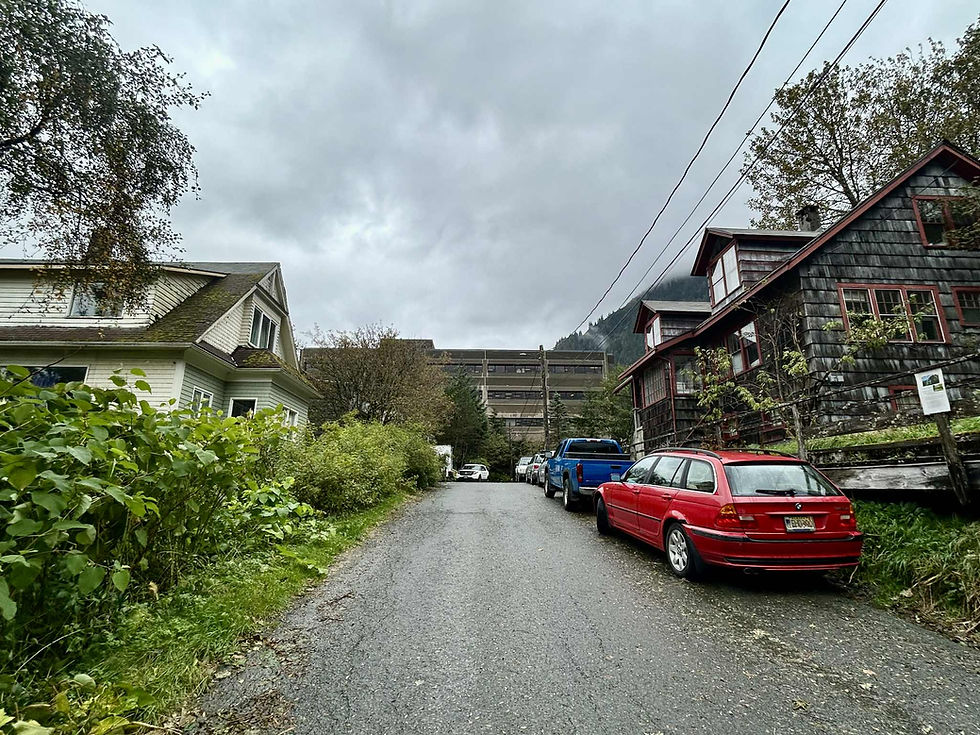
6. Telephone Hill homes have no historic value – myth. The 1984 Telephone Hill Historic Site And Structures Survey completed by the Alaska State Archives management noted that “Using National Register criteria, the Telephone Hill structures meet the qualifications for a historic district.” Numerous CBJ residents have petitioned CBJ to “Save Telephone Hill” as a historic district. A Telephone Hill historic district would include Alaska’s oldest continually occupied house, built by Edward Webster in 1882.
7. Telephone Hill homes are unsafe for habitation – myth. City Manager Katie Koester stated “They have not been properly maintained and are now plagued with mold, leaks, rotten floors and decks, and roofs that are failing.” This is misleading. First the RESPEC survey actually says that of the seven houses, three are “in fair condition for age,” one “has some deterioration,” and only three mention hazards to occupants. Second, from 1998 to 2022 when the properties were owned by the state and a tenant organization was the lessee, over $700,000 was spent on maintenance. It is misleading to characterize the seven homes as unlivable/hazardous and to claim that they have not been maintained.
8. Telephone Hill Redevelopment is the best alternative available to CBJ for high-density housing – myth. This may be the biggest myth of all. There are alternative sites that are easier to develop. For example, when discussing the pros and cons of building a new city hall at 450 Whittier a CBJ document stated as a con: "Would be a great location for future housing development." (https://juneau.org/wp-content/uploads/2022/05/Powerpoint-Presentation-5.19.22.pdf) The 450 Whittier site is owned by CBJ and is shovel-ready. It is a flat site, on a bus line, within walking distance of a grocery store. The voters have twice rejected building a City Hall on that site. The city has to determine some other use for that site. Downtown housing is perfect — what’s not to love? And far cheaper too! The Juneau Economic Development Council recently estimated typical construction cost at $325 per square foot (2024 estimate at https://juneau.org/wp-content/uploads/2024/02/Combined-2025-MPF-Requests.pdf), while the Telephone Hill market analysis estimated that site at $450-$550 per square foot (2023 estimate). What extra value is gained by developing the “very expensive place to develop?”
We believe that commencing demolition without a plan is going to lead to less housing in Juneau and will result in an ugly site with a chain link fence for many years.
We want more downtown housing. And we want the city to spend $5.5 million on a project that will actually accomplish that result!
We beg the assembly to stop Telephone Hill evictions and demolition and move forward expeditiously on a housing project at 450 Whittier.
• Larry Talley was born in Ketchikan, attended the University of Alaska Fairbanks, moved to Juneau in 1977 and worked in Juneau for over 40 years as a computer programmer. Mary Alice McKeen has lived in downtown Juneau since 1978. She is an attorney, primarily retired, and co-owner of a downtown business.