


.png)

Researcher updates the Benny Benson flag story

By Cole Haddock
Daily Sitka Sentinel
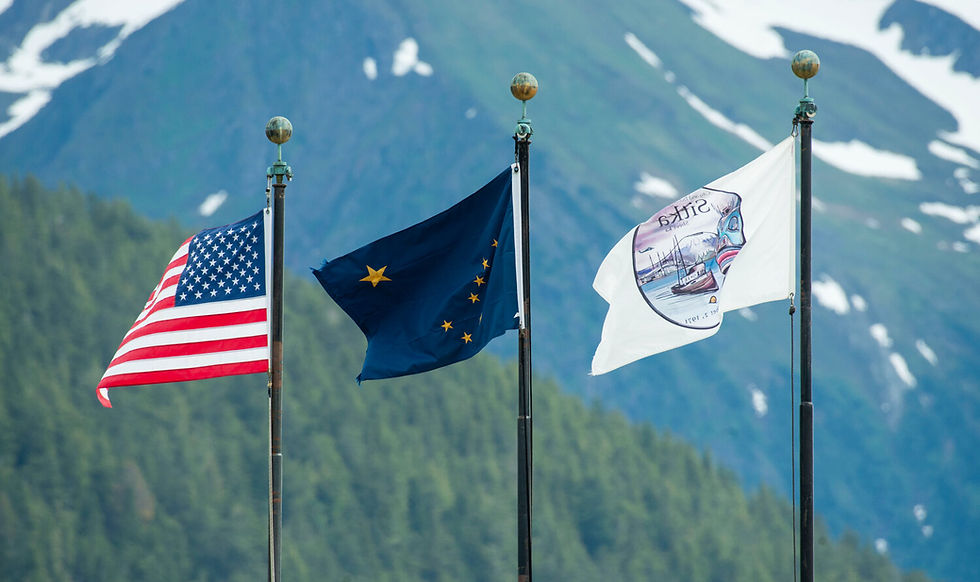
Thursday is Alaska's 99th annual Flag Day, which celebrates the first raising of the Alaska territorial flag — later adopted as Alaska's state flag — on July 9, 1927.
The story about the creation of the flag's design by a boy named John Ben Benson Jr. in the Jesse Lee Home in Seward is frequently told and celebrated in Alaska. Researcher Michael Livingston is hoping that this year's Flag Day is not only an opportunity to honor Benson but to correct the historical record about Benson's life.
Like the youthful flag designer, Livingston is of Unangax̂ ancestry and lives in Unalaska. He is a former policeman and a cultural heritage specialist at the University of Alaska, Anchorage.
On the History section of the University of Alaska website, there is an unsigned article titled Alaska State Flag, and Song, Intertwined Around Benny Benson. The first lines of the UA article reads, “Benny Benson was born in Chignik, a small village on the south shore of the Alaska Peninsula on October 12, 1913. John Ben Benson Jr. was his full given name… His father, John Ben Benson, was a Swedish fisherman and his mother, Tatiana Schebolein, was an Aleut-Russian.”
Livingston says this paragraph is full of commonly repeated errors.
Livingston, who has a PhD. in history from the University of Idaho, has researched Benson for many years. In 2022, he and a group of genealogical researchers published a paper for the Aleutian Pribilof Islands Association titled Benny Benson’s Hidden Unangax̂ Heritage.
Using a variety of sources including census and newspaper records, translated documents from the Russian Orthodox Church, and ancestry records such as the Aleut DataBank, researchers laid out three principle conclusions that differed from previously published narratives about the boy who designed the flag.
The general history of the flag design is that it was the result of a contest sponsored by the Alaska Department of the American Legion.
Livingston cites these corrections to the UA archive article that he says are the result of his research.
Benson’s birthday was September 12, 1912, not October 12, 1913. Benson was 14, not 13 when he submitted his flag entry. Using translated records from the Russian Orthodox church, researchers had the State of Alaska correct Benson’s birth certificate.
Benson was Unangan, not Alutiiq. Benson was born and lived in Alutiiq territory for most of his life, but his mother and her family were Unangax̂
Benson’s mother’s name was Tatiana Ioannovna Dediukhina, not Tatiana Schebolein.
Livingston’s research into the prevailing social attutudes of this country in the 1920s also illustrated the racist backlash that Benson experienced in the media. The Sentinel found these articles in the Library of Congress Archives.
On July 29, 1927, the Seward Daily Gateway newspaper re-published a comment from the Juneau newspaper Stroller’s Weekly that called Benson, “a little breed pupil of the Jesse Lee Home” and said that by allowing him to win the design contest, “the people of Alaska have had one put over them.”
The June 19, 1927, edition of the New York Times published a story about Benson winning the flag design contest, which said, “He has been an inmate of the Jessie Lee missionary home for native and half-caste children since 1916. Benny is small of stature for his years and swarthy of skin. He speaks with the staccato clipping of words common to the Indian race, and knows more about fishing, hunting and trapping than about anything else.”
Livingston questions whether the KKK had anything to do with Benny's getting third place, not first, in the local Seward competition. In the early 20th century, there was an active K.K.K. chapter in Seward. One 1925 headline in the Seward Daily Gateway reads, “Ku Klux Klan Organizer to Form Klan Here.” In 1927, the year Benson won, another headline read, "Burning Cross Makes First Appearance in the City.” The Gateway regularly accepted paid advertisements from the Ku Klux Klan at the time.
The flag competition was held by the American Legion, a veterans organization with a long history in Alaska and, in the early 20th century, had documented associations with the Ku Klux Klan. One headline in the Seward Gateway from October 18, 1923, reads, “Many Members of the American Legion Belong to K.K.K.”
“Just a few days before [the American Legion] made their decision, the KKK did a cross burning ritual in downtown Seward,” Livingston explained. “The KKK did not want a dark-skinned Alaska Native boy to win the flag contest…. The three white male judges gave a white boy from the white school first place and $5. I’ve seen his flag design – it’s good, but it’s not Benny Benson good.”
The judges in the final round of the flag design competition did award Benny first place, and with it a gold watch and a $1,000 cash prize that he later used to go to diesel mechanic school.
In Sitka, the American Legion Post 13 proudly wears the title of “Home of the Tlingit Code Talkers.” In 1927, the American Legion’s national chapter passed a statement condemning any groups that “fosters racial, religious or class strife among our people.” They reaffirmed that vote in 2017.
Before the 100th Flag day - July 9, 2027 - Livingston is calling on the State of Alaska to put Benson’s name in the Alaska Flag Law, which does not currently include his name, and on the Alaska Kid’s Corner website.
He wishes for Benson to be awarded an honorary doctorate from the University of Alaska, which has been awarded to the composer of the Alaska Flag Song. Livingston also says that Benson was not paid the full amount owed to him as the American Legion competition winner, but he is not calling for financial reparations.
“It’s not about the money,” Livingston says. He wants for the State of Alaska to acknowledge, “the wrongs committed against Benson in the last 99 years…. It’s about respect.”
“Recently a constituent brought it to the attention of my office that Benny Benson may not have received the full award package nearly 100 years ago. We’re looking into this,” says Sitka State Rep. Rebecca Himschoot. “I am grateful for the flag design … Benny Benson had a brilliant idea and deserves full recognition!”
Livingston drafted Resolution 25-24, titled A Resolution Acknowledging Crimes Against Alaska Flag Designer Benny Benson on the Journey Towards Truth, Reconciliation, Healing & Conflict Resolution on July 9th, 2027 the 100th Year Anniversary, which the Qawalangin Tribe of Unalaska passed on June 26, 2025.
Later in life, Benny Benson was a fisherman, a diesel mechanic, and, according to Livingston, a professional boxer in Anchorage who sewed dresses for his daughters in Kodiak. Both Livingston and Benson are members of the Qawalangin Tribe of Unalaska. The word Alaska comes from the Unangam Tunuu language, meaning “great land.”
Livingston grew up in Cold Bay, Alaska, with a subsistence lifestyle that would probably be comparable to how Benson grew up. His family fed themselves hunting salmon, seals, halibut, caribou, mushrooms, clams, and built their homes with repurposed materials from an abandoned WWII base.
“If we needed a building built, we built it…. My father was a veteran, so he knew where [the military] buried their vehicles,” Livingston explained. “He would dig them up and get them running.”
Colonization brought “illnesses, slavery, marine resource exploitation, and genocide” to the Qawalangin Tribe of Unalaska, according to tribal history websites. Native people across Alaska in the early twentieth century struggled with violence, family separation, illness, and boarding schools. This is evident in Benson’s life - his mother died of pneumonia when he was three, and he was sent to the Jesse Lee Home. He lost contact with his sister, and didn't see her again for more than 39 years.
To Livingston, it is important to remember Benson’s history accurately, not only to remember the pain that Native people in Alaska have suffered, but also to properly honor the resilience demonstrated by those who survived and left legacies.
“I think it's important that we know the truth, whatever the truth is. [Benny’s situation] got really ugly back in 1927. I think it's important that we know that history, that Alaskans in particular know that history, and acknowledge how strong this seventh grade boy living in an orphanage was to put up with it, that he was strong enough to endure it.”
The Alaska flag has a dark blue background and eight stars. When Benny Benson designed it, he wrote for the judges, “The blue field is for the Alaska sky and the forget-me-not, an Alaska flower. The North Star is for the future of the state of Alaska, the most northerly in the Union. The dipper is for the Great Bear – symbolizing strength.”
• This story originally appeared in the Daily Sitka Sentinel.



_edited.jpg)


