


.png)

Alaska lawmakers raise education lawsuit conflict concern for attorney general designee

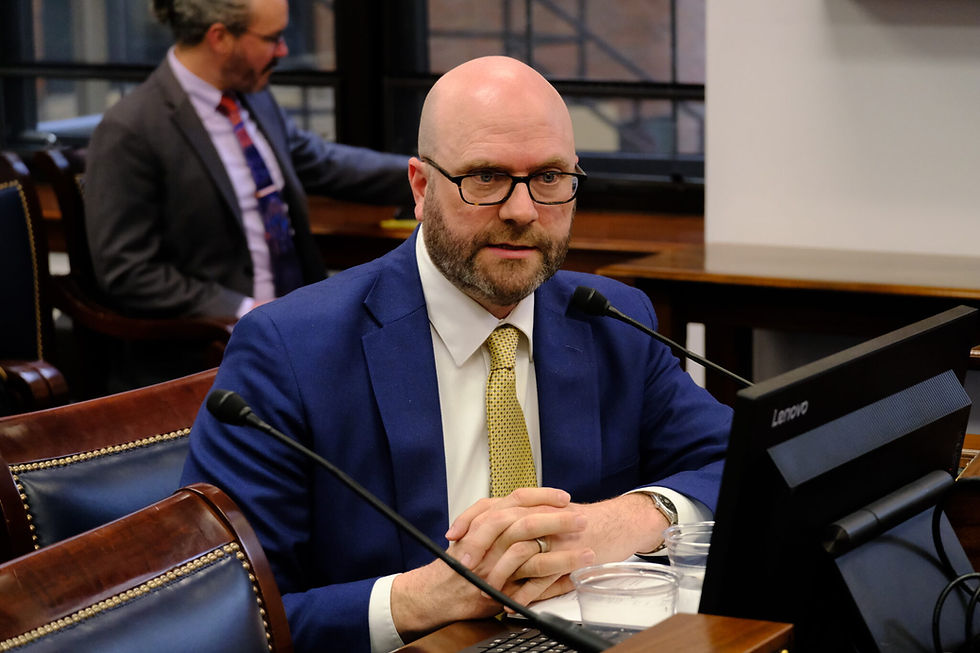
Stephen Cox is the treasurer and founding member of a new private Christian school in Anchorage, scheduled to open in the fall
By Corinne Smith
Alaska Beacon
As Alaska state lawmakers consider Gov. Mike Dunleavy’s pick for attorney general, several have questioned a potential conflict between his involvement with a private, religious school and his role in the state’s top legal office.
Stephen Cox currently leads the Alaska Department of Law, which is defending the state in a lawsuit that challenges the constitutionality of spending state homeschool funds on religious and private school tuition.
He is also the treasurer and a founding member of the Thomas More Classical School, a private Christian school for grades Kindergarten through sixth grade, slated to open in Anchorage in the fall, whose website invites the use of state homeschool funding for nonreligious courses.
Cox has served in the role since his appointment in August, and appeared before lawmakers in a series of legislative hearings last week and Monday, ahead of a confirmation vote for attorney general, expected in the next week.
Sen. Löki Tobin, D-Anchorage, who chairs the Senate Education Committee, noted the apparent conflict between the state constitution and the school’s financial plans at a May 1 hearing.
“Our constitution directly says ‘schools and institutions so established shall be free of sectarian control. No money shall be paid from public funds for the direct benefit of any religious or private education institution,’” she read.
She pointed to his role as treasurer as a direct conflict with the state constitution because the school’s “tuition assistance” web page said it anticipates accepting payment through state allotment funds for courses “that do not use religious-based publishers and/or content.”
The lawsuit that will decide whether that spending is constitutional is currently underway.
Cox said he was not aware of the school’s tuition information.
“I am on the board of that school. I am not involved in the day-to-day operations,” he said, adding that he was involved in hiring a headmaster and the formation of the school. “I am not aware of that part of the website and I’m also not aware of any decisions with respect to allotment programs.”
He declined to comment further saying the issue was in active litigation.
Each homeschooled student is eligible for up to $4,500 per year, to be spent on curriculum, supplies or other educational resources. But the question on whether that money can go toward religious or private institutions is currently being decided.
A group of parents brought the lawsuit to prohibit state money from going to such institutions against the state in 2023, and a judge ruled the allotment system unconstitutional in 2024, but that ruling was overturned by the Alaska Supreme Court. The case moved back to a lower court — four school districts were named as defendants — and last fall a judge denied a motion to dismiss the lawsuit, citing need for evidence of how allotments are actually spent. A discovery period for both sides to collect evidence is open until June 1.
At a Monday hearing before the House Judiciary Committee, Rep. Ted Eischeid, D-Anchorage, pressed the question.
“Does that mean that under Alaska ethics law, you would recuse yourself about decisions that might benefit your school, financially related to public money going to private schools?”
Cox answered a slightly different question. He told lawmakers, for background, he had already looked into the question of recusal given his three children are homeschooled through the Anchorage School District’s correspondence program, Family Partnership Correspondence School. He said that he was advised it wasn’t necessary.
“The advice that I received back from my ethics supervisor after an analysis was that it was not a reason for recusal, because I think there are, like, 25,000 Alaskan students that benefit from the allotment, and so the fact that my kids benefit in piano class and tutoring and whatnot wasn’t itself a reason to recuse,” he said.
Cox is Catholic, and is a parishioner at the Holy Family Catholic Church in Anchorage, according to the school’s website.
Cox said he learned that the Thomas More Classical School was anticipating receiving allotment funds during confirmation hearings last week. He said he was not directly involved with the state’s defense in the lawsuit and that he would seek ethics advice about recusing himself from the case.
“I will say that I’m not involved in any of the day-to-day litigation, or even really any of the supervision of the strategic litigation,” he added. “Recently, last week, I learned for the first time that on the website, there was a reference to the school anticipating becoming a vendor of the correspondent school allotment programs. So I have asked my staff to take another look at that from a recusal perspective.”
On Tuesday, the tuition information on the school’s website had been changed. It now says that it still anticipates taking allotment money, but only in accordance with state law.
At the hearing on Monday, Eischeid asked Cox if the school planned to receive public allotment funds.
Cox said the issue is being litigated in court now, and whether it’s constitutional has yet to be determined.
“I want to be very careful, because this is in active litigation, and these are the issues that the judge and the judges ultimately will have to grapple with,” he said. “But as I understand it, the school districts and their correspondence schools — so for example, ASD’s correspondence schools, Family Partnership — the school districts will decide whether or not and to what extent the allotment can be used for private educational or private institutions, and vendors.”
Cox said when a court rules on the question, the Thomas More Classical School will follow the law.
Rep. Andrew Gray, D-Anchorage, noted that the Thomas More Classical school board president is Charles Gartland, who is also working at the Alaska Department of Law as the civil division director.
“Would he need to recuse from any cases dealing with allotments and private schools?” Gray asked?
Cox said he has asked the department’s ethics lawyers to research the question.
“I would assume that the same analysis that existed for me would also apply with respect to Mr. Gartland,” he said. “But I do not have an answer on that question yet.”
Officials with the Alaska Department of Law did not return a request for comment on Tuesday on how decisions on recusal are made.
Gray said Monday there appeared to be a conflict of interest.
“Even if it’s all above board, as a member of the public, I see that, and I think that I would be more comfortable if the chairman of the board of a private school and the treasurer of the board of the private school wouldn’t work on those particular cases,” he said.
• Corinne Smith started reporting in Alaska in 2020, serving as a radio reporter for several local stations across the state including in Petersburg, Haines, Homer and Dillingham. She spent two summers covering the Bristol Bay fishing season. Originally from Oakland, California, she got her start as a reporter, then morning show producer, at KPFA Radio in Berkeley. Alaska Beacon is part of States Newsroom, the nation’s largest state-focused nonprofit news organization.


