.png)

Anchorage mother drives national push to prevent fentanyl deaths

Sandy Snodgrass championed the passage of Bruce’s Law, named after her son, which expands funds and focus on overdose prevention education for youth
By Corinne Smith
Alaska Beacon
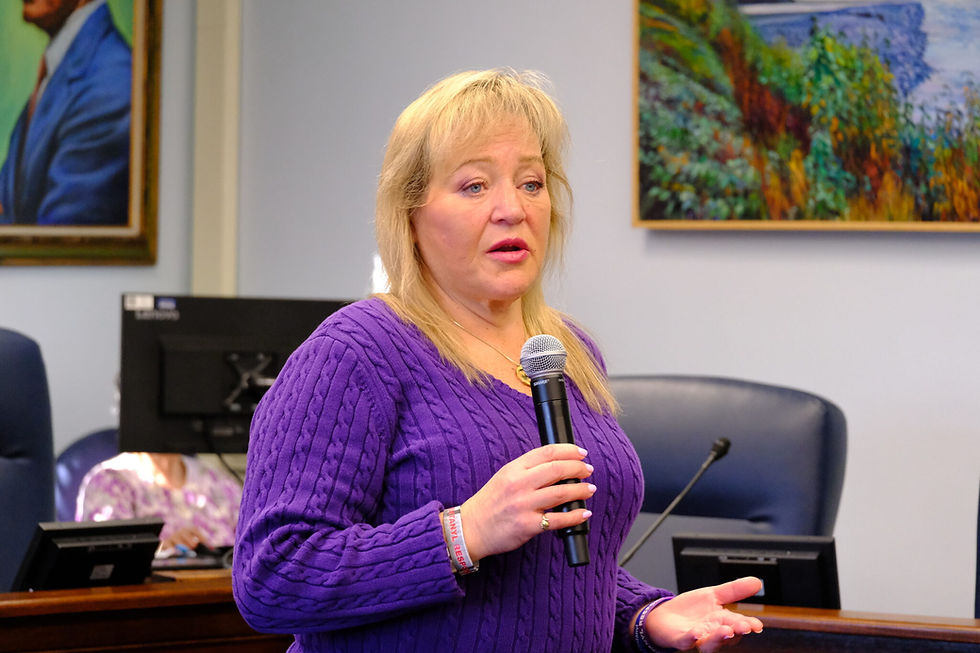
“This is a different world we live in with fentanyl now,” Snodgrass said in a lunchtime presentation after receiving the award. “We live in a world where one pill, one half pill can kill you. And it’s not a tolerance, you know, it’s one time and you can die.”
Trained as a clinical psychologist, Snodgrass founded the Alaska Fentanyl Response Project aimed at raising awareness about overdose deaths, particularly among young people, sharing stories of those who have died and advocating for legislation and resources for prevention and addiction treatment.
“I talk about it as a three-legged stool,” she said. She described demand reduction, law enforcement and treatment as the three legs of the stool. “And if we don’t do all three, the stool will fall over,” she said.
She said her focus is demand reduction. “So I am not law enforcement,” she added. “I don’t have a treatment center. But I did have a child that died from fentanyl poisoning, and so I can tell my story to anybody, anywhere, anytime.”
“You can never die from an illicit drug if you never try an illicit drug,” she said.
Snodgrass’ son, Robert Bruce Snodgrass, died at the age of 22 in 2021, during a wave when Alaska saw the highest increase in opioid deaths nationwide, a 75% increase from 2020 to 2021, according to the U.S. Centers for Disease Control and Prevention.
Fentanyl is a synthetic opioid, clinically prescribed for pain, and is more potent than other opioids like morphine or heroin. As little as two milligrams — an amount the size of a few grains of salt — can be fatal.
The Alaska wave of fentanyl deaths peaked in 2023, according to state data, with 357 reported deaths. Last year, there were 245 deaths reported from 2024 to 2025, according to the most recently available data, with the majority in Anchorage.
Thousands more non-fatal overdoses were reported each month, with many surviving thanks to the use of emergency naloxone, known as Narcan, a life-saving drug that can quickly reverse an opioid overdose.
She said it’s a difficult message to convey the risks to young people, like her son.
“Bruce was an Alaskan boy, through and through — all the Alaskan things. He was a free solo mountain climber. He was a certified mountain guide. He was an extreme sport, high adrenaline young man, just like so many of our Alaskan boys and girls, he lived on the edge and loved it,” she said.
She said she thought she’d get a call about him being injured in some kind of rock climbing accident. “That’s not the call I got. He was safe out there. He was not safe less than a mile away from our home in Anchorage,” she said.
Snodgrass said she’s glad to see law enforcement investigating more fentanyl overdose deaths as drug-induced homicides, and recent legislative action to increase criminal penalties to second-degree murder. But she said she recognizes it can be accidental.
“That guy, whoever gave my son the drugs, is almost as much a victim as my son is. He likely didn’t know there was fentanyl. He likely didn’t want to kill my son. He did not do it intentionally. But that’s what happened. So I don’t call it ‘accidental overdose,’ I call it poisoning,” she said.
She said she mentioned the idea of fentanyl as a “chemical weapon” and a “weapon of mass destruction” to President Trump when they met in the Oval Office in December — weeks later he issued an executive order designating fentanyl as a weapon of mass destruction.
It directs attorneys general to pursue prosecutions of fentanyl sales, including manufacturing, distribution and illicit sale of precursor chemicals, and directs the military and Department of Homeland Security to consider fentanyl in its response to chemical incidents and to conduct counter-fentanyl operations.
Snodgrass cited estimates of hundreds of people dying across the U.S. every day from overdoses. An August 2025 estimate by the CDC showed 77,648 drug overdose deaths occurred in the 12 months ending in March 2025. Fentanyl remains the leading cause of overdose deaths.
“We’ve got to change that,” she said. “It’s as if a jet airliner, a jumbo jet airliner, was crashing in this country every single day, day after day after day.”
Snodgrass said she’s especially focused on doing more school presentations and raising awareness in rural Alaska, which she said drug dealers target for the high retail prices for fentanyl.
“When this reached my son in Anchorage, I was shocked, and the fact that it’s now reaching our rural communities to the extent that it is, is shocking,” she said, citing recent deaths in Nome, Dillingham and Togiak.
“I could not get over the statistics in Togiak of the number of seizures that the DEA was making, 3,000 pills at a time in a backpack on a plane to Togiak. Togiak has 800 people in it. It just was terrifying to me,” she said.
“It devastates the community to lose even one person. And so the numbers coming out of those rural communities are terrifying. They’re horrible, and it just keeps happening,” she said.
Snodgrass said she’s supportive of Senate Bill 288, sponsored by Sen. George Raucher, R-Sutton, that would require opioid abuse and prevention curriculum for students in grades 6 through 12, during an annual drug awareness week known as Red Ribbon Week. It’s currently being considered by the Senate Education Committee.
“They’re innocuous little pills, unless someone tells you that pill is going to kill you, or could potentially kill you,” Snodgrass said. “It’s a little blue pill, and it looks harmless, and you may take it to change the way you feel. That’s all they’re doing. And so the only thing I can do as one person is keep telling that story over and over and over again, and so that’s what I’m here to do.”
• Corinne Smith started reporting in Alaska in 2020, serving as a radio reporter for several local stations across the state including in Petersburg, Haines, Homer and Dillingham. She spent two summers covering the Bristol Bay fishing season. Originally from Oakland, California, she got her start as a reporter, then morning show producer, at KPFA Radio in Berkeley. Alaska Beacon is part of States Newsroom, the nation’s largest state-focused nonprofit news organization.


_edited.jpg)




.png)

.png)