.png)

Assembly keeps closure of city museum, Mt. Jumbo gym on possible budget cuts list; opts not to close pools

Updated: May 15
Eaglecrest avoids worst-case cuts; city leaders also look at removing or altering sales tax exemption on purchases beyond $15,000 to help plug multimillion-dollar deficit

By Mark Sabbatini
Juneau Independent
Closing the Juneau-Douglas City Museum and Mount Jumbo gym, leasing out the Douglas Fire Station, and reducing a range of community grants are among the proposals still on the Juneau Assembly’s cut list after a five-hour budget-crafting session Wednesday night.
However, the possibility of closing one of the city’s two public pools and the Dimond Park Field House appears to be off the table. Eaglecrest Ski Area also avoided the harshest cuts proposed, with Assembly members approving enough funding allowing for "bare minimum" operations next year that envisions a 44% reduction in staff.
Assembly members essentially spent Wednesday night’s Finance Committee meeting deciding which items among several dozen possible budget-balancing measures should remain alive for consideration as a final spending plan for the fiscal year starting July 1 is drafted during the next few weeks. The Assembly is required to pass a final budget by June 15.
The Finance Committee is scheduled to make final decisions on most of the remaining items on the cuts list during its meeting next Wednesday, after which the resulting budget will be considered by the full Assembly.
Many of the items have a range of possible reductions so the museum, for instance, could be subject to a funding cut that would keep it open with fewer staff or result in it being fully closed with its collection divested — or no cuts at all.
"You all can do what you like, and if on the last day you want to pull something that died tonight and put it on the budget, that's within your right as an Assembly member," Christine Woll, the Finance Committee’s chair, told the other Assembly members. "But we're trying to give each other and the body a better sense of where this thing's going to end up. And there are things on here that we might want to tackle six months from now, and so if it gets voted down tonight in six months it can come back again."
The Assembly is scheduled to take public testimony at its June 8 meeting before passing a final spending plan.
City leaders are looking for savings largely due to tax cuts passed by voters last fall that are expected to cost roughly $12 million.
In addition to possible budget cuts, Assembly members considered several proposals to increase revenue.
Among those advancing for further consideration is altering a cap that applies local sales tax to the first $15,000 of a purchase, either by raising the cap to $30,000 or eliminating it altogether. A memo from City Finance Director Angie Flick estimates eliminating the cap could generate up to $6.75 million during the coming fiscal year and up to $9 million the following year.
However, concerns were expressed by some Assembly members about potential adverse impacts of the additional tax on businesses and people making large purchases. As such, the proposal is set to be introduced at a special Assembly meeting later this month and then considered at a regular meeting next month when public testimony will be allowed.
Keeping both pools, Dimond Park Field House open
Mayor Beth Weldon put forth a proposal on the agenda to save $600,000 by mothballing the Augustus Brown Swimming Pool downtown — meaning the facility would be closed to the public, but still minimally maintained to allow it to reopen in the future if funding is available. However, Weldon, immediately after making the motion, added "I would speak very much against it."
"I think we need two pools," she said. "We have high usage. We are surrounded by water. We just did a whole bunch of renovations to Augustus Brown, and the voters have shown time and time again that they want two pools." The motion to advance the proposal failed by a 3-6 vote. For the same reason a proposal to save about $1 million by mothballing the Dimond Park Aquatic Center failed to advance by a 2-7 vote.
Assembly Member Ella Adkison was among the members voting to advance the possible mothballing of both pools. She said she didn’t favor closing either pool, but "if we all voted against everything we didn't like we would not come anywhere near" the cuts Assembly members are being asked to make. The pools, she added, were among the items listed with the most possible savings.
Mothballing or cancelling improvement projects at the Dimond Park Field House, at a possible savings of up to $300,000, also failed to advance by a 2-7 vote. Woll, who voted to mothball the Augustus Brown pool, said the field house was a notably better dollar-for-dollar recreational program.
"For what we spend, what taxpayers spend, this is our most popular thing," she said.
Cutbacks or closing Juneau-Douglas City Museum
Reducing operations at the Juneau-Douglas City Museum at a savings of about $262,000 — or closing it entirely at a savings of about $480,000— advanced on a 7-2 vote.
"When I hear the feedback from the public of which things really get them to come here and stay here the museum simply falls lower on the list of facilities," Woll said.
A proposal to limit the option to just reducing operations rather than closure failed by a 4-5 vote.
"People would lose their jobs, but it would maintain bodies in the museum to operate much-reduced programming (and) reduced hours," Deputy Mayor Greg Smith said. "There would be people in there to keep an eye on the collections, make sure that there's not a broken pipe that soaks all these things. It would allow it to, I mean to say, limp along."
Leasing Douglas Fire Station
City leaders have said since last fall’s election that essential public services will be prioritized over quality-of-life spending such as recreational programs if budget cuts have to be made. However, Assembly members Wednesday unanimously voted to keep closing the Douglas Fire Station — by leasing the space out and saving $35,000 in annual operating expenses — on the list of potential cuts.
"Literally, the Douglas Fire Station is a very expensive storage unit for a fire truck and ambulance, and I think we can find somewhere else to store those," Weldon said.
That decision got strong pushback from recently retired Capital City Cire/Rescue Chief Rich Etheridge, who in a post on a community Facebook page Thursday stated, "Douglas has burned down twice in our history. We know the importance of local emergency response."
"If the bridge is blocked or impassable, no emergency vehicles are getting to Douglas from downtown," he wrote.
"Meanwhile, demand on the fire department continues to increase. Firefighters respond to over 5,100 calls per year. Closing a station for a small amount of lease revenue will do little to solve the City’s financial challenges while creating lasting impacts on public safety."
Enough support for bare-bones operations at Eaglecrest Ski Area
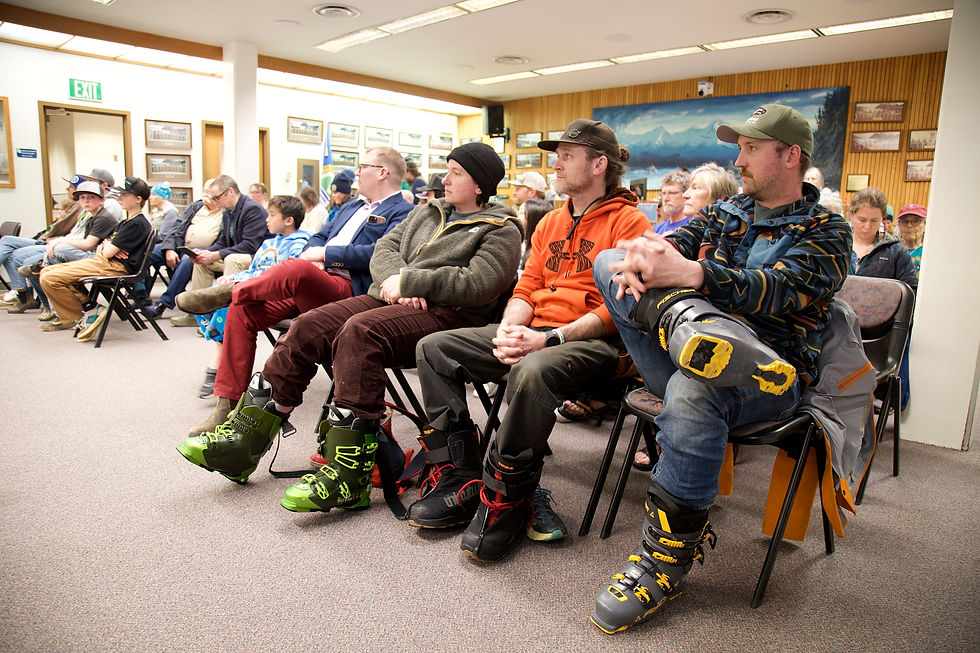
People wearing ski boots, and exhibiting vintage clothing and signs from Eaglecrest, were prominent among the dozens of residents packed into the Assembly Chambers at the start of Wednesday’s meeting. A handful of top Eaglecrest officials and supporters were still there five hours later when a fateful budget decision allowing the ski area to operate next season — but with severe staff and operational cutbacks — passed by a 7-2 vote.
Eaglecrest’s board of directors earlier this year approved a $5.7 million total proposed budget to maintain largely status quo operations, but that would have potentially required more than $3 million in city funds to cover. Instead, Assembly members advanced a $1.7 million allocation that would result in a total expected budget of about $4.3 million. Under that scenario Eaglecrest would cut staff 44%, and be able to meet "absolute minimum requirements" for operations, but would eliminate extras such as concessions unless a vendor provided them.
Still, that got applause from remaining audience members since another alternative was simply continuing the current year’s allocation of $930,000, which Eaglecrest officials said would result in a 56% staff reduction and other cutbacks that would keep the ski area from reaching minimal safety standards necessary for operation.
The austere scenarios come as the Assembly is also in the final stages of cancelling a gondola project that for the past five years was the foundational element of a plan to expand Eaglecrest into a year-round resort with mass tourism options during the cruise ship season. However, the cost of the gondola far exceeded projections, and the city is now looking at selling the equipment at a heavy loss and repaying Goldbelt Inc. a $10 million loan with interest — the latter of which is expected to drain most of CBJ’s unrestricted fund balance.
Reducing some community grants, keeping others
Some grant recipients were asked during previous committee meetings how they would cope with a 30% reduction during the coming year. On Wednesday, Assembly members advanced possible reductions for some recipients that span various percentages of this year’s grants, while sparing some others from cuts.
Among the possible cuts are $40,000 to $440,000 to the Juneau Economic Development Council, $50,000 to $700,000 for Travel Juneau, and $40,000 to $100,000 for the Juneau Arts and Humanities Council. Rejected by an 8-1 vote was reducing Juneau Community Foundation grant funding by $100,000 to $300,000.
"Obviously (it’s a) tough budget situation, but these are grants that go out to our key social service providers doing very important work," Smith said. "There'd be negative consequences for us, for our community, for our neighbors if we do away with these. To me, this is just not an area where I'm willing to make reductions this year."
Rejecting utility rate increase
The decision by voters last fall to exempt utilities from sales taxes played a key role the Assembly voting 5-4 not to consider a rate increase to help patch the budget deficit.
The Assembly last year voted to increase water and sewer rates by 5% a year during the next five years, saying inflation and repair costs were rising faster than the 2% increase that had been in effect since 2020. A proposal Wednesday to further increase rates to raise $9.4 million to offset lost sales tax revenue during the next five years failed, with members rejecting the increase citing voters opting to lower what they pay for utilities.
"I voted for a higher utility rate increase because I think it's important that our users are paying what it costs to get the service, but then the election happened," Woll said, adding "it would really be putting the same revenue, the same tax, essentially back on the same people."
However, Assembly members are considering putting an $8 million bond measure for water/wastewater utility improvements on the fall municipal election ballot, a decision that may occur after the budget is passed.
• Contact Mark Sabbatini at editor@juneauindependent.com or (907) 957-2306.





_edited.jpg)


.png)

.png)