


.png)

Assembly sketches out map through rough financial terrain at annual retreat

City leaders seek ways to moderate impacts of voter-approved tax cuts at day-long meeting shook up by earthquake, record snowfall
By Mark Sabbatini
Juneau Independent
There are potentially scary costs for completing Eaglecrest’s gondola. The impact of the new food sales tax exemption is something of a mystery. And Nano Brooks’ first attempt to implement his proposed land lottery was voted down 5-4.
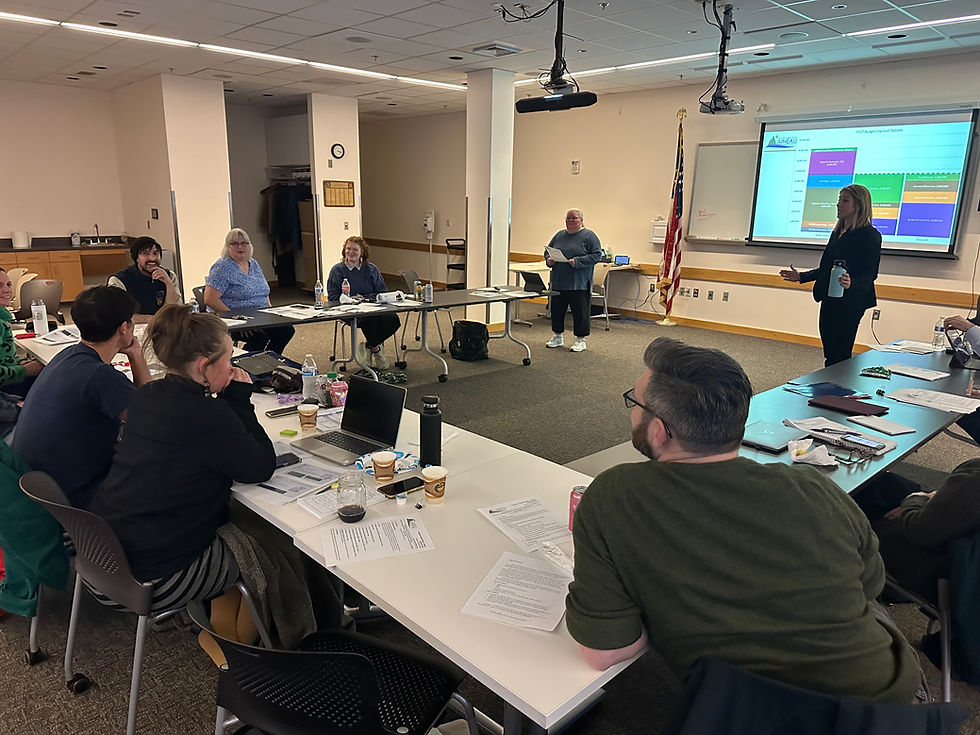
Those and dozens of other aspects about the city’s financial future were discussed during the Juneau Assembly’s annual all-day retreat on Saturday. The nearly nine-hour gathering in a meeting room at Juneau International Airport occurred amidst record snowfall outside and a magnitude 7.0 earthquake about 230 miles northwest of town — which city leaders can only hope isn’t an omen.
The city is facing significant spending reductions due largely to two tax-cut measures voters passed this fall. That resulted in at least theoretical discussions during Saturday’s retreat about not prosecuting misdemeanor crimes (and having the state do so instead to the extent they choose) and closing facilities such as the combined library/fire station in Douglas.
More moderate guidance favoring a phased-in and balanced approach to implementing spending reductions was generally given by Assembly members to city administrators responsible for drafting a proposed budget that will be considered next spring. But members said noticeable impacts are nonetheless likely.
“I’m not eager to stress the public out," Assembly Member Alicia Hughes-Skandis told others during the meeting. "I also didn’t vote for what passed" (during the election).
Voters approved exempting food and utilities from local sales taxes, plus lowering the cap on property taxes to nine mills instead of 12. An initial estimate is that will cost the city about $12 million in revenue — with $11 million of that split roughly evenly between the food and utility tax exemptions. But Deputy City Manager Robert Barr said the estimate for the food tax exemption in particular is uncertain due to exactly how it will apply to a multitude of merchants throughout town.
"We're all over the map on that one," he said. "So our food estimate is the one that I think has the most potential to be wrong and I think it could be wrong in either direction."
A $16.4 million total deficit is projected during the current fiscal year that ends next June 30 and a similar gap is forecast for the following year, according to slides presented by Angie Flick, finance director for the City and Borough of Juneau. In addition to the voter-approved tax cuts the city is facing additional costs such as wage increases for city employees still being negotiated.

The municipal operating and capital projects budget is roughly $200 million, while the entire budget for the current year is about $478 million when entities such as the Juneau School District and Bartlett Regional Hospital are included.
The city will be able to cover the gap since it has about $31.4 million in unrestricted reserves — leaving $15 million looking ahead to next year, after this year’s deficit is plugged — plus about $17 million in additional "restricted" reserves that have more limitations on their use.
However, some of the breathing room is good fortune — literally — since the city ended the past fiscal year with about $11 million in additional reserves due to unexpected interest earnings and other factors, Flick said.
Among the concerns expressed by Assembly members when confronting the looming deficits is ensuring short-term cuts don’t end up being more costly in the long term.
"We have to obviously make some reductions," Deputy Mayor Greg Smith said. "I don't want us to get into a spot where we're saving money by not thinking, by not doing (infrastructure projects), but we're essentially creating a liability in our infrastructure, a deferred maintenance backlog."
"We’re already there," City Manager Katie Koester replied.
"Making it worse," Smith amended. "You already mentioned that we're probably towards the bottom of industry-accepted standards of investment in our infrastructure."
Conversely, ongoing investment in one long-term project — the used gondola being installed at Eaglecrest Ski Area — received attention because CBJ has been subsidizing the city-owned resort for years. The gondola, with a planned opening day by May 2028, has been projected as a way to make the ski area profitable by allowing year-round mass tourism. But Hughes-Skandis said she is concerned about the price tag developers will put on installing the gondola when they submit bids during the coming months.
"Knowing what I know about Eaglecrest I think some of the funding realities are looking pretty bad there to me for the gondola, in light of everything financially and just in general," she said. "I think we're at a point where I really don't want us to go down a sunk-cost fallacy. I want us as a body to compare that to the walkaway number."
Mayor Beth Weldon said that evaluation will be part of the process when considering bids, adding "in all transparency I’ve been hearing some of those numbers too and they’re scary." She said after the meeting she was referring to potential costs, not official estimates.
Assembly members also considered a long list of possible goals for the next year that included Brooks, newly elected in October, proposing a trial version of his land lottery for a single specific city property in Douglas.
"We do the program for one year to see what happens," he said. "You know, $25 a ticket, one ticket per person, per raffle, no corporations, no businesses. And you have to sell a number of tickets that make it up to the fair market value of the parcel before you can declare a winner. If we're looking for new revenue streams, create a new property taxpayer — I'm not looking to do one every single month right off the bat — but just one lot for one year and let's see what happens. If it brings in a quarter million dollars for 0.6 acres that would be a pretty good thing."
Weldon said she has discussed the land lottery with Brooks and poked holes in all of his arguments in favor. Koester said there are also numerous policy questions to be addressed such as whether such a lottery would have to be registered with the state as a gambling activity.
Weldon called for a vote by showing hands after Assembly Member Neil Steininger said he’d be willing to have the Assembly’s Lands, Resources and Economic Development Committee consider the land lottery concept. Members voted 5-4 against sending it to the committee.
Another new proposal by Brooks, implementing an online CBR checkbook accessible for public viewing, got support from Assembly members as something to evaluate.
While the Assembly’s budget process typically begins in earnest in early April, city leaders are planning public engagement activities before then due to what are expected to be larger-than-usual changes resulting from the spending cuts. That includes a public survey scheduled in January and budget allocation workshops beginning in February, said Ashley Heimbigner, CBJ's communications and engagement director.
• Contact Mark Sabbatini at editor@juneauindependent.com or (907) 957-2306.


_edited.jpg)




.png)

.png)


