


.png)

Behavioral health services gaps in Juneau

By Mark S. Johnson
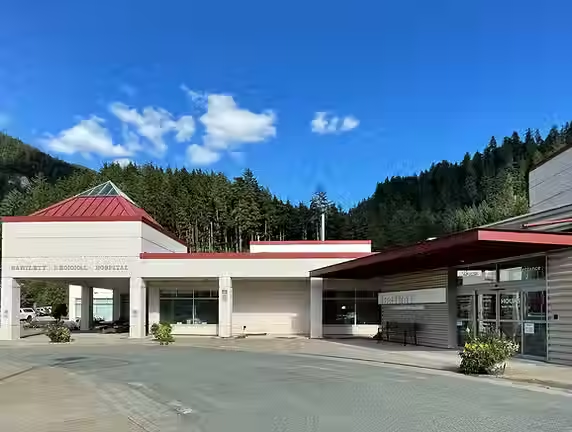
Bartlett Regional Hospital (BRH) is an excellent small city community hospital with an emergency department staffed by emergency medicine physicians, and surgeons and other specialists available on relatively short notice; state-of-the-art diagnostic services; quality intensive care and medical surgical units; qualified physicians and nurses and other specially trained staff; outpatient and inpatient surgical units; and cancer treatment and infusion programs.
In recent years, there has been an increase in quality joint replacement surgeries. BRH cannot provide all specialty medical services available in larger cities, but there are more services available to Juneau and Southeast Alaska residents now than in past years. Travel to Anchorage or Seattle for specialty services is expensive and often logistically difficult, especially for patients with families, so having more services available locally is beneficial to our community.
For more complicated emergencies, such as serious brain injuries or critical cardiac emergencies, there are excellent local air ambulance services available to quickly transport patients to referral hospitals in Anchorage or Seattle.
There are, however, serious gaps in local hospital-level mental health services, including crisis stabilization for all age groups and medically managed substance abuse services.
About 20 years ago, the BRH administration and Board decided that children’s mental health services should be a priority for the hospital. Consultants were hired to conduct needs assessments and architects were contracted to design a new facility. In 2012, the citizens of Juneau voted to approve $4 million from 1% designated sales taxes to help finance the facility.
From 2014 until 2016, the BRH board had a special Child and Adolescent Mental Health Committee to consider alternatives for child and adolescent mental health treatment services, which included a community stakeholder group. There were disagreements over the types of services most needed, but eventually the consensus was that a crisis stabilization service for all age groups was the best option because it could serve that largest percent of people in need. A crisis stabilization system includes the national 988 crisis hotline, prehospital crisis stabilization teams, short-term hospitalizations, plus follow-up outpatient behavioral health treatment. There is a growing number of these services available throughout the U.S. and they have been effective.
A recent Journal of the American Medical Association (JAMA) study found that the 988 Suicide and Crisis Lifeline, launched in 2022, is linked to an 11% reduction in youth and young adult suicides (nearly 4,400 lives saved) between the ages of 15 and 34 through 2024.
Rainforest Recovery Center had been administered by BRH for about a quarter century. Previously named the Juneau Recovery Hospital, the building was donated to BRH about 25 years ago by the City and Borough of Juneau. Over many years, BRH spent several million dollars to upgrade the Rainforest Recovery Center to meet state-of-the-art substance abuse addiction treatment standards. Despite getting a free facility donated by the city, and millions of dollars invested in upgrades, this facility is no longer being used for its intended purpose because a couple of years ago an interim hospital CEO concluded it wasn’t generating enough income to meet its expenses. According to reports then, the shortfall was only a few hundred thousand dollars.
Some of these services were picked up by Gastineau Human Services (GHS). Thanks to them for providing this needed service, but they are not licensed to provide the level of clinical services previously provided by BRH. There are reports that acute substance abuse patients, who previously would have been treated at Rainforest, are now referred to out-of-region facilities and local follow-up treatment often is not adequate.
The other facility that was closed by administrators is the Aurora Crisis Stabilization Facility. It was opened about three years ago, cost about $16 million to build, and was designed to provide crisis stabilization beds with locked units separating kids from adults, as well as Bartlett Outpatient Psychiatric Services (BOPS).
Recent BRH administrators have not seen these behavioral health services as a priority for our community hospital and both buildings are being repurposed for other hospital uses. A proposed BRH masterplan would spend about $1.5 million to convert part of the Aurora Building to a cancer infusion center.
Therefore, about $25 million to $30 million worth of facilities on the hospital campus are not being used for their intended purposes. Furthermore, the Aurora facility was partially funded by the Alaska Mental Health Trust ($2 million), Premera Health Insurance with support from the Rasmuson Foundation ($1 million) and the Alaska Division of Behavioral Health ($2 million). Adding the original $4 million from CBJ sales taxes for children’s mental health services would account for more than half the total cost of the Aurora building.
Last year, the CBJ Department of Law issued the following legal opinion:
“From a Charter and Code perspective the Assembly could open a second hospital with a focus on behavioral health. The state licensing, funding, and relationship with BRH are likely an extremely complex matter that would need to bring specialized hospital law attorneys in on for assistance. But, overall, the answer is yes, this is something that could be done.’
“And we certainly could lease for below FMV (fair market value) if this was a non-profit.”
Based on this legal opinion, the best option may be to find a qualified non-profit organization to lease the Rainforest and Aurora facilities to provide needed behavioral health services in Juneau that the BRH administration is not interested in providing. This option would not involve building new buildings, but would use existing buildings for their original purposes. It should not have a negative impact on BRH’s budget.
If BRH repurposes these facilities for physical medical uses, it is highly unlikely the organizations that contributed funds for construction of the Auroral building would contribute any funds for a separate behavioral health hospital. Consequently, with BRH leaders deciding that these behavioral health services are not a priority for our community hospital, and repurposing these facilities for other medical services, they are effectively precluding any viable options for providing these needed services locally.
Although the CBJ Assembly has a longstanding tradition of letting the BRH Hospital Board manage hospital affairs, this may be a unique situation when the Assembly should intervene to prevent the hospital from repurposing facilities that were funded, designed, and built for behavioral health services.
Finding a qualified organization to provide needed behavioral health services in Juneau may not be easy, but not having available facilities will make it virtually impossible. With their decision not to provide these needed services and to use these facilities for other medical purposes, BRH leaders are depriving our community of behavioral health services that countless community members, previous BRH boards and administrators, and behavioral health providers have worked hard to fund and implement for over two decades.
Not having these services in our community has profound impacts on patients and families, our criminal justice system, schools, the BRH emergency department, and may contribute to our homeless problems. The financial impacts on the community far exceed any funding shortfalls estimated by BRH.
Since the Aurora building has three floors, perhaps a reasonable compromise would be to keep one floor designed for crisis stabilization, another for Bartlett Outpatient Psychiatric Services, and the remaining floor could be used for a new cancer infusion center.
The Alaska Mental Health Trust provided a nearly $3 million startup grant last year to the Southcentral Foundation crisis stabilization facility in Anchorage and it is possible they will consider a similar grant to Juneau if they have assurances that the facility they helped fund would be used for its intended purpose. However, there is virtually no chance they would consider a similar grant to Juneau if the money they previously provided for the Auroral building is used for other purposes.
• Mark S. Johnson, MPA, retired from the Alaska Division of Public Health, has volunteered for numerous health-related organizations, including three terms on the Bartlett Regional Hospital Board, and has lived in Alaska for nearly 48 years, including 47 years in Juneau.




_edited.jpg)


.png)

.png)




.jpg)

.png)