.png)

Dunleavy unveils fiscal plan with sales tax, 50-50 PFD, 1% cap on state spending hikes, higher oil tax

Widespread skepticism among legislators that plan will be enacted; Alaska Municipal League worries it will put pressure on local govenments to reduce taxes and fees

By Mark Sabbatini
Juneau Independent
Juneau residents could be paying a 9% sales tax during next year’s tourism season as part of a multi-year fiscal plan by Gov. Mike Dunleavy that could in theory result in a Permanent Fund Dividend of more than $3,000 that fall.
Dunleavy’s plan is contained in a set of bills introduced in the Alaska State Legislature on Friday and Monday. The most eye-catching items to many residents are likely to be a 2% statewide sales tax that rises to 4% between April and September, plus changes to the Alaska Permanent Fund that would establish a 50-50 PFD plan where half of spendable earnings go to dividends and half to state government functions.
"For too long, Alaska's economic growth has been stymied by uncertainty and volatility," Dunleavy wrote in transmittal letters for legislation sent to the House and Senate on Monday. "We are one of the few states that depend so heavily on a single commodity, subject to daily price swings, to fund state government. This bill is one part of a comprehensive fiscal plan to stabilize state finances, limit spending growth, share responsibility among Alaskans, major industries, and nonresidents, attract investment, and restore rules-based payment of the annual Permanent Fund Dividend."
But there’s considerable concern among legislators and other officials about the practical implications of each of those components. And both are part of a much broader plan that also includes a hike in some oil taxes and fees, cutting corporate taxes, a 1% cap on annual state spending increases, and a "sunset" process that puts state agencies under review and automatically abolishes them unless lawmakers vote to continue them.
"In a normal environment this is a two- or perhaps even three-year project in terms of getting into the nitty gritty detail and…involving the public at every step of the way," House Speaker Bryce Edgmon, I-Dillingham, said last Thursday during a media briefing where the general aspects of the plan were discussed.
New state sales tax would shake up local tax policies
Concerns about a sales tax hurting residents least able to pay more for items, compared to an income tax where higher earners pay more, were expressed by some legislators, including Rep. Sara Hannan and Sen. Jesse Keihl, both Juneau Democrats with seats on the House and Senate finance committees, respectively.
Further concern about a statewide sales tax and other aspects of Dunleavy’s plan putting local governments in a bind was voiced by Nils Andreassen, executive director of the Alaska Municipal League. In an online briefing with reporters on Monday afternoon, he said there are numerous administrative and accounting concerns for municipal officials, but what may be of most concern to many residents is the cumulative burden of paying both state and local sales tax.
"The addition of a state level is definitely a burden that some communities will feel more than others, and there will be calls from those residents to lower not the state's rate, but the local (one), which will diminish revenues at the local level," Andreassen said.
A key concern for municipal officials is the state taking over the collection of all sales taxes and then returning municipalities their share, Andreassen said. Furthermore, local governments would no longer be able to set their own exemptions to local taxes.
He said that would likely create bureaucratic entanglements since municipalities have different rates, exemptions and other criteria for their calculations.
"That pride of place for AML members has been local decision-making — not just rates, but exemptions, caps, basically all the tools that are consistent with trying to develop policy that is specific to a single jurisdiction," he said. A "one-size-fits-all approach" for the more than 100 jurisdictions in Alaska with sales taxes poses plenty of potential pitfalls, "but that's not to say that we can't work can't work through" the issues with lawmakers at the Capitol.
Juneau currently has a 5% sales tax, of which 3% is a temporary tax set for voter renewal this year and 1% a temporary tax set for voter renewal in 2027. Voters have renewed both taxes every four or five years for decades. In addition, voters last fall approved exempting "essential" food and residential utilities from local sales taxes, and the city has further exemptions for nonprofits and other subgroups.
Juneau Mayor Beth Weldon, in a text message Monday, said she hasn’t seen the bill with the tax provisions yet, but agrees with Andreassen that "municipalities will struggle with a sales tax on top of a state sales tax."
"Not sure if he has the votes, so will be watching," Weldon added.
The statewide sales tax proposed by Dunleavy, which would take effect July 1, 2027, would tax food except for items purchased through federal assistance such as the Alaska Supplemental Nutrition Assistance Program. The tax would also apply to most other general goods — including items purchased online via merchants such as Amazon and Netflix — although certain exemptions would apply to items such as jet fuel.
Ensuring a PFD by changing the state constitution
Last year’s PFD of $1,000 was the lowest since payouts began in 1982, when adjusted for inflation, and a similar dividend is likely this year, according to legislative leaders. Dunleavy has proposed so-called "full" dividends every year he’s been in office that are based on a formula that hasn’t been used since 2016 — which would be about $3,650 in his current budget — with the Legislature bypassing his proposed PFDs in favor of lesser amounts based on other formulas.
Dunleavy on Friday introduced a proposed constitutional amendment to 1) guarantee PFDs are paid out every year, 2) allocate half of spendable earnings from the principal of the Permanent Fund to dividends (allowing the other half to be used for state spending), and 3) merge the two existing Fund accounts — the existing fund principal and an Earnings Reserve Account — into a single fund. Spendable earnings from that single fund would be 5% of the fund’s average value over a five-year period.
Dunleavy, in an online message promoting the legislation, said he wants to put the measure before voters in this fall’s election. Two-thirds of both the House and Senate will need to approve the proposal for it to be placed on the ballot.
Currently the amendment as written by Dunleavy would allocate about $2 billion for PFDs, close to the $2.3 billion cost of his proposed budget with its $3,650 PFD, thus equating to a dividend well in excess of $3,000. However, legislative leaders in the bipartisan House and Senate majorities — as well as some members in the Republican minority caucuses — have stated such PFDs are unrealistic because of the massive deficit they would create. Dunelavy’s proposed budget contains a total deficit of $1.8 billion and covering it would require using the majority of the state’s $2.9 billion Constitutional Budget Reserve.
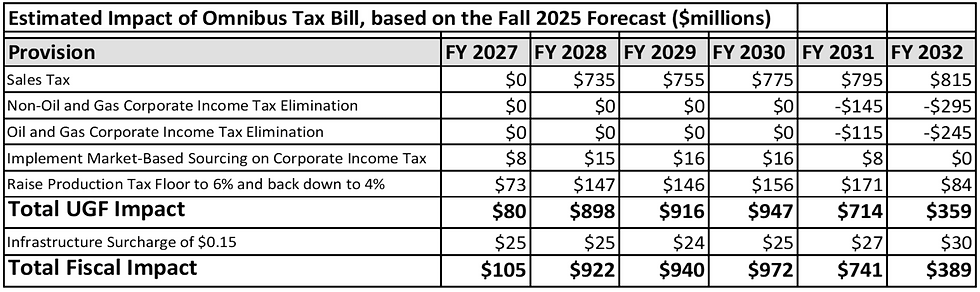
The state sales tax and other revenue-generating measures proposed in Dunleavy’s fiscal plan fall far short of that deficit. The Alaska Department of Revenue estimates an omnibus bill with those measures would generate $105 million during the coming budget year, then $922 million, $940 miliion and $972 milluon during the next three years before declining steeply the following two years. Dunleavy’s bill calls for the sales tax to end in 2034 and other tax changes are also temporary — except for a permanent elimination of corporation income taxes beginning in 2031.
Changes to oil and corporate taxes
Oil companies, long targeted for increases by some lawmakers who say the industry has received overly favorable treatment by the state, would see some increases in taxes and fees under Dunleavy’s proposed plan.
"For oil and gas, the bill raises the minimum production tax floor for oil produced on the north slope from four percent to six percent starting in 2027, then reverts to four percent later under specified conditions," the Alaska Department of Revenue notes. "It also imposes a new infrastructure maintenance surcharge of $0.15 per barrel of oil produced, with proceeds directed to a pipeline corridor maintenance fund."
The tax increase would raise up to $171 million annually before it expires in 2032 and the surcharge up to $30 million, according to the department. Eliminating corporate income taxes would cost the state about $540 million per year.
Dunleavy, in his State of the State address last Thursday, promoted his fiscal plan as a five-year stopgap until the state begins to see significant new revenue from oil and other natural resource development, due largely to Trump administration actions to speed up those projects by easing regulations.
While questions about the timing and actual revenue such projects may bring, some legislators during the session’s first week have stated they are glad long-discussed proposals for a fiscal plan putting the state on solid economic footing will likely be a highlight issue this session.
"I am thankful the Governor is finally addressing the multi-billion dollar structural deficit caused by the oil wealth giveaway of 2014," Sen. Scott Kawasaki, D-Fairbanks, wrote in a Facebook post Monday that asked constituents their opinions about the sales tax provision of Dunleavy’s plan.
• Contact Mark Sabbatini at editor@juneauindependent.com or (907) 957-2306.


_edited.jpg)


.png)

.png)