


.png)

Gary and Jackson Lehnhart selected to Alaska High School Hall of Fame

Updated: Mar 1
Father and son to be inducted together among 14 chosen for April ceremony

By Klas Stolpe
Juneau Independent
We go one, we go all.
That has been the Juneau-Douglas High School: Yadaa.at Kalé Crimson Bears soccer motto from the first season Gary Lehnhart began his JDHS coaching career.
“I was watching this movie about a bunch of misfit boys on a sailboat,” Lehnhart said. “It was about turning these troubled boys into good citizens…They are on the water and the captain said they had to strike out on their own, achieve and work hard, but at the end of the day they had to fit into a group. And I thought, ‘That’s perfect, that’s exactly what it is that I want as a coach.’ I want players who were not afraid and were bold and adventurous and willing to take risks, but I want them to always do it in the context of a team and understand that the team at the end of the day was more important.”
Lehnhart will be inducted as a coach into the Alaska High School Hall of Fame (AHSHOF) at 2 p.m. Sunday, April 26, at the Special Olympics Alaska building, located at 3200 Mountain View Drive in Anchorage. His son Jackson Lehnhart, a 2013 JDHS graduate, will be inducted as an athlete.
What the motto from the 1996 Ridley Scott disaster film “White Squall” stands for — commitment to solidarity among the crew — has shaped every young man’s life that has been associated with Gary Lehnhart on the field or in the classroom from the first time he walked through a hallway of the Juneau School District in 1990.
It has shaped Jackson’s life. The 2013 soccer Gatorade Player of the Year has a list of accomplishments that speak volumes to what a young man can achieve behind life skills learned through sports, academics and friendships.
“I am honored,” Jackson Lehnhart said. “I think it's really fun to go back to all of those memories and feel grateful for that fact that I got to have them. Obviously it's an incredible honor, but the bigger piece I am grateful for is just how unique the experience of playing sports and doing activities in high school in Alaska is. I think about the housing, the flying and ferry rides and time that we had as teammates. It is such a special experience. I think what this has really done as an honor is bring me back to those moments and how grateful I am for being able to have those moments. I think it's a pretty special place to experience sports as a kid. And this is just such an honor to kind of relive that.”

Gary Lehnhart noted Jackson talking about how excited his Amherst College teammates were flying for the first time as they traveled to the 2015 NCAA National Championship, “and Jackson was so calm, he has been flying to games since he was 10 years old because that’s the way we do it in Alaska.”
It was that trip to watch his son play in the national championship that Gary Lehnhart cites as one of his favorite sports highlights.
“Sharing that moment, his moment, was just, well, I cried,” Lehnhart said. “Knowing the effort he put in, the joy he has had for all the sports he has played, and then to be on the field as a father, not a coach, to see it…Sharing special moments with family, and now this moment, being selected with Jackson is (his voice trails off in emotion).
In the past Gary Lehnhart has been notable in getting others into the AHSHOF including, among many, Chugiak coach Ed Blahous Sr. in 2012 and JDHS ’01 grad Justin Dorn in 2019.
“It is always difficult for me when they ask me as a coach, who do I want to nominate?” Gary Lehnhart said. “That was one of the reasons why I think it didn't happen for Jackson as quickly as it probably should have…I have had a lot of really good soccer players and I think Jackson is unusual because he was not just a soccer player, but he was a multi-sport athlete and successful in multiple sports. So I was not surprised when his name came forward and I was really excited to be a part of it. And then to see mine at the same time. I guess that makes it super unique and really fun for me to merge the two. So much of my coaching was involvement with my children, even my girls at practice as young kids and then being able to coach the boys in high school. Just really lucky.”

Among his charges were six Gatorade Players of the year (Justin Dorn 2000-01, Rob Lossett 2001-02, Dylan Ashe 2005-06, Colin Flynn 2007-08, son Jackson 2012-13, Kai Ciambor 2024-25), but he holds just as important the half a dozen JDHS commencement ceremonies he spoke at, including Carlos Boozer’s 1999 class, and his son Taylor Lehnhart’s in 2011. (His daughter Brittany graduated in 2007 and daughter, Carly in 2008).
“I think the last speech was in 2017,” he said. “It was humbling each time that the students chose me. I sure had fun doing them and enjoyed the response afterwords.”
To date, Gary Lehnhart has amassed 411 wins, 116 losses, 59 ties (142-11-10 in the Southeast Conference). Under him, the Crimson Bears have qualified for every state tournament since its inception, won seven state titles, been runner-up nine times, placed no lower than fourth, and won the GPA Award 10 times and Sportsmanship Award seven. He has numerous coach of the year honors through youth, Olympic Development, Arctic Winter Games and national teams, and equally important teaching accomplishments from 1990-94 at Floyd Dryden and at JDHS from 1994 until his retirement in 2022. His nature is such that he acknowledges these honors, but has a modest view of his own importance in them, instead believing that talent and success come from and are shared with others.
Jackson Lehnhart graduated JDHS with a 3.96 cumulative GPA. The 2013 Alaska Gatorade Player of the Year was that season’s NSCAA Scholar All-American, an NSCAA West All-Regional Team member and ASAA All-Tournament Team selection. That senior season also saw him nominated as a baseball Gatorade Player of the Year while he helped the Crimson Bears place third at state and made the ASAA All-Tournament team. That senior season he was the starting point guard on the JDHS basketball team and winner of the team’s Zach Gordon Award. As a senior he was team captain in all three sports. Like his father, Jackson’s humble attitude prefers that his accomplishments be noted by his relationships with others.
“Just so many memories of teammates and opponents,” Jackson Lehnhart said. “Like in high school baseball where we would house players from multiple different teams and there would be two kids from Ketchikan in the house and two kids from Sitka in the house and some of our team…you had kind of a career that you had built over the years, all the way back to when you were ten years old that you became such close friends with. It is just such a special thing that certainly does not happen often.”
Jackson Lehnhart’s achievements — amplified in letters of support from teammates and coaches to the Alaska High School Hall of Fame stating his work ethic, setting a standard for commitment, unselfishness, loyalty, academic fortitude, leadership, integrity and a community-first attitude — would make a Eagle Scout blush. Many of the same attributes were included in letters to the hall of fame on Gary Lehnhart’s behalf.
“I really liked what Phillip (Fenumiai 2013 JDHS graduate/teammate) said of Jackson,” Gary Lehnhart said. “He talked about Jackson as a teammate and his unselfishness and I agree with that sentiment about him. That’s what you want as a coach. Players like him, unselfish yet unafraid to take risks and try.”
Jackson Lehnhart, who would sprint across the Adair-Kennedy pitch in his soccer shin guards over to the baseball diamond to never be late, deflects those praises.
“I kind of took Gary’s, our team motto into college and found our college program really embodied a lot of the same things,” Jackson Lehnhart said. “My college coach (Justin Serpone, DIII Amherst) did such a good job of building a family and making sure no matter what contribution you are making for the team, whether that is scoring the goal or yelling from the sideline, you felt like you were critical. He did that because it is true and he made sure everybody had a place…We took pride that we would be the loudest, that our bench players would outperform theirs, even without stepping out on the field. For me, who didn’t have playing time early on, it gave me a place, a reason to stick with it. And when I did get to the point where I had playing time on the field it gave me an appreciation for more than the 10 guys out on the field. I think that is such a critical mindset to have, whether that comes to work or life, there are so many applications of that, and whether it was my dad or coach Serpone I feel like most of my sports moments keyed in on that specific thing.”
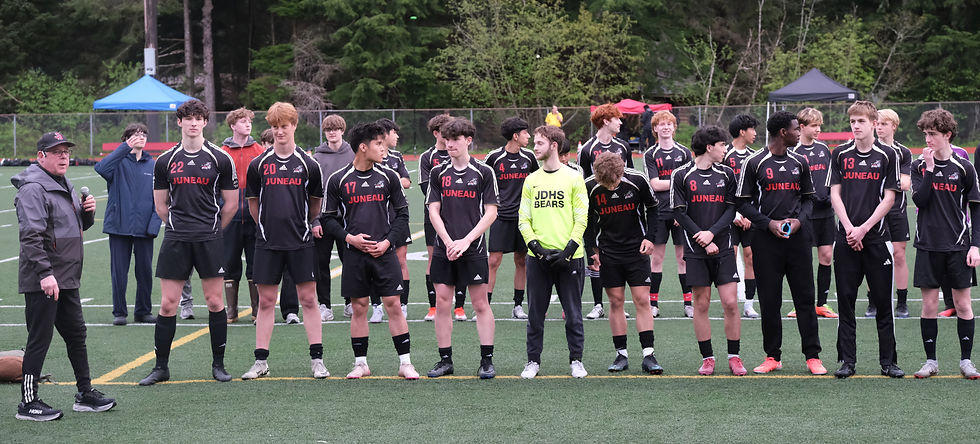
Gary Lehnhart and Jackson Lehnhart were interviewed together. Following is a compilation of the conversations
MOST SPECIAL SPORTS MOMENT TOGETHER
Jackson: The obvious one for me is when we won our national championship in my junior year of college. My dad flew in. He actually wasn't able to make it to the semi-final because he got snowed in at Juneau, pretty classic. But was able to watch the game virtually, saw that we won, booked a trip the next morning, and arrived in Kansas City minutes before we kicked off. I think just that being the culmination of so much time we had together, playing soccer and with other sports, that culmination where he appeared on the sideline and was there for such an important special moment for me. I think that was far and away the coolest sports moment I have ever had. And certainly one of the most fun moments I have had with my dad. I think...Honestly, I can't really think of another moment where he wasn't there that was special to that degree. I guess the moment of us getting past the elite eight was pretty special. We had kind of banged our heads against the wall two years leading up to that. And so getting that, finally breaking through and getting to go to the final four in Kansas City and, while that was really special, the culmination of it in Kansas City with my dad arriving here, I think, is the most special moment that I have had.
Gary: Three answers. The one is what Jackson said, and in that game, I was with my camera and I was getting harassed by the opposing team. The ball rolled out of bounds and I threw it to Jackson because he was going to throw it in and he said, "thanks dad." And when they found out I was his dad, they just started saying things like, "Do you have a job? How come his shoes look like that?" And there was just poking fun because they could poke fun. And the photographers saw that and heard that and they invited me onto the field. So I got to watch the national championship game with the photographers right behind the goal, which was epic. And it ended up being fortuitous because when Jackson scored the first goal in the game and the NCAA photographer saw that was my son and sent me the whole sequence of the goal, from run up to the score and the celebration. So we have this great sequence which is up in our den and it's fun, like he said, to see the culmination of his dreams.
Two would be his sophomore year. We pretty much had the whole family up in Anchorage. They won the state championship. His brother (Taylor) was the goalkeeper and made a brilliant save to save the game at the end. Jackson was Subway player of the game. That was probably a highlight, a family highlight of just seeing and having the both boys do that together. My mom had flown up from L.A., and Nancy was there.
Gary 2: I am fortunate to have taken part in, not only a lot of state championship wins, but a lot of state championship losses, in fact more, and then teams that didn't win. Sometimes some of those games are even more memorable. Like Jackson's senior year getting knocked out in the first round when we were clearly the dominant team, and soccer is like that. So I guess the answer that I have to that is more of a cumulative answer, which is, every year, for me it is not so important anymore that we win. It sounds kind of silly, but it's just not. I just like watching the boys come in and then hope that it happens. And they play so hard. It does happen or it doesn't happen now. And then helping them understand that in the context. So many of the state championships that we won, we probably should have lost, and so many of ones we lost, we probably should have won. Soccer is like that. Games are unpredictable. They turn on one goal.
Gary 3: And I think the one other memory that I have is when Jackson was in college and he was struggling with breaking the starting lineup early in his career, and tired of the challenges of being in Alaska. He was home for the summer and he didn't have the level of competition around to train like his teammates. It was fun to just sort of figure it out with him that summer. We got together a group of players that I was coaching. We practiced as regularly as we could, and we figured out a plan about it, a way that he could get on the field, and it worked. And he got on the field the next year and the rest is history. So I think that is probably one of the memories that I am most fond of, too, is just how we kind of figured that out together.

ON JDHS BASEBALL AND COACH FRANK BARTHEL
Jackson: He was such a special person. Such a critical part of my high school baseball experience and so many of my teammates as well. For him it was the same thing: be the loudest one on the bench. He would yell ‘rack ‘em up from the bench. He saw himself as the loudest one and it gave energy to our team to be a part of it no matter where you are, everyone plays their role and contributes to some degree.
Gary: Because I didn’t have to coach at the same time and I could just be a fan. The role Frank and Will (Race) had in Jackson’s life and just seeing the passion Jackson had. As a little kid, Jackson and I probably played as much or more baseball together than soccer, almost daily playing catch in the yard. And I remember coming home from work and him sitting there, and he wasn’t holding a soccer ball, he was holding a baseball mitt and that was what he wanted to do…and then to be able to watch him have success, I loved watching all of that and being able to watch without having to think as a coach.

VALUE OF ACADEMICS FOR THE ATHLETE
Gary: I played at a very high-powered football high school in Southern California. The quick version is that we went to the CIF finals three years in a row, which is unheard of, and we won in my senior year. But the sad part of it is that my high school, for being such a prominent high school, was really run by athletics and run by coaches. And while I was in the middle of it, I wrongly appreciated how much I was allowed to be an athlete and not a student. And then when I went to college and I was playing, but I was also starting to think about my future, I realized that I was done such a big disservice. And I remember the first English class that I took in college, and my first paper that I wrote was just torn apart. And basically, the teacher told me, "You're not a very good writer." And I was struck like, "Wow, really? I got all As in high school." And it was because I was graded by coaches who weren't taking it serious. So I really told myself that I was not going to do the same thing, I was going to be a teacher first and a coach second. I didn't want my students to think that the order was reversed. So I put a lot of pride in my teaching. I put a tremendous amount of time in it and I tried to instill in my players the same kind of value that education was more important than the playing. So the best way I could do that was to mentor it by trying to be a good teacher and for them to see that I was putting more effort in my teaching than I was necessarily in my coaching. I am sure that a lot of my students thought of me as a coach because that was what I was as well. But I know that I've heard from a lot of them that were not athletes who appreciated their time in my classroom. That probably means more to me than the appreciation that I got from my players. And it still happens. It is fun when I go to a grocery store or somewhere where I get pulled over by a police officer (he laughs) and they let me go because I was a good teacher in their life as a kid, but it did happen. But yeah, I go to a grocery store and someone says, "I remember your class." That means a lot.
Jackson: I am very lucky to have had parents who are educators themselves. They did such a good job of teaching us the importance of our education, and truthfully to enjoy it. It is such an important part of development as a kid and I am grateful they did such a good job teaching us that. There is a balance (with sports), and at times it can be hard. That being said, it is all growth, and I think it is important to remember that. The balancing act builds discipline and time management, but also commitment which is incredibly important.
WHAT SPORTS DO WELL
Gary: I think the best thing sports does well is it teaches people how to lose. Because you are going to lose…I remember as a student winning the California football sectionals after having lost the two previous years and being so down about that. I remember driving home on the bus and thinking, "Is this it? All these years and all the effort I put into it," and I just expected it to feel bigger and better. I think the losing helped put that into context that you have to deal with failure. And so as a coach, I enjoy watching kids overcome that, overcome the failure of maybe not starting a game or having to come out because they make a mistake. Or they do something that doesn't work and figuring it out. And then the other part of it is when they have success, trying to help them balance it and realize that it is not the culmination of their life, nor should it be. There are bigger and better things to worry about. (Now speaks of the JDHS Crimson Bears loss in 2005, a 1-0 semifinal defeat to eventual state champion South Anchorage). It was one of the worst losses we had in a game and I remembering telling the players when I was looking at them, and they were so downcast, I said, "Hey guys, if this is the worst that's going to be in your life, then you have had a dang good life. You have had a lucky life." That's what I think the mental part of it is. Athletics is really good with helping mold people to deal with failure.
Jackson: I think that one thing I would say for someone that is kind of looking for an outlet to share with someone or looking for help, I think that is just kind of the beauty of what has been built with the activities and sports in Alaska. That network that we have specifically in Juneau. These are coaches, facilitators, parents, etc., they are all there because they want to help. It is easy for a kid or a student to see a teacher or a coach as someone who is scary to share with, but I think it is just good to remember as a student or an athlete that they are there to support you, and they are potentially some of the best people to look to for guidance and support. As much as someone can kind of see it that way, it is a relationship that is built over time and a trust that's built over a time, but at the end of the day it's people that are really there who support you. I think once you kind of break through and recognize that, it can be a really powerful thing to have those people in your life and I guess it's just important to remember that is why they are there.
Gary: Watching Jackson interact with his teammates, it sort of reminds me of the role models he had with people like Colin Flynn and Rob Lossette and Dylan Ashe and Justin Dorn and others. All of those guys spoke with actions more than words and I think it helps the rest of us because they are seen. These guys are super successful. And so see them show the unselfishness, show how to deal with failure, to show good sportsmanship…Each one of those guys was so appreciated by the opponents, which is an incredible compliment. And it is not what you often see in some of the better players. And all of those guy had that, and I think one of the reasons why they were all so successful and won the awards that they did was that they did treat people with respect and so those actions help others of us understand how to live better lives and I appreciated that.

COACHING YOUR KIDS, PLAYING FOR YOUR FATHER
Gary: A unique experience. I think it can be a problem. From my perspective, it really wasn't too big of a problem in the sense that the decisions were pretty obvious and so for me it was just the enjoyment of having them around…Jackson didn't win the lunch box award (coaches award presented to the player of the game) until late in his senior year and a kid asked him, "Wow, you must have won that a lot." He was like "No, this is actually the first time." This kind of shows that when you do coach your kids, you can’t really give them awards like that. You have to take a step back. But I think there is something good about that, too. I think it was good for them and it was good for me too, but I just loved being with them, being able to watch them play and having them see some success and even their failures. I just loved being with them.
Jackson: He did a very good job as a parent knowing at what phases in my life to give a certain degree of coaching. I have such fond memories as a little kid where it wasn't all that serious, it was for fun. That kind of extended into getting to have access to the high school team and I remember as a little kid running around, watching them practice. Then there is a whole other phase that came later where I kind of looked at him as a much more serious coach and I needed the guidance to really develop and become a better player and I was much more into it. I wanted him to give me stronger feedback and push me harder, and I think he was well-equipped to do that as well. It has been fun to go through that journey and I don't think really at any point it felt like he’s overstepped. I think he has always kind of been there in the capacity that I was looking for as a kid, as a son, as an athlete…I think he has done a great job of supporting me throughout that journey.
COMPETITIVE PASSION LEFT ON THE FIELD, OR BROUGHT HOME
Jackson deferred to his father.
Gary: There are two answers. The first one is my wife, Jackson's mom, Nancy. She certainly was a huge support to all of us, but it wasn't as important to her in a good way as it was to us. I think that always helped balance things out. Because I thought it can take on too big of a role and gets too much exposure. You can take the wins and the losses a little too much. So to have the most important person in both of our lives have so much balance, I mean, she cared about what was going on up on the field, but part of her did not care. I think the other thing was that we kind of had an arrangement. When the kids would ask me a question, I would say to them, "Are you asking me as a coach or as a dad?" And if it was as a coach, then gloves were off and I could say, "You need to do this, you need do that." But if they asked me as dad it was all, "I love watching you play, it is so much fun to see you." Just being super positive and I think it was good to be able to separate that because they did not need to be coached all the time, they needed to be parented. I also didn't want to be the coach all the time. I wanted to watch it and that is one of the reasons why I didn't coach any of their youth teams, I wanted a watch. I wanted to be the dad. I did help and I was on the sidelines because a lot of the teams were coached by parents who needed help and so I had the best of both worlds. I got to come to practices and help those guys figure out how to coach and then I got to stand on the sidelines during games and watch as a parent. And so all the way through all the club games and then with Jackson the other sports also, basketball and baseball and football, it was just fun to watch them play.”
WHAT WOULD YOU SAY TO YOUR YOUNGER SELF
Jackson: Oh man, a lot. But I think the biggest is just enjoy it. Like, what I would give to go back to a rainy night at 7 p.m. under the lights in Adair-Kennedy…It’s just such a special moment in your life, and the experiences that you have there are not experiences that you can replicate. I think, as much as my guidance could be, take it seriously, work harder, honestly just enjoy it and appreciate even the moments that are kind of seem difficult, I think they are going to be moments that you value so much and wish you could replicate in the future. So that would be my biggest piece of guidance.
Gary: I think for me, the hardest part, because I'm the decider is I can't give everybody what they want. And it breaks your heart sometimes to see people work so hard and it just does not happen for them. There's not a direct line between effort and achievement. Sadly, some people are just blessed with abilities that others aren't and as a coach you have to hand out bad news so often…and I make mistakes, you know. If I go back over the years, there's so many of them I wish I could go back and fix. You can't, you have to live with them. Yeah, there were some successes, but there also were kids that it just didn't work out for them, and to know that I was part of that and it will always be part of, I guess, my legacy…One of the blessings of athletics and also the curse of it is that you have something kids really want. They want to achieve, they want to play and it is a competitive thing, which means there are winners and losers. That's not just in terms of the game, but also just who gets to travel. Some of the most gut-wrenching decisions in my coaching life have to do with who is number 16 on the travel list. Those are probably the hardest moments that I think back on over the years. Trying to decide because number 17 stayed home, he didn't get to get on the plane, he didn't get to sit on the bench and watch…And I grew up in a place where seven high schools had 2,000 students within 20 minutes’ drive and so we did not have that, everybody got to go to the game and sit on a bench. You didn't have a cut-off list. We don't have the money to take everybody and to some of them it is so devastating.
FAMILY BEHIND YOU
Jackson: My brother, aside from just being a really great sibling, but also the fact that he was a goalkeeper was actually quite fun. That meant there was a lot of moments where the two of us were going head to head, I think that made both of us a lot better. It was certainly a point of bonding for us, was just the fact we could, in his capacity of the goalkeeper and me as an attacking player there were a lot of fun moments where we butt heads on the field in practice and things like that. Certainly he has always been such a supportive brother, as were my sisters, but I just have such fond memories being so close with my brother. Another one is I loved to pitch as a kid. I have a vivid memory of throwing a pitch in the Auke Bay Elementary School covered area and hitting my brother in the face and he ended up getting a pretty good shiner. And he just kind of wore it and I remember thinking "you could be really mad at me right now, but you seem to be perfectly comfortable with the fact that just happened." It just shows that he was pretty darn supportive as we grew up and hopefully felt the same for me but I definitely remember that being a special relationship where the two of us have a lot of moments, just me and him.
Gary - I remember the epic family games. Nancy had a family home that her grandparents owned on Cape Cod. We would go back there every other summer. Jackson’s sisters were older, and they were both very good soccer players. And so early on we would play 3 v. 3 on the lawn at the Cape for hours and Nancy would play with the two girls, and I would play with the two boys and it would be 3 against 3. Some of my best memories are those 3-on-3 games on the grass.

WIFE & MOTHER, STABILIZER & ANCHOR
Throughout the interview, Gary and Jackson Lehnhart referred to Nancy Lehnhart — wife and mother — many times. She is their "champion," their ‘stabilizer in rough waters and anchor at night.’ She ran an elementary art program in Juneau schools and also managed an art kit program so teachers could check out lessons previously taught - an art lesson library.
Nancy Lehnhart was asked what the induction of Gary and Jackson meant to her.
On Gary: I would say that I am especially impressed by and proud of the true heart of an educator that Gary has, which, in my definition, is centered around the well-being and growth of kids, his students and his players. Of course he is interested in the outcomes of games and seasons, but honestly, not that much. Not compared to the outcomes and success of the experience for the kids. When we have conversations over the years about his soccer practices and games, it's about individual kids, and groups of kids, the struggles that arise, the positive tone, maturity, the way kids are growing to be stronger players and more generous people, the fun they are having, those things. Maybe he just knows that I don't care to remember the mechanics of the game much, but I do think the game is beside the point for him. It's the opportunity to be involved with young people in such a dynamic sport which has the potential to really be a catalyst for positive growth for them.
On Jackson: As for Jackson, it was always a pleasure to watch him in the many hours of sports. He worked hard and seemed truly to enjoy it all, his teammates, his coaches, just the experience of playing. I remember one opening day for Little League when the snow was blowing sideways and he was just out there on the pitcher's mound, his skinny little arms sticking out of his tee shirt which was flapping in the cold wind, grinning away, so glad the season had started. The element of all of our kids sharing soccer, and really, sports in general, with Gary has been really special. They had so many fun times, all of them playing together and sharing that with a dad that is so deeply connected to sports. I think Jackson just felt at home in it all and really flourished, which was so great, from a mom's perspective.
NEXT STEPS
Jackson works in business strategy for a tech company in San Francisco. He and wife, Hannah, are expecting their first child (a boy) in June.
“The skills you gain from your experiences playing sports as a kid certainly continue to show up throughout your life,” he said. “Work ethic, the willingness to work within a team, and really just the desire to hone a craft. I am incredibly excited for the new adventure of building a family. Teamwork seems like a crucial one for that.”
Gary is about to start another JDHS soccer season. He doesn’t see a difference between today’s youth and his own. As a teacher or coach, the grass still appears green on both sides of the fence, so to speak.
“When I was a player, we had some bad attitudes and we weren't the best, necessarily, we didn’t listen to our coaches all the time, didn't treat our teachers with respect all the time,” he said. “I don't really see a huge difference now. I appreciate the way my players work hard and try. I don't think they have stopped, I don't think that has changed. Certainly the social media piece makes things a little bit harder for kids today to keep things in context and not blow things out of proportion. But as a teacher I still saw students that when you gave them good lessons they were eager to learn and are respectful and players the same way. I have a great group of freshmen this year. I'm super excited just as I was in the first few years of my coaching, I don't see much difference. They want to play hard, they want to be successful, it means a lot to them. I don't really see a huge difference.”


• Contact Klas Stolpe at klas.stolpe@gmail.com.


