.png)

Juneau joins nationwide protests with ‘No Tsars, No Kings’ event on Alaska Day

Updated: Nov 10, 2025
Peaceful protest invites all to tell their story; one man standing solo on Douglas Bridge turns the U.S. flag at Juneau courthouse upside down

By Jasz Garrett
Juneau Independent
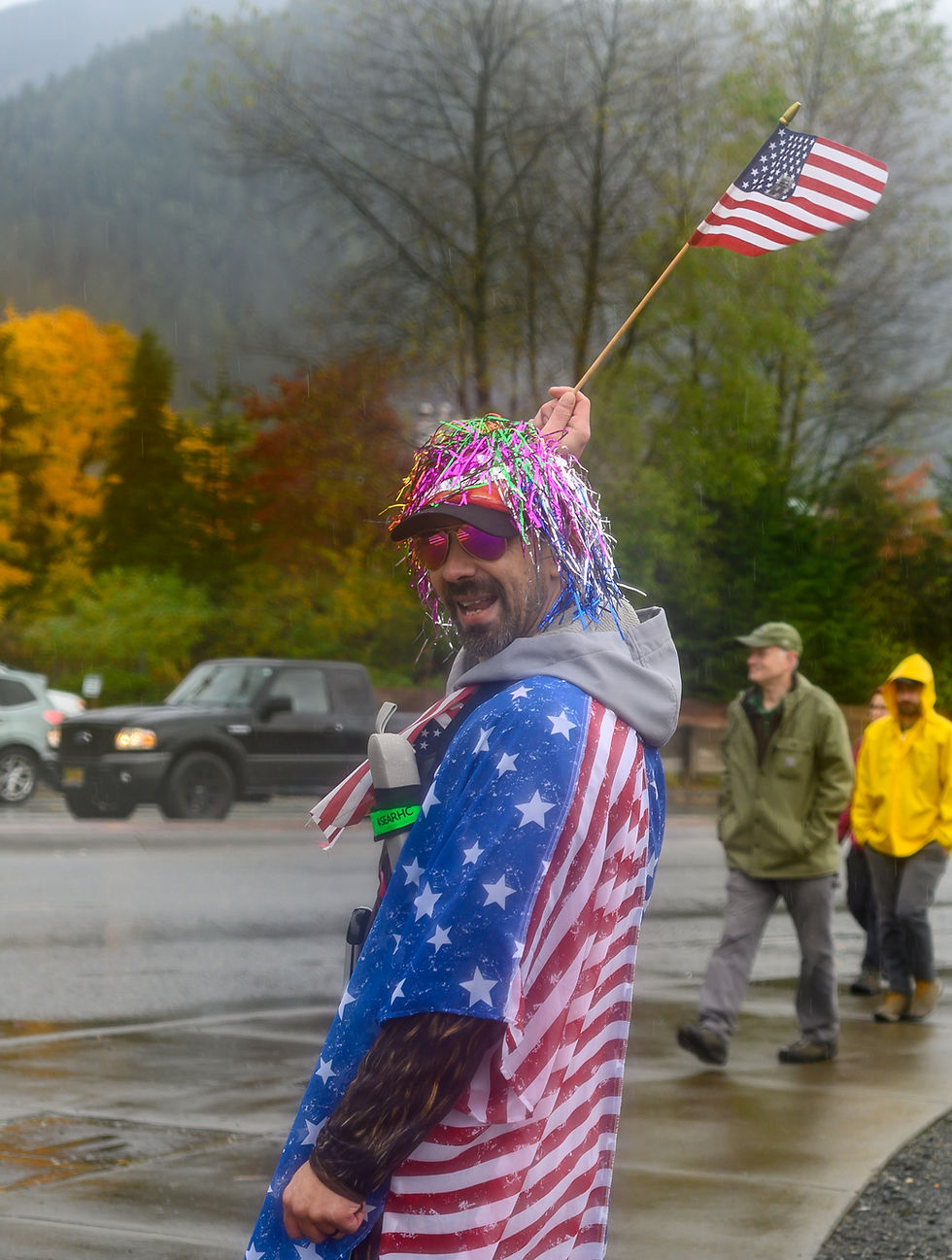
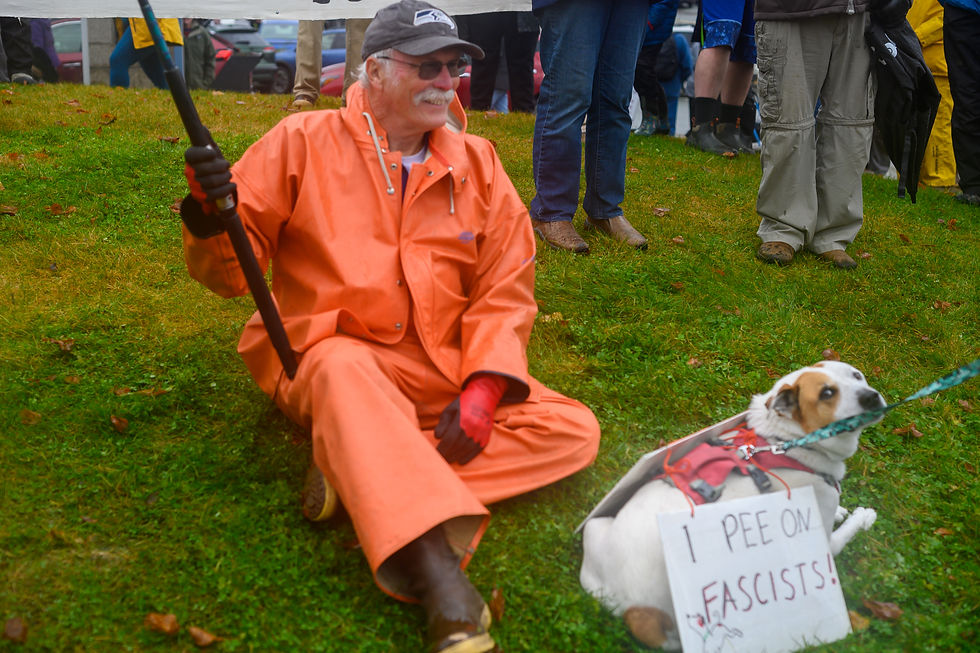
“No Kings” protests across the country have been called “anti-American,” but Juneau’s event of more than 1,000 people was described as “a happy, loving, joyful, music protest.”
It was one of 16 other similar protests in Alaska on Saturday, according to the official No Kings website. The map also shows events occured in different countries. More than 2,000 people attended the Anchorage protest, according to the Anchorage Daily News. More than 2,600 nonviolent demonstrations were planned across the country, and millions turned out Saturday to protest the Trump administration, the Alaska Beacon reported. Groups of people in Juneau were coming and going during the hour-and-a-half rainy event, making it likely the rally broke its summer attendance record.
Juneau Indivisible organizer Gina Chalcroft said “No Kings” was not a hate protest.
“The hate America protest happened on Jan. 6, 2021,” when a mob of President Donald Trump supporters attacked the U.S. Capitol, she said.
Chalcroft said the Aug. 15 Trump summit in Anchorage with Russian President Vladimir Putin was a stark reminder that Russia once controlled this land. She said the title “No Tsars, No Kings” was chosen for Juneau’s rally to celebrate Alaska “no longer being under control of either.” On Friday, a Kremlin envoy, Kirill Dmitriev, proposed a “Putin-Trump” rail tunnel under the Bering Strait to connect eastern Russia and the state, suggesting billionaire Elon Musk could build it.
Juneau for Democracy member Aaron Brakel opened the protest, acknowledging it was held on the land of the Áak’w Kwáan and T’aaku Kwáan.
“Alaska Day, among other things, symbolizes the colonial transfer of a European claim of unceded Indigenous lands from the Russian Empire to the United States,” Brakel said. “And we want to acknowledge that Alaska is Indigenous land of the many Alaska Native peoples.”
Like other anti-Trump protests held earlier this year by organizations Juneau Indivisible, Juneau for Democracy, and the ReSisters, Saturday’s was mellow without conflict. Speakers encouraged peaceful, non-violent action. Chalcroft said even though U.S. Speaker of the House Mike Johnson called the protests anti-American, “No Kings” was a chance to exercise First Amendment rights.
The event also offered voter registration, information on protesters’ rights, and accepted donations for the Southeast Alaska Food Bank.
Chalcroft said the protests were not to change anyone’s mind — “these protests are for us.” She said freedom of speech was supported, but if it became confrontational, attendees were encouraged to find “crowd support.” Seven members of a safety team trained in de-escalation were on standby, identified by their bright yellow vests.

Gerry Donohoe arrived at Bill Overstreet Park at about 12:30 p.m. carrying a sign that read “We Are All Immigrants.” He is retired from the U.S. Coast Guard with 24 years of service in the Caribbean, “fighting the drug war down there.” He said he knows all of the rules of engagement for chasing drug smugglers.
“What our military is doing right now is just so illegal,” he said. “It’s just crazy that we’re killing people out in the international waters off of Venezuela, that we’re taking over the cities with our U.S. military. That is all illegal, and it seems like the courts are doing their best to try to stop it, but we, the people, cannot be silent about it.”
Donohoe said the National Guard is not meant to act against people protesting the government. The Alaska National Guard is currently assisting Western Alaska flood victims after the devastation of Typhoon Halong. Directions on how to provide relief to Western Alaska were provided at the rally.
Citing research by Harvard University, Donohoe said he believes protesting helps. For example, it takes 3.5% of a society to protest “before a regime is brought down,” Donohoe said.
Holding an upside-down American flag, Sitka resident Kenneth Rear watched the protest from the Douglas Bridge over Gastineau Channel. Calls to “care for each other” and “take action” could be heard from the rally below as cars whizzed by him — some people honked and waved in support, and others yelled in anger. One person told him to go back to Seattle. Rear said he was born in Juneau and was visiting after moose hunting up the Taku River, where his family has a subsistence cabin.
“I realized some people are offended by the upside-down flag and I didn’t want to bring unnecessary angst to the No Kings protest,” Rear said when asked why he didn’t join the protest below. “I turned upside down the flag at the state Capitol this morning so the state troopers might be looking for me.”
Rear said an upside-down flag is a known symbol of distress.
“We’re not living in a constitutional republic right now,” Rear said. “Donald J. Trump is illegitimate, in violation of our Constitution, and he’s violating the Constitution right and left, on a daily basis, including murdering people with the United States military and international waters with drone strikes. He’s committing acts of war against Venezuela and all kinds of unidentified people. I don’t believe that they even know who those people are that they’re killing.”
By Saturday evening, the flag across from the Alaska State Capitol was turned back up by Brad Rider, according to a social media post by Suzanne Downing. Rear said the U.S. Forest Service fined him hundreds of dollars this summer for turning the Sitka National Historical Park’s flag upside down on Flag Day.
“I want people to think about why they love the flag so much, why they love America so much, and whether we still have that country,” he said.

Retired Alaska Superior Court Judge Philip Pallenberg said the most crucial event is the next election, which is just over a year away. He encouraged the crowd to support candidates for the House and Senate who will uphold the U.S. Constitution and “not blindly support Donald Trump in violation of their oath.”
Pallenberg pressed people to be politically active and continue attending rallies in ever-increasing numbers.
“It may come down to one person, a general, a judge, or even a business leader, needing to find the courage at great personal risk, to say ‘no’,” he said. “That courage will be easier to find if that person knows that they have millions of you behind them.”
Brakel said it was important for the protest to hold space for people to step up and share their unique concerns and perspectives. After six scheduled speakers and a singer, the rally shifted to an open-mic format. Songs and poetry were encouraged. The crowd sang along and cheered.
“These are the real circumstances and challenges of our times,” Brakel said in an interview. “We need to work with each other. That’s why we wanted to hear from people. Everybody sees things from different pieces. There’s so much going crazy and going wrong…that we can’t track all of it.”
Bre Andersen said she felt “a fire” that made her speak for the first time at a protest.
“Whatever you guys are doing now and whatever we decide to take a stand against now will impact our future generations,” Andersen told the crowd. “And we see it. We are paying attention. We are trying to make sure that everyone is also paying attention. And not only that, I’m here as a disabled person and from an immigrant family. I am from a first-generation immigrant family and they fought to be here. They have gone through all of the horrible processes to get here, through lottery system, to just exist here.”
Andersen said, “We all have a story and that’s what our power is as people.”
In an interview, Andersen, who is on chemotherapy, said she is scared to lose insurance coverage. As a University of Alaska Southeast student who works full-time, she said she wanted to show her young peers that they can take action even if they feel tired and unable to enact change. She said even one person can make a difference by talking.
“If I can get up there and still do something, then so can everyone else,” Andersen said. “And I think it’s especially just important to me to see minority groups represented.”
• Contact Jasz Garrett at jasz@juneauindependent.com or (907) 723-9356.





_edited.jpg)



.png)

.png)