.png)

Juneau’s top 10 stories of 2025

Flood successes and election setbacks for local leaders; advancement of long-discussed projects on land and at sea; protests of local and federal actions among highlight headlines

By the Juneau Independent staff
The primary criteria for the top 10 stories is: What had the greatest impact on the greatest number of people?
There are other considerations — hypothetically speaking, a plane crash that killed 20 people would clearly be a historically significant event. But as noted in our story about the Juneau Independent’s 10 most-read articles, what’s most newsworthy isn’t necessarily the same as what gets the most web clicks.
One quirk of those "other considerations" is we published a list of "Juneau’s 10 strangest stories of 2025" on Dec. 28 — and noted that we didn’t include any stories there that would also appear in the list of the 10 biggest stories. However, that was the second day of what turned out to be a historic five-day storm that wreaked havoc far beyond what was anticipated at the time. As such, we present the following without a numerical ranking:

Five days of record snowfall and a monthly record of 82 inches that obliterated the old record of 54.7 inches set in 1964. Five days of below-zero temperatures — including four new daily record lows during a five-day period.
The results were dire in many ways for Juneau during the holiday season. Boats and their shelters sank, roofs at businesses collapsed, water pipes burst and froze, and residents in Juneau and elsewhere in Southeast were isolated — either unable to get vehicles unstuck on unplowed streets, or cut off from flights and ferry service for extended periods.
City street crews, public safety officers, power technicians, harbor staff, airport maintenance and others worked around the clock during the most intense of the storms that began on Dec. 27 and continued through New Year’s Eve. But they were unable to keep pace as Juneau received more snowfall during the storm than any previous five-day period in recorded history with locations out the road north of Auke Bay reporting more than six feet of accumulation.
While the storm lifted on the final day of 2025, the threat remains high for many residents who are worried about clearing several feet of snow from roofs before additional snow and/or rain causes them to collapse. Advisories of avalanche risks are also being issued by the city.
Amidst the heavy burdens residents shouldered, some lighter and uplifting moments occurred. Many people with equipment and the ability to dig helped neighbors who couldn’t, and plenty also earned some extra holiday cash by offering their shoveling services. For those able to dig their way out, the epic snowfall made for memorable skiing, sledding and snowshoeing, and tourists in town for the holidays returned home with Alaska tales for the ages.
Now then, counting down to number one, are the official top 10 news stories in Juneau for 2025:

A $28.5 million contract was signed in July for the first phase of work on another ship-related project discussed for years. The new state ferry terminal at Cascade Point about 25 miles north of the current Auke Bay Ferry Terminal has raised concern among some officials and Juneau residents.
A state study declares the new terminal won’t be a net plus for travelers or the Alaska Marine Highway System. But the study asserts the project will be a boon for a new gold mine nearby that will be able to ship ore from the site, as well as Goldbelt Inc.’s prospects as the owner of the property where the terminal will be located.
"The extensive capital costs of the Cascade Point terminal are difficult to justify based solely on operational cost savings," the study notes. "In isolation, the project provides modest reliability gains and reduces emissions but also introduces new infrastructure responsibilities and long-term maintenance obligations."
"However, the project’s perceived value increases when broader considerations are taken into account," the study adds. It further asserts "the decision ultimately depends on how much weight policymakers assign to social value, long-term resilience, environmental considerations, and system-wide efficiency."
Further questions were raised when the state signed a $1.3 million contract with Juneau Hydropower to provide power to the new terminal — even though both the terminal and power station are still officially in the proposal stages. The state has indicated it will pay the company even if the terminal ultimately isn’t built.
Public comments are being taken until Jan. 9 about the current phase of the project. State transportation officials have said they’re hoping construction can begin this summer and be completed by 2027, with additional facilities possibly constructed in future years.

A long-sought icebreaker the U.S. Coast Guard will homeport in Juneau made its official debut in the city in August. While officials hailed the ship as the launch of a new era for Alaska’s capital, the hype is for a potential reality that won’t occur for at least a few more years.
The Storis, named after a previous Coast Guard icebreaker stationed in Juneau after World War II, made a splash at its commissioning ceremony Aug. 10, following a couple of days of public tours that attracted immense interest just before it set out for an inaugural 112-day patrol further north. It is now in Seattle for the winter, undergoing upgrades that are expected to take several years to complete between summer deployments in Alaska.
The headline claim of officials who worked to obtain the vessel, including U.S. Sen. Dan Sullivan (R-Alaska), is up to 190 personnel and 400 of their family members may eventually be permanently stationed in Juneau. That prospect is factoring into the discussions and actions of city leaders on issues ranging from housing to schools.
The Storis is a 360-foot-long repurposed, repainted and renamed ship built in 2012 as an oil service vessel for a private company. Both Coast Guard and political leaders acknowledge that means the Storis has limited capabilities — even with the upgrades — and is serving as a fill-in vessel until newer and more capable icebreakers are built.

Turning a neighborhood with Juneau’s oldest home into something else has been pondered by state and local officials for more than four decades. But the starter’s gun on redeveloping the neighborhood was fired this year when the Assembly approved evicting the residents renting homes there, along with initial funds for demolishing the structures.
Nearly all of the tenants moved out by a Nov. 1 deadline, but people in two of the homes who contested their evictions in court were still living there as of Dec. 31. However, people in one home have been ordered by a judge to move out by Jan. 21, and the dispute involving the occupants of the other house is about moving out either Jan. 21 or Feb. 21.
A few longtime Telephone Hill residents, including some challenging their evictions, filed a civil lawsuit against the city, claiming the redevelopment plan is illegal. A trial in the case isn’t likely until summer, but city officials have said they may continue with their demolition plans before then — barring an injunction by former residents that prevents such work.
The plan approved by the Juneau Assembly calls for building four mid-rise apartments with 155 total units. City officials said the evictions are needed now so the existing homes can be examined for hazardous materials before demolition occurs, with the hope of beginning redevelopment work this summer. One key motivation for the project is the homeporting of the Storis icebreaker, since the U.S. Coast Guard facility is a short distance away and thus would make Telephone Hill convenient for employee housing.

The capital city may soon have seven cruise ship berths, so it’s time to start considering tourism growth beyond the current voluntary five-ship-a-day agreement with the cruise industry, according to some municipal leaders.
A private two-berth cruise port Goldbelt Inc. is proposing on land it owns along the west side of Douglas Island, with a target opening date in 2028, is expected to drastically shift Juneau’s tourism season. Either a large percentage of existing passengers (a record-high 1.7 million in 2025) will be directed from downtown to the remote site if a five-ship agreement remains, or the city will face the prospect of an additional 500,000 passengers and seven ships.
"Even with current visitation limits in place through 2027, additional berths signal future growth," Jill Lawhorne, community development director for the City and Borough of Juneau, wrote in an October memo to Juneau Assembly members. "Infrastructure capacity must be evaluated to match potential increases in visitors."
The private port, named Goldbelt Aaní, is expected to host Royal Caribbean ships at a stop that will feature a replica 1800s Tlingit village, flight and dayboat tours, and other visitor attractions. Goldebelt has stated it may also be the first stage of more extensive development on its property along the island coast.
Among the concerns of city leaders, who were caught off guard when the project was first announced in the fall of 2024, is the impact the development will have on nearby Douglas residents, and how emergency response and other public necessities will be addressed.

A violent police incident filmed on a citizen’s cell phone sparked an uproar that resulted in the forced resignation of the officer involved and policy changes by the Juneau Police Department.
Brandon LeBlanc, a 17-year law enforcement veteran, was filmed violently throwing Christopher Williams Jr. onto a sidewalk outside the Douglas Public Library on July 30, causing head injuries that knocked Williams unconscious and resulted in him being flown to an Anchorage hospital for treatment of skull injuries.
City and tribal government leaders quickly issued statements denouncing the incident. LeBlanc resigned at JPD’s request on Aug. 28, one day before bodycam and dashboard camera video of the encounter was released publicly.
LeBlanc said his actions were justified because he was making instant decisions in a potentially life-threatening situation, and a state investigation determined no criminal charges were warranted. Williams filed his lawsuit in November, asserting CBJ "failed to reasonably hire and/or train and/or supervise Officer LeBlanc, which was a substantial factor in causing harm to the plaintiff." The lawsuit is still pending.
JPD, after conducting an internal review of the incident and department policies, determined, among other things, that it would clarify procedures for requesting priority medical responses for unconscious persons and meet with tribal officials to discuss improving interactions with Alaska Native residents, Police Chief Derek Bos told Assembly members.
The person who filmed the incident, Ibn Bailey, said his intent — rather than exposing the officer’s actions — was to show racist behavior toward him as a Black person. The incident began when Williams’ fiancée, Marisa Didrickson, was arrested for alleged aggressive actions toward Bailey. As of Jan. 1 there is no case against her listed in the Alaska Court System’s database.
Bailey said he felt protected by the actions of LeBlanc and another officer who responded to the scene.

There were rumors of ICE raids, but none in reality. There were large-scale protests, but the National Guard didn't occupy the streets to stop them. The Mendenhall Glacier Visitor Center lost virtually all of its staff in February, but Juneau’s most popular tourist attraction managed to get enough support from Discovery Southeast and cultural ambassadors from the Central Council of the Tlingit and Haida Indian Tribes of Alaska for the 2025 season.
Major impacts to the lives of Juneau residents occurred as a result of President Donald Trump returning to the White House for a second term on Jan. 21, but generally they didn’t match the scale of the biggest events making national and global headlines.
Federal workers went without paychecks during a 43-day shutdown that also saw people cut off from food assistance benefits. Nonprofits and Alaska Native entities saw grant funds eliminated. Some refugees from other countries fled in fear despite being in the country legally, fearing revocation of that status and/or being detained regardless. Diversity, Equity, and Inclusion were sidelined by the University of Alaska Southeast and the Juneau Arts and Humanities Council in an effort to retain federal funding.
More substantial impacts may lie ahead in 2026, such as residents unable to afford skyrocketing health insurance premiums, and to the benefit of some, like mining interests, with projects that may get a boost from Trump’s mandates to eliminate restrictive regulations. But since those — like the "what if" fears expressed about things such as immigration raids — remain only possibilities, the cumulative impacts of Trump on Juneau in 2025 merit this spot on the list.
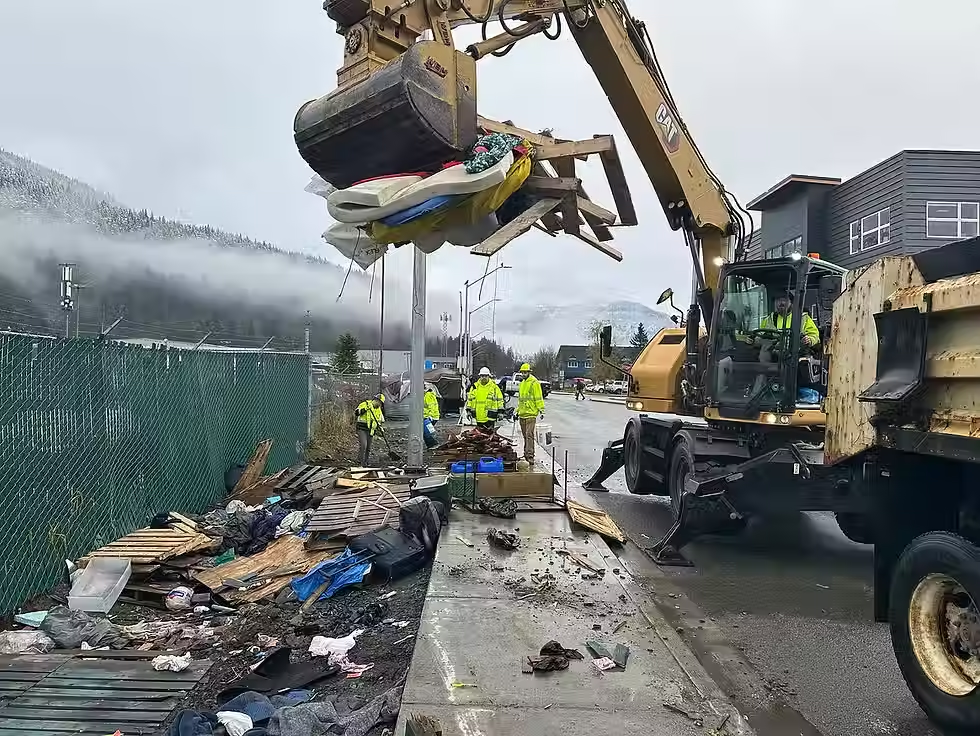
Juneau’s second year in a row without an officially designated campground for people experiencing homelessness was in many ways similar to the first — meaning difficult for everyone affected.
A new policy went into effect, allowing the Juneau Police Department and/or other City and Borough of Juneau officials to dismantle homeless encampments after providing a 48-hour advance move notice. A large encampment was dismantled on Teal Street in mid-June, but people began returning once a three-day vacate period ended and officials ultimately allowed the tents housing a few dozen people to remain until snow arrived in November.
But that caused problems for the Glory Hall, a homeless shelter in the middle of the block within the encampment, which in August ended daytime meals and services to non-residents due to safety concerns about people working and staying at the shelter. The Glory Hall reopened for daytime access in December after installing an extra security door at its entrance.
A cold-weather emergency shelter is open in Thane for the third consecutive year between Oct. 15 and April 15. But many people are continuing to camp at scattered sites around town, despite hardships imposed by the record cold and snow that arrived with winter.
3. Alaska Legislature overcomes two vetoes by governor to enact $700 increase in per-student funding

The first major increase in education funding in well over a decade occurred in two stages during 2025. The first step occurred when the Alaska Legislature overrode a veto by Gov. Mike Dunleavy to pass a $700 hike in the existing $5,960 Base Student Allocation in May. Next, after Dunleavy did a line-item veto of $200 of the increase when he signed the budget in Juneau, state legislators again overrode his action during a special session in August.
The increase was at or near the top of the priority list for legislative majorities during the past few years, with advocates saying largely flat funding since 2011 has seriously eroded the finances of districts due to inflation. The Juneau School District cited flat funding — along with poor accounting practices by a former employee — as a core cause of the district’s worst-ever financial crisis when it had a multimillion-dollar shortfall in 2024.
A series of cuts and school consolidations by Juneau’s school board helped resolve the crisis, but members again were facing staffing shortages, neglected maintenance and other funding issues in drafting the district’s budget last year. Among the restorations made when the Legislature overrode the governor’s budget veto in August was a universal free breakfast program for students.
Dunleavy said he vetoed the funding increases because his policy demands, such as more support for charter schools and allowing students to enroll at any district in the state regardless of their hometown, went unaddressed. The Legislature, as part of the bill passed in May, established an Education Funding Task Force with the stated intent of studying such policies throughout the coming year.
Education officials in Juneau and elsewhere also expressed considerable concern in 2025 about another Dunleavy administration proposal that would restrict funding municipalities can give to districts. That proposal, which purportedly would take effect July 1, 2027, is scheduled to get further consideration by the state board of education early this year.

Juneau set a glacial lake outburst flood record for the third straight year in August, with the Mendenhall River cresting at 16.65 feet, compared to 15.99 feet in 2024 and 14.97 feet in 2023. But unlike the past two years that resulted in widespread major damage to homes and infrastructure, the impact of this year’s flood was relatively contained due to a levee of HESCO barriers placed along the most vulnerable stretch of river.
Yet there was still seepage, damage to the barriers and some homes lacking the protection. That further fueled the cries of residents and some public officials for a long-term solution to the flooding. In December, a coalition of local, state and federal officials announced an intention to study a "lake tap" project, involving boring a tunnel through Bullard Mountain so water from Suicide Basin drains more slowly into Mendenhall Lake. Initial estimates are the project could cost up to $1 billion and take several years to complete.
City leaders are still facing plenty of year-to-year challenges until a long-term remedy is in place. Hailed as a major step forward on those was an agreement the city signed in October with the U.S. Army Corps of Engineers, in which the latter will pay for a second phase of HESCO barriers that will extend the current levee in both directions. Also discussed at the same meeting was a separate buyout program for residents on View Drive — where HESCO barriers are deemed impractical by CBJ engineers due to the geographical makeup of the area — that could occur before another flood arrives next August.

Households will pay $944 less in taxes on average, but the city is facing a cut of $12 million to a $200 annual budget as a result.
That is the simplified outcome of the Oct. 7 municipal election in which voters approved one ballot measure exempting essential food and residential utilities from the city’s 5% sales tax, plus another measure lowering the cap on property taxes to nine mills instead of 12.
The sales tax exemptions began in November with some hitches in determining precisely what they applied to. The property tax cap mostly likely will take effect when a new budget passed by the Juneau Assembly takes effect July 1.
July 1 is also when most of the cuts implemented by city leaders are likely to occur, since the Assembly is opting to spend reserve funds until then in order to keep operations stable during a transition period. Members agreed during a retreat in December that public safety and infrastructure will be priority items in the coming budget, while cuts are most likely to target programs such as libraries, recreation programs and community grants.
The election also resulted in notable changes to the Assembly and Juneau Board of Education.
Two-term incumbent Assembly Member Wade Bryson, who described himself as the most conservative of the nine members, was ousted by Libertarian local business owner Nano Brooks in his third attempt at a seat. Voters supporting Brooks cited a range of actions by incumbent city leaders they were unhappy with, ranging from the redevelopment of Telephone Hill to proceeding with plans to spend millions moving to a new City Hall despite bonds for that move failing in elections the previous two years.
Three new members joined the school board in 2025, including former member Steve Whitney being appointed in May after Will Muldoon unexpectedly resigned in April, and Jenny Thomas and Melissa Cullum winning open seats in the October municipal election. The board’s president prior to the election, Deedie Sorensen, initially opted against running, but then entered the race late as an unsuccessful write-in candidate.
• Contact Mark Sabbatini at editor@juneauindependent.com or (907) 957-2306.


_edited.jpg)


.png)

.png)