


.png)

Negative job growth forecast for Southeast Alaska in 2026

Updated: Jan 3
Trump’s federal worker and budget cuts, plus continuing outmigration and low birth rates are factors in projected loss of jobs for region, according to state report

By Mark Sabbatini
Juneau Independent
Southeast Alaska gained no jobs in 2025 and is expected to see a drop in 2026, due to President Donald Trump’s downsizing of the federal government as well as a long-term population decline that has resulted in mostly flat job numbers for many years, according to a new state report.
Strong growth in cruise tourism helped the region recover from a huge drop in jobs at the beginning of the COVID-19 pandemic in 2020, according to the January issue of Alaska Economic Trends, which is published by the Alaska Department of Labor and Workforce Development. However, the growth rate has tapered off as the growth in tourists has leveled out and other economic conditions have returned mostly to normal.
"A new development last year was the second Trump administration’s push to shrink the federal workforce through the Department of Government Efficiency and various budget rescissions and cuts," the report notes. "Longer term, powerful demographic forces — declining birth rates and a moderate but persistent trend of more people moving out than moving in — continue to influence the region’s economy."
Statewide job growth in 2026 is expected to be 0.9%, down from 1.2% in 2025 and 1.8% in 2024, according to the report. Anchorage and Fairbanks are expected to see 0.8% growth this year, and the Matanuska-Susitna Borough 1.3% growth.
Gov. Mike Dunleavy has enthusiastically endorsed Trump’s agenda, which among other things includes executive orders mandating the repeal of regulations that inhibit natural resource industries such as oil drilling and mining. The state jobs report notes "while the federal administration has removed some of the barriers to possible projects, procedural steps remain — both permitting and environmental — and large projects take time."
Meanwhile, the current economic reality is less rosy since "the state receives more federal dollars per capita than any other," according to the report.
"In 2025, the Trump administration moved quickly to cut government jobs and contracts, institute tariffs, reduce immigration, and take an active role in Alaska’s resource development," the report notes. "Nationally, federal job and funding cuts have been appealed and sometimes reversed, and litigation around the tariffs is still moving through the courts."
"It will take time for the dust to settle. However, tariffs generally chill consumption as they drive costs up, and restricting immigration reduces available labor, which can also raise costs."

But the projected loss of jobs in Southeast this year also reflects a declining population trend that dates back many years and is forecast to continue for decades into the future, according to state reports. A 2024 study states Southeast Alaska’s population is expected to drop 17% by 2050, by far the most statewide.
Annual job figures for Southeast Alaska dating back to 2013 show six straight years of flat or negative job growth between 2013 and 2023, followed by a small gain in 2019 and the enormous COVID-related drop in 2020.
While a loss of jobs "is not great news," there are some reasons for optimism in the state’s report, Brian Holst, executive director of the Juneau Economic Development Council, stated in an email Saturday.
"In this case, federal jobs reductions (-100) account for the job loss in their projections for the region — which is not a surprise," he wrote. "It is positive news that private sector employment is at all-time highs in both Juneau and Southeast."
JEDC is projecting "private sector employment growth will compensate for losses in government jobs" in Juneau in 2026, Holst wrote.
"In addition to federal job losses, we may see some local government job reductions in the second half of 2026 due to CBJ budget decisions," he wrote. "The construction sector is the area we would expect to see some increases in employment in 2026, as dock/port infrastructure/facilities work by Huna Totem, Goldbelt, and the USCG may begin. There is also continued well-known demand for more housing in Juneau for current and future (think USCG) residents — which also leads us to believe construction employment will increase in Juneau."
Three industries are expected to see job growth in Southeast in 2026: construction (6.7%); health care (3.4%); and transportation, trade and utilities (1.3%), according to the state’s report. The steepest drops are expected in seafood processing (-8.3%) and federal government jobs (-7%). Mining, retail, professional and business services, education, and leisure and hospitality are among the industries forecast to see no change in job numbers.
While tourism is the region’s largest private sector employer, the Greens Creek and Kensington mines "provide nearly all regional mining jobs and are the largest taxpayers for Juneau," according to the report.
"In 2024, Juneau’s average mining wage was $136,000, making mining disproportionately important to the regional economy," the report notes. "An increasing percentage of the state’s mining jobs are held by nonresidents, however, including in Southeast. Ten years ago, 33 percent of Alaska mining workers were nonresidents; by 2024, the share had risen to 44 percent."
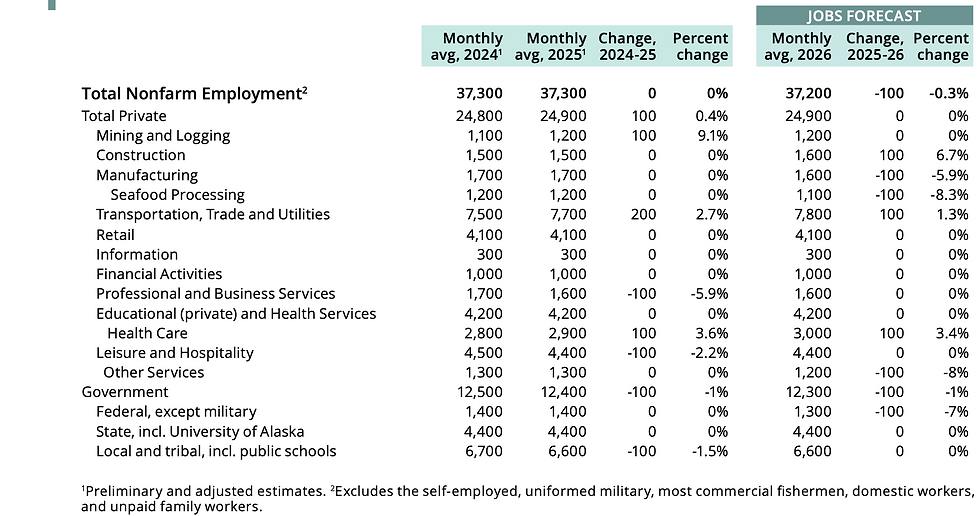
As with other resource development statewide, the report notes circumstances appear to be favorable for the mining industry — but it may take years before significant jobs and revenue are realized.
"Rare earth elements are no longer an import the U.S. can rely on, so the federal government and private mining companies are moving to cultivate domestic sources," the report states. "While no large mines are likely to open in 2026, several are under study."
• Contact Mark Sabbatini at editor@juneauindependent.com or (907) 957-2306.


