


.png)

On The Trails: Happy springtime!

By Mary F. Willson
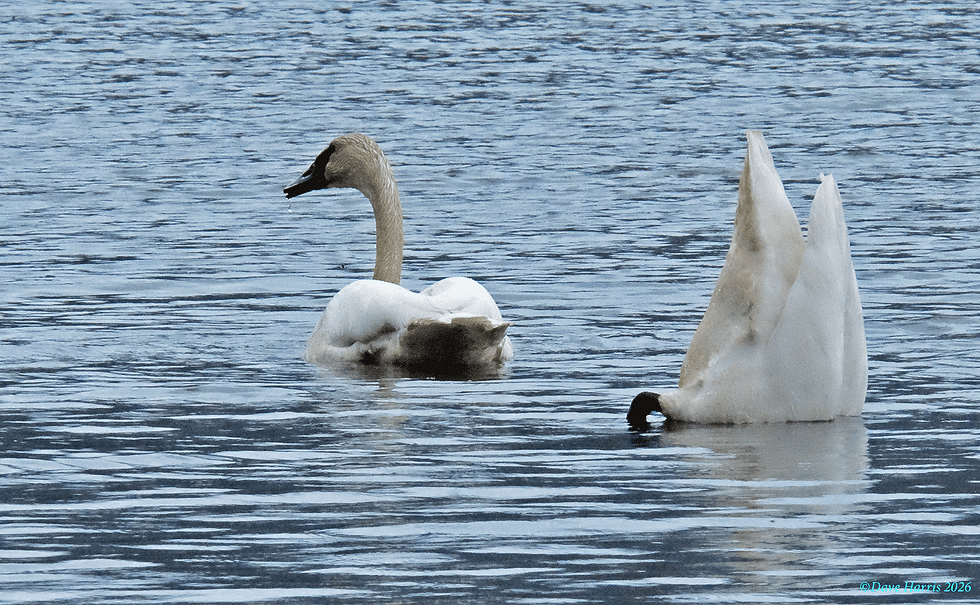
Ice-out at Twin Lakes! Some swans soon discovered the open water and quickly took advantage of the access to submerged vegetation. Skunk cabbage inflorescences grew larger, bringing their cheerful yellows to the dark grounds. Mountain bluebirds continued to show up in the wetland, delighting many of us as they head north; they are gone before the end of April.
Robins and varied thrushes are calling and singing; we see them running over the ground as they look for edibles. Bears are awake and out scrounging for food. Our heavy winter snows still cover the ground deeply in some places, which may limit the places they search.
And the ruby-crowned kinglets are here! They move through the trees, often flicking their wings. And their rollicking song is a welcome sign of spring. They winter in southern U.S. and Central America and nest in conifer forests across Canada, northernmost U.S., and in the western mountains.
Nests are typically in conifer trees, at variable heights. Although I think we often consider them to be canopy-nesters, they sometimes nest quite close to the ground; a friend found a nest at the edge of a meadow in a spruce branch that swept down low, just a little above the meadow vegetation. Females do the nest-building and incubation, males bringing food to the sitting female; both parents feed the chicks and remove their feces.

Chicks fledge when they are about two and a half weeks old; the exact timing varies. Ruby-crowns are mainly consumers of insects and spiders, occasionally taking small fruits. That ruby-crown is often concealed, to be erected and displayed during territorial defense or during courtship.
Pairs of mallards are visiting my still-icy pond, walking over the ice to reach narrow stretches of open water along the edges. They visit the fallen seeds that the siskins and juncos scatter from the feeder suspended above. A male yellow-rumped warbler regularly comes to my peanut butter feeder, perching or hovering. There could be more than one, but I only see one at a time. He has the white throat of the "myrtle" subspecies, which ranges widely over the north, hybridizing with the western "Audubon’s" subspecies, together making the yellow-rumped species. The hybrids have been seen here, but they are a bit tricky to identify precisely.
Hummingbirds are back again. They usually come a bit later to my part of the upper Valley, but I saw one recently. So I hustled up some sugar-water and filled the feeder right away. Later, there were two of them, vying for access to the feeder. Out at the arboretum, I watched a hummer visiting snowdrop flowers, which offer both pollen and nectar. There was just enough room for him to hover between the drooping flowers and the ground.
Green grass is rapidly sending up big shoots out in the wetlands. The big fat buds on the elderberry bushes are starting to open, given us a glimpse of foliage to come. The lighter green of deciduous leaves is always a welcome sight on the dark background of conifer needles.

In gardens, the crocuses are in full bloom and queen bumblebees visit the flowers for pollen and nectar. At the arboretum, those bees like the butterbur (aka coltsfoot; Petasites) inflorescences, which nestle close to the ground in a wreath of leaves (the plant later becomes quite large).
• Mary F. Willson is a retired professor of ecology. "On The Trails" appears periodically in the Juneau Independent. For a complete archive of Mary Willson’s “On the Trails” essays, go to https://onthetrailsjuneau.wordpress.com


_edited.jpg)



.png)

.png)




.jpg)