.png)

On The Trails: Snow!

Updated: Jan 5

By Mary F. Willson
One big snowfall after another! It’s a record for December: over five feet of snow are reported for some locales.
For me, it means lots of shoveling; I no sooner get the deck cleared than here it comes again — first a battering of sharp, stinging ice crystals, then a lovely cascade of big soft flakes, and then a steady fall of smaller crystals.
Of course, it also means waiting for the city plows and the hired plow-guys to clear the roads and my driveway. Sometimes the snowplow berms at certain road junctions get so big that the ability to sight coming traffic is impaired. We also deal with occasional power failures. But all that snow sure is beautiful!
For other animals that live here, the snow can mean lots of different things. Voles and shrews can nestle down in their burrows, protected from very cold temperatures by that insulating blanket. However, if freezing rain or freeze-thaw cycles make thick crusts in the snow cover, sometimes the sheltered little mammals can suffocate from a build-up of respiratory carbon dioxide that can’t escape to the open air.
Porcupines waddle over the snow, leaving body-size grooves on the surface. They stay active, but with a lowered metabolism (except when courtship starts in late winter), burning stored fat and feeding on low-grade needles and bark. They spend a lot of time in trees, feeding or hiding in dense vegetation, or in dens in hollow logs or trees.
Sitka black-tailed deer, with their long, thin legs, can’t travel over the snow. They often prefer to gather in ‘yards’ in dense tree-cover (old-growth, if they can find it), where less snow reaches the ground. There they make a trampled area almost clear of snow, with a few much-used trails leading out to feeding areas.
Moose are larger and usually more solitary than deer. They often move around, looking for willows and other deciduous trees with edible twigs. If they have to crunch through very crusty snow, the icy snow may even slice their legs with many small cuts, encouraging them to move to areas with softer snow.
Snowshoe hares, with their big hind feet, usually travel on the snow surface. Standing on the snow, they reach up to nibble the twigs of shrubs; the deeper the snow, the higher they can reach. Thick fur helps keep them warm, and they can also huddle in ‘caves’ under bent-over, snow-laden small trees or drooping, low conifer branches. Their coat color changes gradually from brown to white in the fall, an adaptation regulated by photoperiod. If all goes well, white coats develop as the snow cover grows and the hares are thus camouflaged. But photoperiod and snowfall cycles are not always in synch, and sometimes the coat colors are white well before the snow falls (or snow falls while the coats are still brown) and the hares are conspicuous. Camouflage vs conspicuousness: surely that influences the risks of predation.
Weasels, slim and agile, can travel easily in the vole tunnels, fortuitously munching on moribund voles or capturing those that are just resting. Least weasels and short-tailed weasels (ermine) get white coats in winter, but can have the same synchrony problems that hares do.

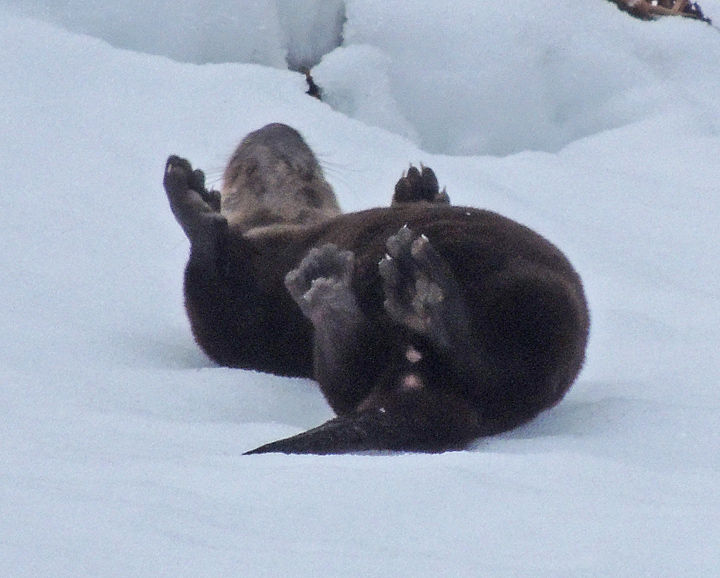
Other, larger predatory mammals keep their dark-colored fur and most can travel over or through the snow. Wolves may travel far; if they find a deer yard, havoc ensues. The deer try to escape, often failing, in the deeper snow and the wolves then have a feast — maybe enough to keep them happy for several days. River otters come out of the water, sometimes sliding for long distances over the snow surface, facilitating their travel. They also come out onto the snow to romp and roll, perhaps for fun.
All that snow covered up many of the food sources for small birds, which may have to make wider-than-usual searches. For example, a wren was observed to dive into a snow tunnel and "swim" back up the surface a few feet away and a song sparrow was seen to do some snow-diving. Wayward or wind-blown arthropods (springtails, certain midges and other flies, spiders, etc.) are easy marks on the snow and they lurk in moss and under lichens. Although trees may be blanketed in snow, some of their bark crevices, needle-clusters, or mosses remain accessible to nuthatches and chickadees, to search for dead or resting insects, or draw from some of their seed caches. Seed-eaters get an occasional temporary bonanza from an alder tree with ripe cones. Some of the more agile ones, such as siskins, winkle out the seeds directly from the cones; that activity in the canopy loosens more seeds, which fall to the snow, accessible to the less-agile ones (e.g., juncos, song sparrows). Crossbills may raid the stash of spruce cones owned by a red squirrel.
Ravens cruise around the snowy landscape, looking for carrion (hunter-killed or dead of starvation). Or they head for the beaches, where low tides expose small edible critters or where they can fight the gulls for washed-up animal carcasses. For ravens, the snow is also a playground, good for tobogganing down slopes and skirmishing with each other.
Thanks to Kathy Hocker and Bob Armstrong for helpful consultation.
• Mary F. Willson is a retired professor of ecology. "On The Trails" appears periodically in the Juneau Independent. For a complete archive of Mary Willson’s “On the Trails” essays, go to https://onthetrailsjuneau.wordpress.com.


_edited.jpg)


.png)

.png)