


.png)

View Drive residents’ best option to fight the flood may be to move

Updated: Aug 16, 2025
If homeowners decide to opt in, it would be Alaska’s first buyout project under the Emergency Watershed Protection Program
By Jasz Garrett
Juneau Independent
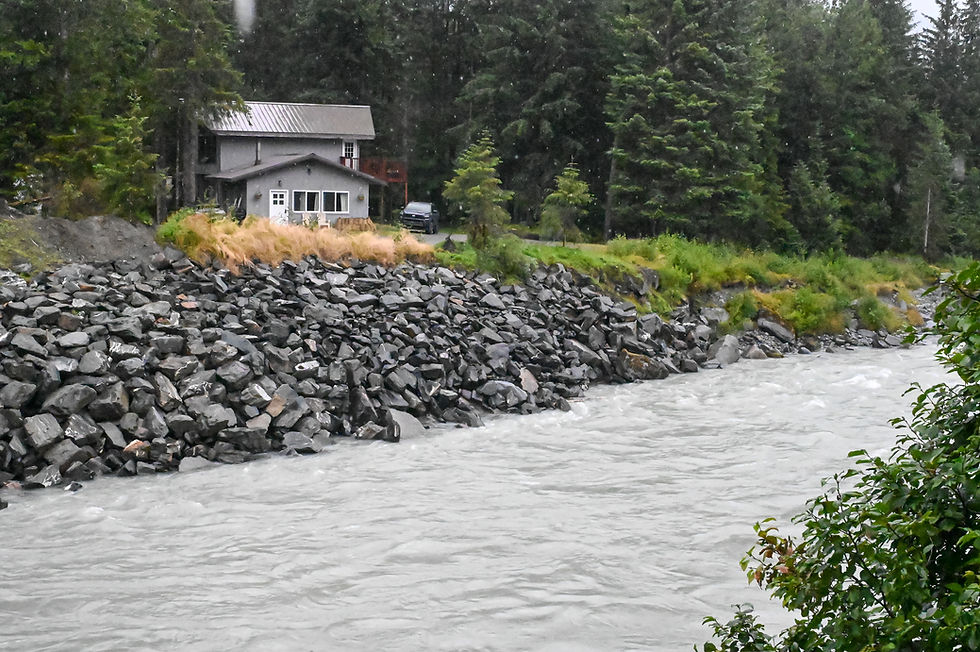
Miles of HESCO barriers were installed earlier this year along the Mendenhall River as a semi-permanent levee against Juneau’s jökulhlaup. As some Mendenhall Valley residents wonder how well the temporary solution will protect their homes, those on View Drive may consider abandoning theirs permanently.
“We feel crippled because the city is not acting to support us,” Elizabeth Figus, who lives in the neighborhood, said.
Phase One of the two-mile HESCO installation, beginning at upper Marion Drive and ending at Rivercourt Way, was completed in May. Shortly after, the Juneau Assembly unanimously decided to extend the barriers another mile downstream to protect city and school properties. Another extension to Brotherhood Bridge could be considered next year, according to City Manager Katie Koester.
But upstream, View Drive residents whose homes have flooded in the past wondered why they weren’t part of the conversation.
Figus asked city officials why View Drive couldn’t be feasibly protected and what options were available.
During the design process, the HESCO barriers were found to be impractical in the neighborhood, according to city engineers and the U.S. Army Corps of Engineers Emergency Management Program. The levees require a specific height and width to be effective, but many properties on View Drive lack sufficient space, as well as room for a service road.
Minor yard flooding on View Drive begins at a 10-foot flood stage according to the Juneau Glacial Flood Dashboard. At 11 feet, yards flood up to one and a half feet of water, and at 13 feet, one to two feet of water is projected to flow inside some homes.
At 14 feet, more homes see moderate to major flooding. At the water stages experienced in the last two years, there is major home flooding.
“For mitigation and preparation for this season, we recommend some resources from FEMA and the state, as well as from the city,” said Ryan O’Shaughnessy, emergency programs manager for the City and Borough of Juneau.
O’Shaughnessy said residents are advised to use the National Flood Insurance Program and CBJ’s Emergency Flood Response page.
“We do encourage all residents who are in the flood zone, when the basin begins to release, that they evacuate,” he added.
After recognizing the HESCO strategy is likely to be ineffective, View Drive residents requested CBJ initiate the Emergency Watershed Protection Program (EWP).
The city and the Central Council of the Tlingit and Haida Indian Tribes of Alaska asked the National Resources Conservation Service (NRCS) to initiate EWP, which is intended to relieve imminent hazards to life and property caused by a natural disaster.
Usually, the program has to be requested within 60 days of a disaster, but NRCS granted the request for a waiver.
NRCS State Conservation Engineer Brett Nelson met with View Drive residents, as well as city and tribal officials, on July 9.
“They’re doing their due diligence,” he said. “They know they’ve got problems with these jökulhlaup events, and they're doing the smart thing. They're trying to explore all the possible options that they have in front of them to consider so that they can make an informed decision as to what course of action is best for their particular situation.”
The next step is for a damage survey report to be completed, which Nelson said his team plans to submit by Aug. 21. The water level in Suicide Basin is expected to be full on about Aug. 12 and a release resulting in a glacial lake outburst flood typically occurs within days after capacity is reached, according to National Weather Service Juneau.
The survey will outline options available through the Emergency Watershed Protection Program.
Nelson said the survey is likely to recommend buyouts for the 20 View Drive homes, many of which have flooded repeatedly in the past — even before the jökulhlaups were recognized to widely threaten public safety.
“There aren’t any other obvious good solutions,” he said. “The EWP program cannot pay to elevate the houses. We cannot pay to build a big floodproofing dike around the neighborhood. The Corps and CBJ took a look, and they decided they couldn't protect the neighborhood with the HESCO baskets, or they couldn't realistically do it, at least. And so that’s ultimately why we're talking about buyouts. Now we’re well aware that in most cases, buyouts aren't the preferred solution, but sometimes they're the best solution. And I think this might be one of those cases.”
He said he recognizes it’s not an easy decision to make.
Nelson said the option for buyouts through EWP was relatively new for Alaska last August, shortly after a record-breaking 16-foot flood struck Juneau.
“The city wasn’t aware that it was an option,” he said. “We weren’t really pushing that as a solution because at the time we were working with the city on which eroding banks needed to be fixed.”
He added that the assumption was “everybody can be protected by the HESCO, so there won’t be a need for this buyout.” For decades, NRCS has completed projects that relocate houses to a safer area, but this would be the first buyout project through the EWP program for Alaska.
Other states do similar projects, like Kentucky, West Virginia, and Louisiana.
“Those states typically use them like in areas where there’s just repetitive damage,” Nelson said.
“Juneau has it really bad, because you guys are going to be hit every year, maybe even twice a year, where some of these other areas, they might only get hit every four or five years, but that’s just too much,” he said.
The damage survey report determines program eligibility and is the funding request document if CBJ chooses to move forward with buyout sponsorship. Nelson said he believes the project will be eligible and it will be sent to national headquarters for funding.
Once the project is federally funded through the EWP program, an estimated cost will be presented to the buyout sponsor, which is likely to be the city and/or the tribe. The sponsor would be responsible for 25% of the cost.
The project cost would take into account the estimated values of the homes, demolition costs, remediation of properties, and environmental restoration.
“It’s really important to note that after this point, if this project agreement was signed and funds were appropriated by the project sponsor, who is yet to be determined, the homeowners would then be able to view an appraisal of their property, and at that point they would determine whether or not they wanted to opt in or opt out of this program,” O’Shaughnessy said. “It’s completely voluntary.”
Total project costs could fluctuate depending on homeowners’ decisions. Nelson said in some cases, when enough people opt out, it means the project is no longer eligible.
“If four of the 20 properties decided to participate, I need to make a decision on, ‘Does that accomplish the goals of the program? Does that constitute a technically feasible, beneficial solution?’” Nelson explained.
If only a few homeowners choose the buyout route, he said it is still worth it, because the goal for View Drive is to mitigate flood damage.
Opting into the buyout program would mean the property becomes a hazard, and it can never be redeveloped.
“The whole purpose of the EWP buyout project would be to try and keep development out of the floodplain, so that flood damages aren’t worsened for other residents, and also keep flood damages from occurring on these houses that are in the floodplain,” Nelson said.
The project sponsor, likely to be the city or tribe, could choose what was done with the properties as long as no permanent structure is built. Nelson said it would be OK if people wanted to use the area for a walkway along the river, for example.
Supplemental appropriations from Congress fund the EWP program. This means there is not a set amount of funding in any given year. When the program runs out of money, a supplemental appropriations bill is passed.
For this current fiscal year, the agency has been granted authority to spend $964 million. It carried over a balance of $44 million from last year and was given $920 million in new appropriations. To date, $750,000 (0.1%) of the total $964 million has been obligated.
Once the project is submitted on Aug. 21, it is not a national competition for the federal funds. If it is deemed an eligible project, it will be funded. If the program is out of money, the project will go on a waitlist.
When funding becomes available, the project should be completed within 220 days. Because these are real property transactions, Nelson said that timeframe could be challenging. He said it would be more realistic for this project to take up to a full year, and an extension could be filed.
Nelson anticipates a View Drive project would be a consideration for the city, tribe, and residents, because it’s uncommon for a project he finds eligible to be overruled at national headquarters.
“If the property is at imminent risk, if it’s creating an imminent risk to life or property, (and there is) the threat of a future event, then they’re eligible,” he said.
Though View Drive would be a specific project, Nelson said another neighborhood could make a similar request through the EWP program. A future request would have to come from a qualifying sponsor, which can be any legal sub-unit of government or federally recognized tribe.
“Let’s say another neighborhood gets badly damaged in this year’s flood, they can request another project, and it could be done somewhere else,” he said. “Hopefully that doesn’t happen.”
• Contact Jasz Garrett at jasz@juneauindependent.com or (907) 723-9356.


