.png)

34th Alaska Legislature ends regular session after passing dozens of bills on final day; special session on gas line starts Thursday

Budget with $1,200 dividend for residents, omnibus bills on crime and education among items passed; public employee pension, election reforms among those falling short

By Mark Sabbatini and Ellie Ruel
Juneau Independent
The 34th Alaska Legislature ended on a productive note by passing a barrage of bills Wednesday before adjourning a few hours before the midnight deadline. But lawmakers will return Thursday for a special session focusing on a natural gas pipeline, one of the biggest things that didn’t pass.
The Senate adjourned first at 7:58 p.m. Wednesday upon a motion by Sen. Lyman Hoffman, D-Bethel, who is retiring as the longest-serving member in the history of the Alaska Legislature after serving since first being elected to the House in 1978.
"Mr. President, on my and my wife's 54th anniversary, I move and ask unanimous consent the Senate of the 34th Legislature adjourn sine die," Hoffman said.
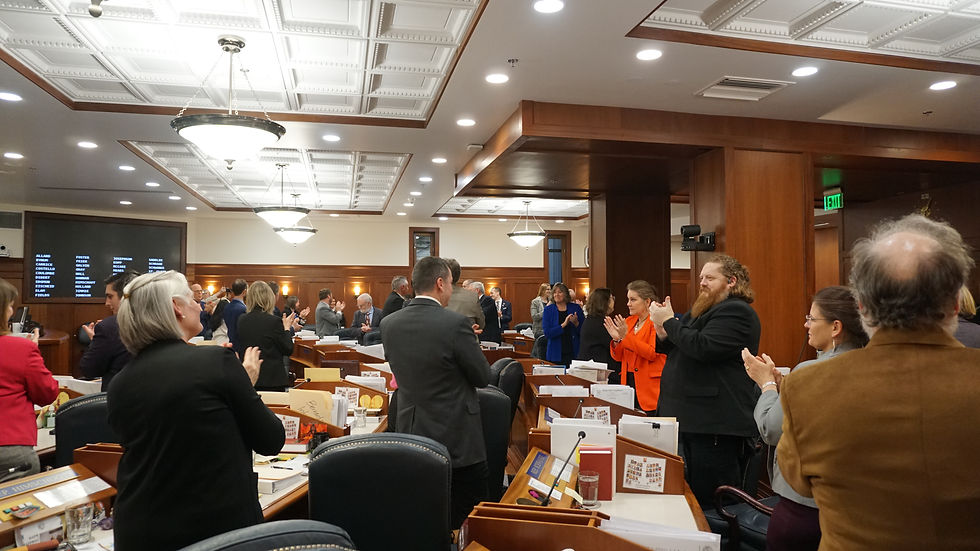
Senate President Gary Stevens, R-Kodiak, who is also retiring after this session, declared the Senate adjourned, to applause from the lawmakers, staff and visitors in the chamber.

The House convened for the final time at 8:52 p.m. for final passage on three bills before a series of speeches by legislators offering congratulations and thanks — and some emotional farewells by legislators who are departing.
"Time passes — believe me, time passes," Rep. Dan Saddler, R-Eagle River, said during a tearful announcement of his departure after serving a decade in office. "There are no indispensable men or women, and it is time for me to find out what life is like outside the grind of campaigns and fundraising, and organizations and caucus formations, and subcommittees and committees, and prayers, pledges and daily calendars — and, Lord help us, special sessions, even when they're not that damn special anymore."
Rep. Andy Josephson, D-Anchorage, who is also among those retiring after serving for the past 13 years, motioned for the adjournment of the House at 9:43 p.m.
Among the legislation getting final passage on Wednesday was a roughly $13 billion operating budget that includes a $1,200 payout for residents eligible for Permanent Fund dividends, a crime package that combined about 10 bills on a wide range of legal matters into a single piece of legislation, and an education "mini-bus" bill with funding boosts and policy changes.

Leaders in the House and Senate majority caucuses, both of which consisted of bipartisan coalitions, cited significant increases in public education funding and passing a bill reviving pensions for public employees as some of the major accomplishments of the two-year session.
But the Legislature had to override a veto by Republican Gov. Mike Dunleavy to get last year’s education increase and lawmakers failed this week to override his veto of the pension bill. They also failed to override his veto of an elections bill that also combined proposals orginating from a large number of lawmakers.
"We did our best and we passed the bills, and that's all we can really get," said Senate Rules Chair Bill Wielechowski, D-Anchorage. "It's out of our hands at that point. We passed with overwhelming margins, (but) we just came up on the pension bill a few votes short, in the elections bill a few votes short, but we worked hard on those. We passed what we think were bipartisan fair bills, and it's for a future Legislature to pick them up again."
111 bills passed, dozens considered on final day
A total of 846 bills and resolutions were introduced during the 34th session of the Alaska Legislature. A total of 111 passed both the House and Senate, including at least a couple dozen during the final day.
Much of Wednesday’s activity consisted of concurrence votes, such as the House voting to accept a vast range of changes by the Senate to an education bill introduced in Feburary of 2025 by Rep. Andi Story, D-Juneau. The original bill sought to establish a pilot student loan repayment program for residents who become teachers in Alaska, but the final version included tens of millions of energy relief payments to K-12 schools, shifting more responsibility for classroom funding to the state instead of municipalities, and other provisions.

Some last-minute provisions also made it into bills during the closing hours.
During the Senate floor session, Sen. Jesse Kiehl, D-Juneau, introduced an amendment increasing unemployment insurance benefits to a bill providing a regulatory framework for travel insurance that passed by a 14-6 vote, with the House subsequently concurring with the change by a 34-6 vote.
“The maximum weekly benefit under this amendment goes up to $470,” Kiehl explained. “Fear not, no one will come to Alaska to sponge off our unemployment system. To get here, you pretty much have to pass through Washington, and their maximum weekly benefit is $1,152. So don't worry, we're safe.”
Kiehl said the amendment was borne out of a “tremendously overfunded” unemployment trust fund in the state.
“This simply provides a little improvement to a system of support that you really need when you're looking for a job,” Kiehl said. “It keeps folks housed and fed, certainly doesn't keep anybody rolling there.”
Sen. James Kaufman, R-Anchorage, disagreed with the amendment saying it was bad practice to stuff other pieces of legislation into the bill.
“I think it's bad practice and a bad harbinger for the future,” Kaufman said.
Similar objections were voiced by some lawmakers during the day on other "package" bills.
"I'm going to vote yes on this, but as I do I am going hold my nose because this process — I won't say stinks, but it doesn't smell good," Saddler said just before the vote on Story’s education bill.
Iran war changed focus, fate of session
At the end of last year’s session some Alaska lawmakers said the state was facing its worst fiscal situation in decades due mostly to low oil prices. When the Legislature returned this January the primary concern was how to put the state on stable financial footing.
Dunleavy introduced a long-range fiscal plan — a concept discussed by lawmakers for decades — that included a sales tax, 1% cap on state spending hikes, some higher oil taxes and many other provisions. Legislators expressed skepticism about many aspects of the proposal, with some leaders instead eyeing a lean budget that, among others things, might further reduce Permanent Fund Dividends that last year were $1,000, the lowest ever when adjusted for inflation.
“In the beginning we were worried about just keeping the (Permanent Fund) dividend alive and getting a balanced budget, and talking about how long our (Constitutional Budget Reserve) is going to last,” said Sen. Bert Stedman, a Sitka Republican who co-chairs the Senate Finance Committee, said during a press conference after Wednesday’s adjournment. “Then within a period of a couple of months things totally changed and the revenue forecast jumped up.”
But the Iran war launched Feb. 28 by the U.S. and Israel caused oil prices to skyrocket, resulting in the Alaska Department of Revenue issuing a revised forecast that literally changed the state’s fortunes.
The forecast last December predicted oil prices of $62 a barrel for the coming fiscal year, while the revised forecast was for $75.26, which would mean more than $500 million additional for the state. In addition, the revised forecast predicted the current surge — with oil often well above $100 a barrel — would provide well in excess of $500 million during the remaining four months of the current fiscal year.
As a result, the final budget for next year includes a $1,000 PDF plus a $200 energy relief payment intended to offset the costs of higher oil for residents, a capital projects budget of about $2.5 billion that was nearly twice the size of the current year’s, and other boosts such as the increase to education funding that also includes energy assistance payouts to schools.
However, the entire 19-member, all-Republican House minority voted against the compromise operating budget that passed the House, mostly arguing the dividend to residents should be higher given that the state was benefiting and residents suffering financially from the oil price spike.
“My primary objection to this budget is that in FY26, the state is absolutely swimming in money,” said Rep. Will Stapp, R-Fairbanks, during floor debate Tuesday night.
The spike also meant lawmakers stopped focusing on a fiscal plan and instead the dominant topic became the gas pipeline — although legislative leaders agreed oil prices will likely drop to the lows previously forecast once the war ends.
Handful of lawmakers will remain after special session begins
Once the special session begins at 10 a.m. Thursday, most legislators are expected to depart Juneau while the House Finance Committee takes up its version of a gas line bill Thursday afternoon. Members of the Senate Finance Committee are scheduled to depart with most of their colleagues until convening on that committee's gas line bill beginning next Wednesday.
Stedman said House and Senate staff members are already collaborating on work that will be necessary for the respective finance committees to consider possible compromise legislation.
Dunleavy ordered the special session Tuesday when the Legislature was unable to pass a bill advancing the project. There are vast differences in proposals by the governor, House and Senate in the amount of tax breaks and other assistance to give to the project’s developer. Dunleavy and some legislators say large incentives are necessary to make the project economically viable, while other lawmakers — especially in the Senate — say the governor’s version gives away too much revenue that should go to the state and municipalities.
Stedman said he’s hopeful discussions during the special session will be less contentious than the negotiations that broke down at the end of the regular session.
"It will be a lot different because it's a single subject," he said. "There's nothing else on the deck. There’s very few moving parts and it'll be a concentration on just that. And (the governor) plans on being around as much as he possibly can."
• Contact Mark Sabbatini at editor@juneauindependent.com or (907) 957-2306. Contact Ellie Ruel at ellie.ruel@juneauindependent.com.
More photos from the final day of the regular session