Filipino American History Month bridges culture bearers from Alaska to the Philippines

‘Bridging Our Stories’ film released earlier this year explores rediscovery of culture, transmission to younger generations

By Jasz Garrett
Juneau Independent
In the documentary “Bridging Our Stories,” Ketchikan resident Alma Manabat Parker took a journey to the Philippines to reconnect with her culture. She met T’boli culture bearer Lyn Buti there.
Buti is scheduled to visit Juneau this weekend.
“You guys get to share in this wealth of cultural sharing and I hope you do take advantage of it,” Manabat Parker said.
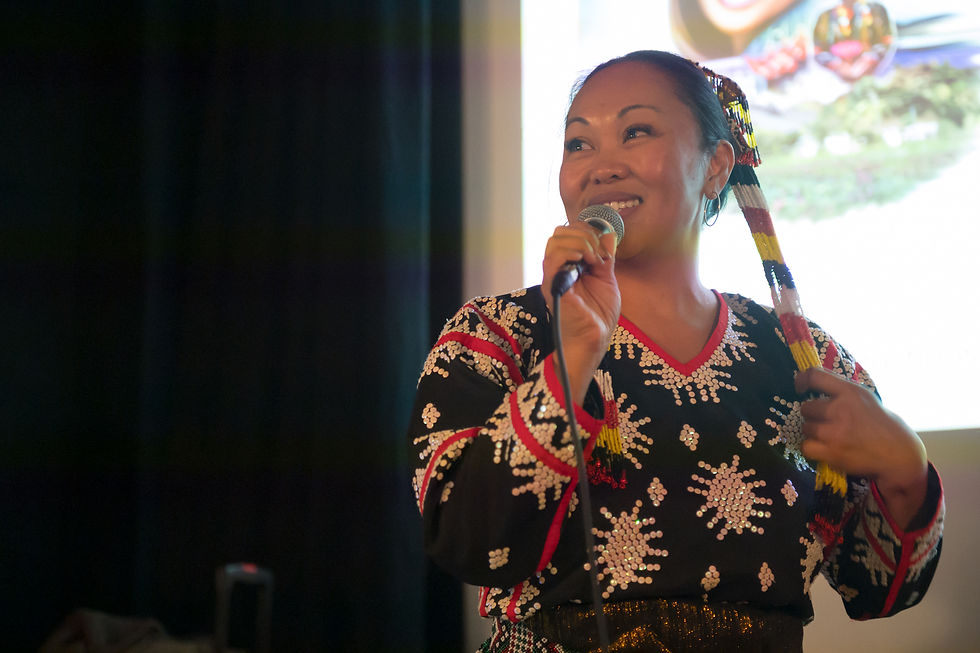
Buti is an artist, musician, and community leader from Lake Sebu, South Cotabato, Philippines. Through art, cuisine and cultural education, she preserves and shares T’boli traditions.
Buti is coming with the Parangal Dance Company to teach traditional Filipino dances and lead a cooking class on how to make the T’boli dish Onuk Nelut, a chicken dish that is cooked inside bamboo.
Workshops are being held on Saturday and Sunday with Filipino Community Inc. to celebrate Filipino American History Month. The history month, recognized every October, was recognized by Congress in 2009 and the Alaska Legislature in 2023.
Registration for the workshops is open to everyone.
Workshop Registration
Filipino Dance Workshop with Parangal Dance Company and culture bearers at the Filipino Community Hall on Saturday and Sunday from 10 am to 3:30 p.m.
Onuk Nelut: A T’boli Food & Cultural Experience at Auke Recreation Area's Eagle Shelter on Sunday from 9 a.m. to 12 p.m. (Limited space)
From Roots to Rhythm: Cultural Peformance by Parangal Dance Company on Saturday at the Filipino Community Hall at 7 p.m.

Bridging Our Stories
The documentary “Bridging Our Stories” follows Manabat Parker’s journey to embrace her role as a culture bearer in Ketchikan. She immigrated to the United States at 8 months old.
“Am I Filipino — am I Filipino American — am I American enough?” she asks in the short documentary directed by Rafael Bitanga.
The 24-minute film explores the intersectionality of cultural identity. It took 100 hours of filming to create.
It was a full theater at Gold Town for the first time the film was shown publicly in Juneau. More than 65 people overflowed out of the theater during a free watch party last month.
The film won four awards and world-premiered in May 2026 at the Los Angeles Asian Pacific Film Festival. Since then it’s played at more than a dozen film festivals, a conference and several community screenings.
Those included educational screenings for Juneau-Douglas High School: Yadaa.at Kalé and the University of Alaska Southeast Asian American/Pacific Islander Club. The AAPI club facilitated a panel with the documentary’s team during the event.
AAPI is scheduled to show the film again Friday at the UAS Egan Library at 6 p.m. with free admission, including a teaser performance from Parangal Dance Company.
At 8 years old, the director immigrated to Kodiak Island from the Philippines. Bitanga began filming in 2023 and production wrapped in 2025.
“I think one of the questions I was always asking is, ‘Why are Filipino stories not seen in media, specifically in film?’” he said during an interview. He added he studied hospitality, not film, but became interested in media during a college project.
“Bridging Our Stories” is his first film, which he pursued after graduating. He said he first learned filmmaking through the nonprofit organization See Stories.
Bitanga said he connected with Manabat Parker through the Alaska State Council on the Arts and she was a grantee for the Youth Cultural Heritage program.
“Being a Filipino immigrant myself and having parents who ended up working for the cannery in Ketchikan, it was from those types of connections that ended up leading me to ‘I am from the community.’ This is a story that I think really matters to many more communities, which has actually now led us here to Juneau itself,” he said.
He said by hosting community screenings and discussions, the production team hopes to inspire people to take action within their own communities.
“Yes, this is a Ketchikan film about a Filipina in Alaska, but much more universally, I think it answers the question of — for the younger generation — what can they learn from the history of decolonizing Filipino history that has been transmitted?” he said.
“So that the younger generation can start to understand: Yes, we were colonized by Spain, by the United States, by the Japanese. So those are the different things that we would love to be able to continue to work with our elders and be able to share with the younger generation that this is a different part of our culture that’s not often said.”
Producer Lailanie Gadia grew up on the Island of Guam, where she said there’s also underrepresented stories and a large Filipino population.
“A lot of these stories don’t exist in mainstream media. And so, I think it’s really important that we really push to bring this film beyond Alaska,” she said. “I’m just excited by the journey that this film has already taken, and just the interest that we’re getting from so many people across the nation who are interested about Filipinos in Alaska.”
She agreed with Bitanga that it’s important to uplift culture through the film, adding it was an all-Filipina production team. She came onto the project in November 2024 to help Bitanga finish the production and strategize the film’s release.
“We really wanted to make sure that our voice and our story was authentic, and so we were really very intentional about building the team. And I think when we're trying to tell stories from our community, we really want to make sure that we build a strong team that understands the intention of the film,” Gadia said.
Both said they are proud of the documentary, but Bitanga added “we’re only halfway there.”
“We’ve made the film, we’re doing the screenings,” he said. “Let’s continue to activate communities across Alaska and across the U.S. regardless if there’s a Filipino community center or not.”
‘See what’s at stake’
In the film, Manabat Parker grieves the closure of Ketchikan’s Filipino community hall where she grew up. It closed in 2015 due to a lack of funding. She was taught Filipino dance in the 1980s by Helen Lamarsh.
“What does it mean when these physical spaces are lost?” she asked.
Juneau’s Filipino Community Hall was originally constructed in 1909 during the gold rush era and the building downtown was later added to the National Register of Historic Places in 1994.
“What is the story that’s going to be told for younger generations to actually see what’s at stake?” Bitanga said during a panel after the Juneau screening. “I think to ground it here in Juneau, I am incredibly grateful to see that we have the only standing Filipino community center in the state of Alaska, right here in Juneau.”
In the film, Manabat Parker talked about the importance of having a place to gather and practice dance. She said when Ketchikan’s center closed, it felt like a symbol of Filipino immigrants being continually invisible. Filipinos comprise 10%-12% of Ketchikan’s population, and many came for cannery work and military service.
“I was really trying to reinvigorate our Filipino culture and music dance scene, because when I was growing up, as the film showed, we were really vibrant, and then something happened,” she said. “We don't know what happened, and it could have been the physical space, it could have been a disconnect from different generations that come and immigrate to Alaska. But when I was awarded the Rasmuson Individual Artist Award, I was like, ‘What can I do? And what can I do to change that?’”
After its closure, Manabat Parker began cultural enrichment classes in Ketchikan’s elementary schools. The film follows her seeking a deeper connection with her heritage to mentor her dance students, which led her back to the Philippines.
“I felt the need to reconnect with my Filipino identity to be a teacher — felt a need to bridge the gap,” she said.
Manabat Parker said colonized dances are traditionally what Filipino children in Alaska learn. She described the Indigenous Filipino dances she witnessed during her trip as vibrant and rich.
“Traveling helped me feel like a part of the Philippines,” she said. Manabat Parker added she doesn’t think traveling is necessary to reconnect with culture and “the journey is however you want to take it.”
“We’re just all in the presence of learning,” she said. “You all can absorb regardless of your age, and again, you don't have to travel to do so. You can find it in your community, and by us coming to Juneau, we hope we've extended that opportunity to extend our family and our community for sharing and cultural exchanges and broadening that throughout the state of Alaska. Because again, Filipino presence is here.”

Manabat Parker said she hopes the film inspires leaders of all cultures, drawing parallels to cultural revitalization efforts of the Alaska Native community.
After the film was shown in September, two of her students danced on stage with her.
Zofina Volkmann and Angela Estipona-Hernandez, both 14, said in an interview they’ve been dancing for about five years.
“It’s really cool to see us being represented and our culture,” Volkmann said about the film.
She explained the dance at the film screening was from the T’boli tribe, as were handmade clothes they wore for the performance.
“There’s different variations of the dance. Like this one is an updated version of the other ones. So we practically took all the other dances from the variations, and then we mix it into one,” she said.
“There’s all different cultures coming to see us, and I feel connected with the people who are Filipino and the people who aren’t Filipino, and it feels so special for me to share,” Estipona-Hernandez said.
Manabat Parker described experiencing a full-circle moment during the film showing. She said she hopes she is doing justice to what her elders passed down to her.
“We’re doing this for the next generation to understand — to represent us,” she said, adding both Volkmann and Estipona-Hernandez now teach dancers themselves.
• Contact Jasz Garrett at jasz@juneauindependent.com or 907-723-9356.