


Joel Jackson, president of the Organized Village of Kake and longtime tribal leader, dies at 70

Updated: Aug 30
Lifelong Kake resident was a tribal council member for more than 35 years, and advocate for Indigenous rights, environmental protection and cultural healing
By Mark Sabbatini
Juneau Independent
Lifelong Kake resident Joel Jackson, who served as president of the Organized Village of Kake for the past eight years and a tribal council member for more than 35 years, died Saturday at Mount Edgecumbe Hospital in Sitka, according to family members and tribal officials.
Jackson, 70, a member of the Kàach.àdi clan and a child of the Tsaagweidi clan, was diagnosed earlier this year with pancreatic cancer. His uncle, Ken Jackson Sr., who also has lived in Kake most of his life, said in an interview Sunday his nephew "had some good role models" growing up in a large family that led him being a memorable community leader.
"His father (Thomas L. Jackson) was probably the speaker of the community before Joel," Ken Jackson said. Joel Jackson’s oldest brother, Tom Jackson Jr., served as police chief for the village before Joel Jackson filled that role for three years.
"Joel listened a lot to the older ones," his uncle said. "He had an ability to listen and then make a decision. Sometimes that's really important if you're as notable as you are for giving information too. And he had a very analytic mind. He could figure things out."
Tributes to him were shared throughout the weekend by tribal leaders and others throughout the region.
"I think the thing when I think about Joel is just he was a fierce advocate," Chalyee Éesh Richard Peterson, president of the Central Council of the Tlingit and Haida Indian Tribes of Alaska, said in an interview Saturday evening. "He was often at every kind of consultation and meeting involving our way of life, and he was never afraid to stand up and say what needed to be said."
Kake Mayor Lonnie Cavanaugh, in an interview Sunday, said she remembers that when she was a teenager Joel Jackson was the police officer giving her her driver’s test. Years later they both started getting in tribal council politics.
"With Joel the one thing that he always used to say is he didn't have all the answers, he didn't know everything," she said. "But one thing about Joel: when he believed in something, he was passionate about it. I mean, you could tell by the change in his voice, he would get very passionate when he spoke about something. He would go in head first."
One of the most memorable projects he was devoted to was a cultural healing center in an old bunkhouse about 52 miles from Kake in Portage Bay, Cavanaugh said.
"He had a vision that he wanted it to be a rehabilitation place where people can go for healing," she said, adding "There were a lot of obstacles with that and he just he felt so passionately about that, that we needed some place like that for our people."
Efforts are now underway to complete renovation of the site, hire local staff, and fund ceremonial, food, and cultural programming, according to the project’s website.
Mike Jones, president of the Organized Village of Kasaan, said in an interview Sunday he first met Joel Jackson about four years ago and they served together on the Southeast Indigenous Transboundary Commission, a coalition of 14 tribes working on sovereign rights issues.
"I think he's got just such a powerful presence that people are drawn to him, and once they are there's just an instant connection," Jones said. "I think he connected with an awful lot of people and he just had that in him, and we became quick friends."
Laaganaay Tsiits Gitanee, Joel Jackson’s niece and a Kake resident who sponsored a GoFundMe to help his treatment, stated in a social media post Saturday that "He loved our Native peoples deeply and spent his final night in the Tongass, his homelands where his spirit has always lived."
Joel Jackson described his own childhood in a narrative about healthy forests published in June by the advocacy nonprofit Salmon State.
"When I was a young kid — about 10 or 12 — me and my cousin, who’s the same age, we went fishing with our uncles," he said. "Where we went there’s two salt-water-fed lakes, as well as fresh water coming down from the hills. You’ve got to go in there at a certain tide in order to get up into the lakes. And what we were there for was chum salmon, dog salmon, in the fall time. Me and my cousin, we thought it was just the greatest thing to be with our uncles, going on an adventure."
He said it was one of his earliest memories of going out with his uncles, and because of challenges they experienced during the outing "I think it was kind of an initiation for us to go with them, and they wanted to see how we’d react to being in a cold, tough situation."
Joel Jackson became a commercial fisherman with his father and other family members early in his working career, and in his later years "he still was a fisherman because you're a fisherman for life," Ken Jackson said. He also worked as a road builder for the Kake Tribal Corporation for 22 years.
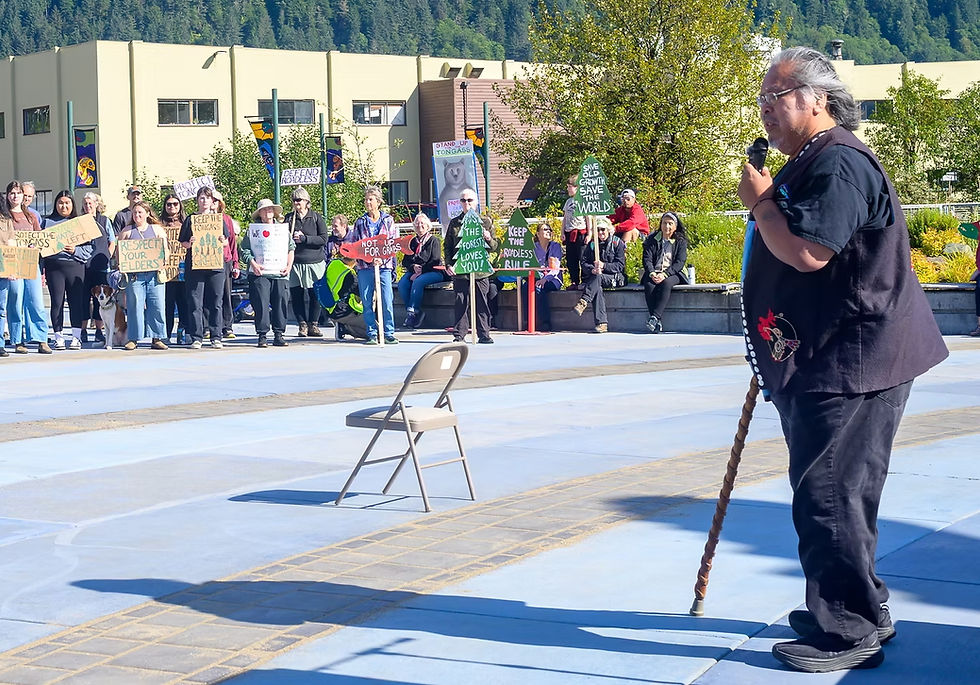
His advocacy included protection of the Tongass National Forest, subsistence and other Indigenous rights, obtaining an apology from the U.S. Navy in 2024 for its 1869 bombardment of Kake, and Alaska Native cultural healing projects.
"He had a lot of direction from people that were before him, but he was a good speaker," Ken Jackson said. "Joel's voice carried. He had that baritone calm and there were times when that voice was the one everybody wanted to hear. You know, some people they make speeches and people walk out, walk around, look at their phone. But even those guys, if (Joel) talks to you, he’d look you in the eye and watch you. And you’d sort of put your phone down, and watch and listen and learn from him."
Jones said that in addition to major Tongass issues such as preserving the Roadless Rule to protect against adverse impacts of industry, he remembers Joel Jackson advocating for recognition of forest assets such as cultural trees.
"Cultural trees — like canoe trees and totem pole trees," Jones said. "These old-growth red cedars are really intertwined with our culture and who we are, and especially as we're the original totem pole people. So what are we without our old-growth trees? And he was just really passionate about our culture and hanging on to the way we live."
Cavanaugh said another project in Kake that bears Joel Jackson’s imprint is a newly planned visitor center.
"Just about a year ago we had this one building that you know was empty," she said. "It was a city property and I was just talking to him and I said, ‘Joel what can we do with this building? I need something that represents Kake, and he just nonchalantly threw it out there. He goes, ‘Do a visitor center — you know, put a coffee shop in it,’ and so guess what? That's what we're doing."
Peterson, when asked what advocacy by Joel Jackson first comes to mind, said "I think first and foremost was probably trying to protect our lands — he was very staunch on the roadless issue and trying to retain the roadless protections. But he's also very concerned about healing and I know it was one of his goals to see a healing center built."
Tributes to Joel Jackson included praise for an ability to interact with a wide range of people and situations ranging from political gatherings to coordinating emergency response efforts in the community to trying to expand cultural awareness to diverse audiences.
"I think he was there for everybody, big or small, it didn't matter who you were, what your struggles were, what your background was," Jones said. "He was advocating for everybody, tribal or non-tribal."
Joel Jackson could be an imposing presence and so "maybe for a new person, I think he could be intimidating," Cavanaugh said.
"You meet Joel and look at him, and there's this big guy," she said. "He kind of can look gruff sometimes. I think he could be intimidating. But once you start talking to him, he really cared deeply about his community and he actually was a softy once you got to know him."
Jones said he considers Joel Jackson a mentor as a village tribal president and many others have gained from his leadership as well.
"He was just a pillar of a man," Jones said. "He's just a legend, even in his in his own time, and he's going to be missed really bad. Voices like that for our land and our way of life are really hard to come by, and I hope some of us can pick up that slack."
• Contact Mark Sabbatini at editor@juneauindependent.com or (907) 957-2306.


