


.png)

On The Trails: On the Outer Point Trail

By Mary F. Willson
On a day in mid-May with alternating sun and showers, a friend and I took a stroll on the Outer Point Trail. Our original intent was a walk on the Rainforest Trail, but that idea was jettisoned vigorously and immediately upon seeing a horde of tourists beginning a guided tour there. The Outer Point Trail was ours for a time, and a few others came later.
The friend and I share an interest in observing plants and birds and whatever else we notice along a trail. On this morning, the first plant that caught our attention was fern-leaf goldthread (Coptis asplenifolia). This little herbaceous perennial spreads both by rhizomes and via insect-pollinated seeds. Perhaps its most interesting feature is that it changes sex expression. The same plant can produce male flowers in one year and hermaphrodite flowers (both male and female) in another year. If a plant bearing hermaphrodite flowers produces fruit, it is likely to produce male flowers the next year. Because there is a big energetic cost of producing fruit, the plant may not have enough resources to do so in consecutive years. A nice little experiment might be to supplement some fruit-producing individuals with extra resources to see if the likelihood of making male flowers the next year is reduced (compared to unsupplemented individuals).
The early-blooming Coptis was accompanied in the understory by groups of small wintergreens known as Pyrola (or Monese) uniflora. They had three leaves surrounding a big bud that will become the single, drooping flower sometimes called "shy maiden" or ‘single delight’ or simple "one-flowered wintergreen" or many other common names. The mature flower is buzz-pollinated by bumblebees, which vibrate (buzz) the pollen from the anthers and carry it to others of that species. If pollination succeeds and a fruit is produced, the flower rotates from its drooping position and faces outward and upward. The mature fruit opens and the miniscule seeds are wafted away in a breeze.

The other herbaceous species of flower in the understory was skunk cabbage, sometimes called "swamp lantern," making a spectacular color show in the swampy areas. The older individuals were already in male-phase, producing pollen, while those that had sprouted more recently were in female-phase. The aroma of this plant drifted around the forest in many places. I don’t find it unpleasant at all (in fact, delicately sweet), but some folks dislike it.
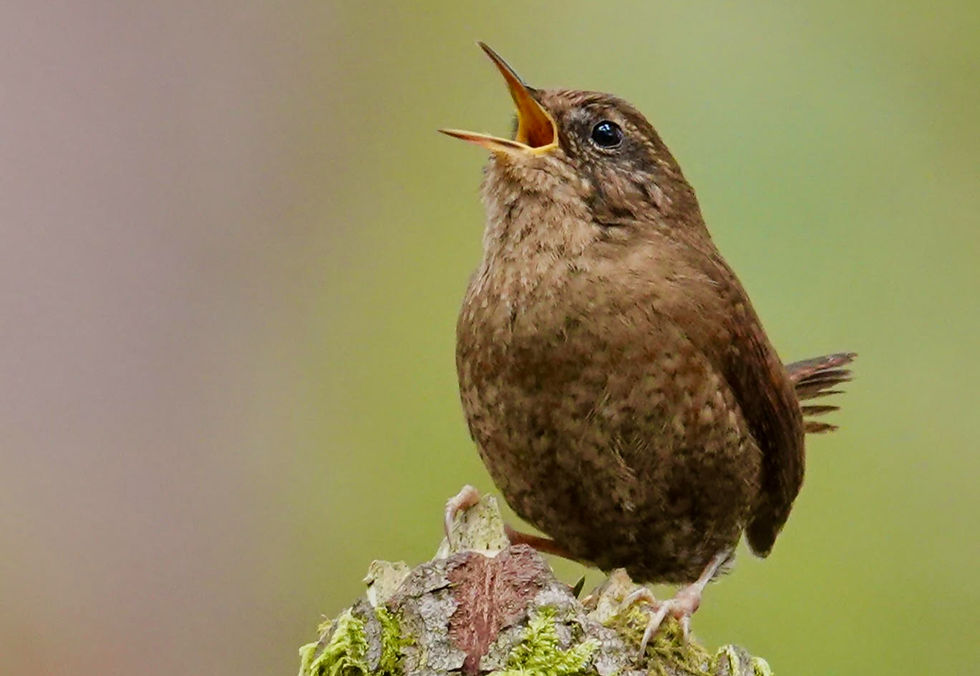
Most of our attention was on small herbaceous plants in the understory (but blueberry shrubs were flowering too). As we contemplated some ferns, a Pacific wren started to sing. He stood just a few feet in front of us on a tall shrub. As he vibrated with the energy of his singing, the shrub bounced with him. A distant woodpecker tapped, varied thrushes sang, and the Merlin app suggested that there were unseen Townsend’s warblers, western flycatchers, yellow-rumped warblers, and others.
The big beaver dam was in good shape and the big beaver lodge was in full view from the trail. These beavers manage a good-sized stream system, creating the pond for the lodge, but also maintaining small dams on lower reaches of the stream. The pond is important not only for the beavers but for other species too — wood frogs sing as they court along the pond edges. Wood frogs are not common here, so this pond contributes significantly to local biodiversity.
Back at home, the pond has been hosting mallards since the ice melted. At first, a mixed batch of maybe a dozen or so, both males and females. Then the females disappeared, presumably tending their nests, and a few males were here occasionally. But a few days ago, a female reappeared. She associated very closely with one of the residual males. She (probably the same individual) has been out there with a male every afternoon and evening since then. I suspect she lost her first clutch and is back to get started on another one. Here’s hoping for lots of ducklings on the pond in June!
• Mary F. Willson is a retired professor of ecology. "On The Trails" appears periodically in the Juneau Independent. For a complete archive of Mary Willson’s “On the Trails” essays, go to https://onthetrailsjuneau.wordpress.com


