.png)

Vexed lawmakers told it will take ‘at least a year’ to assess report calling state pay uncompetitive

‘I do feel like this is basically being stuck in a bureaucratic malaise that is slowly grinding my soul into powder‚’ House member tells Dunleavy administration official presenting new plan
By Mark Sabbatini
Juneau Independent
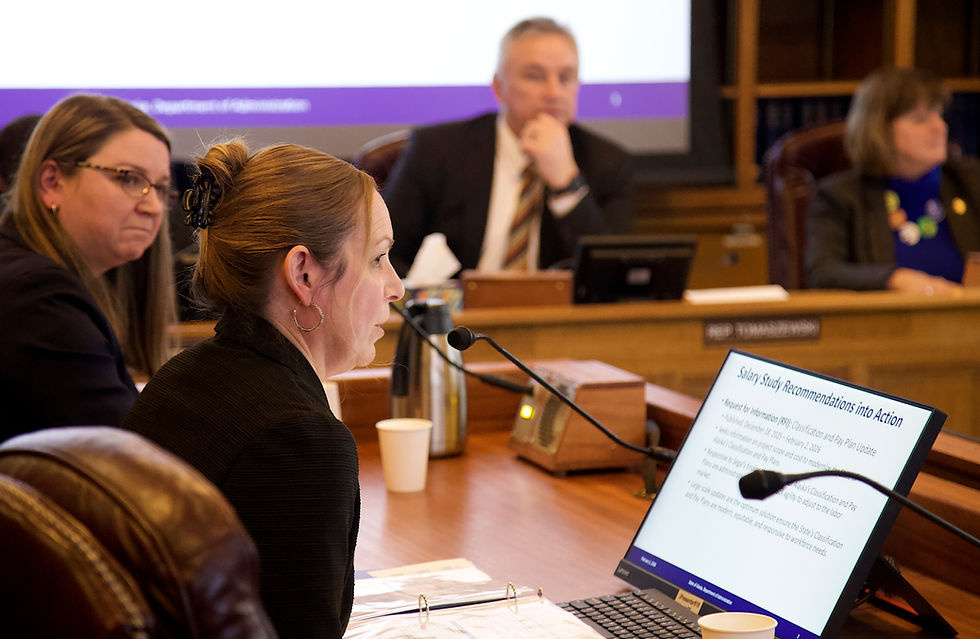
State employees hoping they might see a pay hike due to a study declaring their wages uncompetitive may be in for a long wait, as a Dunleavy administration official said Monday the plan is to spend "at least a year" assessing how the study’s recommendations can be implemented.
That declaration to the House Finance Committee was met with chagrin from legislators who noted the study underwent extensive delays — along with a changing of parameters aimed at lowering the definition of competitive — before it was released last April. Committee members, among other things, asked if further delay by the new assessment would make the salary study outdated — and thus cause further delays while more data is collected.
"I've always wondered what the word Byzantine bureaucracy meant and I feel like after today I kind of know that," Rep. Will Stapp, R-Fairbanks, said during the back-and-forth questioning. "This issue has been going on a long time. I don't think in all the meetings that we had on the salary study it was ever mentioned that we would ever have required a classification study. So I do feel like this is basically being stuck in a bureaucratic malaise that is slowly grinding my soul into powder."
The day of the hearing was also the deadline of a six-week public bidding process for a "Classification and Pay Plan Update" that "Seeks information on project scope and cost to modernize the State of Alaska’s Classification and Pay Plans," according to a presentation to the committee by Aimee Devaris, director of the Alaska Division of Personnel. When asked about the timeline for the assessment she noted no funding for it is in the governor’s proposed budget for next year.
"So I think we would be looking at least a year to develop those plans," she said.
The salary study was supposed to be completed by June 30, 2024, but instead was delayed by nearly a year while the administration spent additional money and lowered the comparative standards measured. The study found pay for 31 of 36 occupation groups was 85%-98% of the state’s official standard for competitiveness, and 21 of 36 were below the lower-standard public/private sector average.
Devaris responded to the frustrated questions of some committee members by noting she’s a former federal employee who started her current job less than three months ago. As such, she was unable to answer many of the specific inquiries about the study the Legislature approved spending $1 million for in 2023.
"Being very new to this position and joining the Division of Personnel and the department when I have, this is among a set of very high priority areas of work that I'm undertaking," she said. "There will be a very collaborative approach to developing a strategy for pursuing the results of the salary study, as would be necessary if we do in fact take on comprehensive changes to our classification plan, and the pay scales would follow that."
"So this planning will have to happen in partnership with (the Office of Management and Budget) in the governor's office. This information will have to be reviewed by the Legislature. The unions will be involved. It will be quite a comprehensive project."
Such general assurances didn’t satisfy Rep. Sara Hannan, D-Juneau, whose questions included the costs of implementing changes based on salaries being at the 65th percentile of an occupational standard — long the state’s declared benchmark — and a 50th percentile benchmark added by the administration when the study was extended.
"I don't have those numbers in front of me," Devaris said. "I think that's something that we'll have to follow up and get back to you on."
Hannan’s reply, directed to Devaris and another administration official testifying during the hearing, included a message to Department of Administration Commissioner Paula Vrana, who oversees the personnel division.
“I guess I would like that message to be that it's a little bit shocking to me that your commissioner is not with you today," Hannan said. "That she sent the lambs to the fire knowing there were going to be questions about something we spent a lot of time asking about last year. And so you're doing great jobs that you've been sent to do, but we did have sort of an expectation of some specificity that we've spent a year trying to get."
It’s possible the data will show the cost is too high for legislators to support salary increases to the state’s 65th percentile goal — or to do it all at once, Hannan said. But "we at least need to know that the calculations that we paid a million dollars to have…so I'd like your commissioner to bring us that information."
One point of emphasis by Devaris during Monday’s presentation is there are wide variances in the study’s findings about how competitive certain state jobs are — and that "classification and pay plans are administratively complex and lack agility to adjust to the labor market."
An example of the complexities of the report is midpoint public employee salaries overall were found to be 91% of Alaska’s declared 65% benchmark. But biological sciences jobs were the least competitive at 85% to 93% of the benchmark, while craftwork and labor positions were the most competitive overall at 98% to 101%. Some police, firefighters and corrections employees had the highest pay at 103%.
Devaris noted related steps being taken by Dunleavy include an administrative order redefining minimum qualifications for more than 350 job classes.
"This means using competency-based standards rather than, for example, just college degrees to reduce barriers to candidates for entering state service," she said. "We now have 10 agencies participating in this effort and it's aimed at strengthening recruitment for the state's workforce."
• Contact Mark Sabbatini at editor@juneauindependent.com or (907) 957-2306.