


.png)

This year’s outburst flood expected to be similar to last year’s, but variables remain

No significant changes to basin capacity, according to recent drone survey; how the flood hazard changes over time yet to be understood
By Ellie Ruel
Juneau Independent
While flood mitigation efforts are increasing in intensity with heightened flood walls and a new earthen berm, local scientists say this year’s release will likely be nearly the same magnitude as last year's.
Jason Amundson, a University of Alaska Southeast researcher studying Suicide Basin and its outburst floods, presented an update on flood dynamics at a Juneau Flood Solution Advocates meeting on Thursday. He said outburst floods are largely a consequence of glacial change.
“You have a small basin initially, some small floods that occur. The basin gets bigger, like we see right now. We have a much larger basin than we did 10-15 years ago,” he told the crowd. “At some point the glacier retreats far enough that the basin is going to get smaller, and then the glacier will retreat past it — no longer a hazard. And so this is the sort of thing that we're grappling with is trying to understand how the basin is changing. How is the flood hazard changing over time?”

Since 2011, he said, 40 to 50 separate flood events from the basin have occurred — many of them too small to notice — which changed drastically in 2023. In the last few years, Suicide Basin has drained completely to the bottom, allowing scientists to understand its capacity better. Compiled data from all of the releases can give a better picture of how severe future major flood events can be.
“The nice thing about this is it tells us if we know what the volume of Suicide Basin is, we can have a fair bit of confidence in what size flood you could get out of the basin,” Amundson said. “There's a bit of scatter, it's not a perfect straight line or anything like that, but there is a relationship here between the volume and the discharge.”
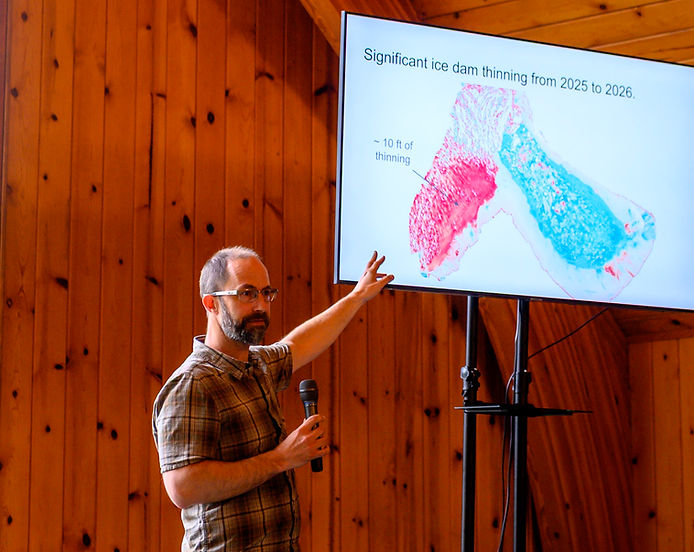
One of the ways the research team tracks the changing basin capacity is through repeated drone surveys, which are used to create digital elevation models that help illustrate the basin’s geometry. UAS began the drone program in 2018 to map Suicide Basin.
Amundson said competing dynamics made the total volume change almost zero based on preliminary numbers. Since last year, glacier thinning that lowers the ice dam decreased Suicide Basin’s storage capacity by about 1,500 acre-feet (a unit of measure equivalent to a foot of water on a football field). Iceberg melt has contributed about 1,000 acre-feet of water storage capacity in the past year.
“Thinning of that ice dam has reduced the storage volume of the basin by maybe 2-3%,” he said. “The loss of icebergs and melt has increased the storage by maybe 2%. Those things almost cancel out, and so it seems to me that there's really not that much change from last year to this year.”
One resident at Thursday’s meeting asked if the record amount of snow last winter would contribute to the basin’s fill rate. Scientists told KTOO in March snowpack is completely unrelated to the conditions that control the size of glacial outburst floods.
Amundson said if the basin has a full drainage like the last few years, he expects the release in early August — however, it could drain before filling all the way.

The most difficult factor to quantify is how the boundary between Mendenhall Glacier and Suicide Basin is changing over time, Amundson said.
“You have this large unsupported cliff, ice just wants to float into Suicide Basin, so it's really a dynamic environment,” he said. “The water level goes up and down, and the glacier responds to that.”
He said the basin’s peak volume is still unknown. Repeated drone surveys also allow scientists to calculate how fast the ice of Mendenhall Glacier is flowing into Suicide Basin and how that changes over time. In addition to drone surveys, the UAS team installed global positioning system receivers to help understand how the boundary between the glacier and basin is evolving.
“There's really a lot of uncertainty regarding how that boundary is moving, how the ice dam is changing shape, and what sort of impacts that might have on the flood,” Amundson said.
Amundson said the reason engineers are using larger numbers to help design potential solutions for outburst flooding is because of this trajectory being unknown.
Eventually, he said the floods will likely fade back into a non-catastrophic event as the glacier thins. Over the last year, the ice sheet has lost 10 to 15 feet of thickness.
“What I anticipate happening is that it's going to continue to have floods for several decades, but at some point they're going to become kind of curiosity again, like they used to be,” Amundson said.

The rate of release can impact how forecasters predict when the Mendenhall River will reach its peak. Last year, the initial discharge was masked by heavy rainfall, which shifted the forecasted peak time. The Mendenhall River crested at a record 16.65 feet the morning of Aug. 13, 2025. Early weather service alerts called for the Mendenhall River to crest in the afternoon, but on the eve before the water level peaked that was adjusted to morning..
“That was a challenge for us last year is that we were kind of in the dark for a couple of days, right as the flood was starting, so it was hard to know exactly when it had started,” Amundson said.
Although it’s difficult to predict when the basin’s drainage begins, Amundson said last year’s forecasted crest of the Mendenhall River — 16.6 feet — was the most accurate so far.
“We were all kind of maybe amazed at how close it was last year,” he said.
Amundson said if more water moves through the glacier due to rain, the basin may release faster since the drainage system will have “opened.”
“You can think of the bottom of the glacier as having kind of a plumbing network, there's all these channels under there that the water's flowing through,” Amundson explained. “That plumbing network evolves seasonally, as there's more and more water going through the glacier.”
Aaron Jacobs, senior service hydrologist for National Weather Service Juneau, explained the rate of release complicates flood forecasting during the agency’s open house Saturday.
“The other thing that we cannot really monitor or even forecast, really, in the future, is the rate of release, so how fast that water can come out,” Jacobs said. “We're using an average of the last three years for the shape of the hydrograph. Last year was the fastest we've seen the water come up, but we're also thinking that was a little bit because of the atmospheric river.”
Amundson and Jacobs both received a legislative citation for their research on Suicide Basin alongside Jamie Pierce and Eran Hood at the Juneau Flood Solution Advocates meeting Thursday. Debbie Penrose-Fischer nominated the local team for “teamwork, scientific rigor and unwavering commitment.”
Weekly updates on how fast the basin is filling are available at the weather service’s monitoring page. Experts also talked about the timeline of Juneau’s glacial lake outbursts on Tuesday during a KTOO flood panel, which can be viewed here.
• Contact Ellie Ruel at ellie.ruel@juneauindependent.com.


