.png)

Why LWV Alaska opposes Ballot Measure 2


By Marianne Mills and Sarah Moore
The League of Women Voters of Alaska (LWVAK) is a non-partisan, grassroots, statewide volunteer organization. Our mission is: empowering voters, defending democracy. We never support or oppose political candidates, but we do take positions on statewide issues, including ballot initiatives, after extensive research and analysis.
We are in strong support of Alaska’s current election law, which includes a nonpartisan open primary, dark money disclosure rules and ranked-choice voting. This law was approved by voters in 2020 and re-affirmed by the electorate in 2024. LWVAK supports Alaska’s election process because we view it as a more inclusive, representative and functional democratic system than party controlled elections. Here are specific reasons why:
An open primary
With 63% of Alaska voters not registered with a political party, an open primary where we select any candidate of our choice — just makes sense. Without an open primary, political party control will return, with each party again establishing the rules for who may participate. This means that parties control who is on the primary ballot and whether you need to be registered as a member to vote in their primary. Ballot Measure 2 also states that candidates for governor and lieutenant governor would again run separately rather than as a ticket in the party primaries.
Dark money disclosure
“Dark money” is money spent to influence an election when voters cannot see who originally provided the funding. Alaska’s 2020 law added a “true source” requirement so that funding could be traced back to whoever actually paid for it. Ballot Measure 2 repeals that requirement. This is particularly important with spending from Independent Expenditure (IE) groups, allowed to proliferate after the 2010 U.S. Supreme Court Citizens United decision. Without Alaska’s dark money disclosure rules, we wouldn’t be able to see who is actually funding contributions to IE groups. It also eliminates the paid-for-by disclaimers on broadcast and digital advertising, drops the disclosure requirement for contributions over $2,000 a year, and removes fines for certain disclosure violations.
Ranked choice voting (RCV)
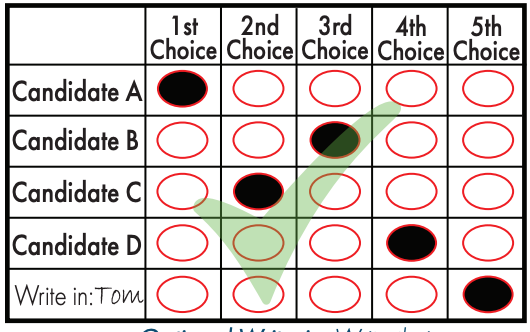
RCV provides the voter with choice – the choice of ranking candidates in order of preference – or not ranking if that is their preference. The system ultimately ensures broader support for the winning candidate.
RCV ensures that the winner has majority support (50% +1), rather than just a plurality (the most votes in a particular race).
Alaska’s current election system increases representation and reduces polarization. Candidates/elected officials work to communicate with a broader swath of constituents as opposed to only those with a particular political affiliation. This reduced polarization greatly impacts how candidates work with their peers once elected.
For all of the above reasons, the League of Women Voters of Alaska urges Alaska voters to vote no on Ballot Measure 2 on the 2026 general election ballot.
• Marianne Mills and Sarah Moore are co-presidents of the League of Women Voters of Alaska.




_edited.jpg)


.png)

.png)