.png)

Wolf pack’s bold approach baffles biologists, hunters near Haines
Encounter on mountain near Chilkat Lake leaves one wolf dead, many unanswered questions
By Rashah McChesney
Chilkat Valley News
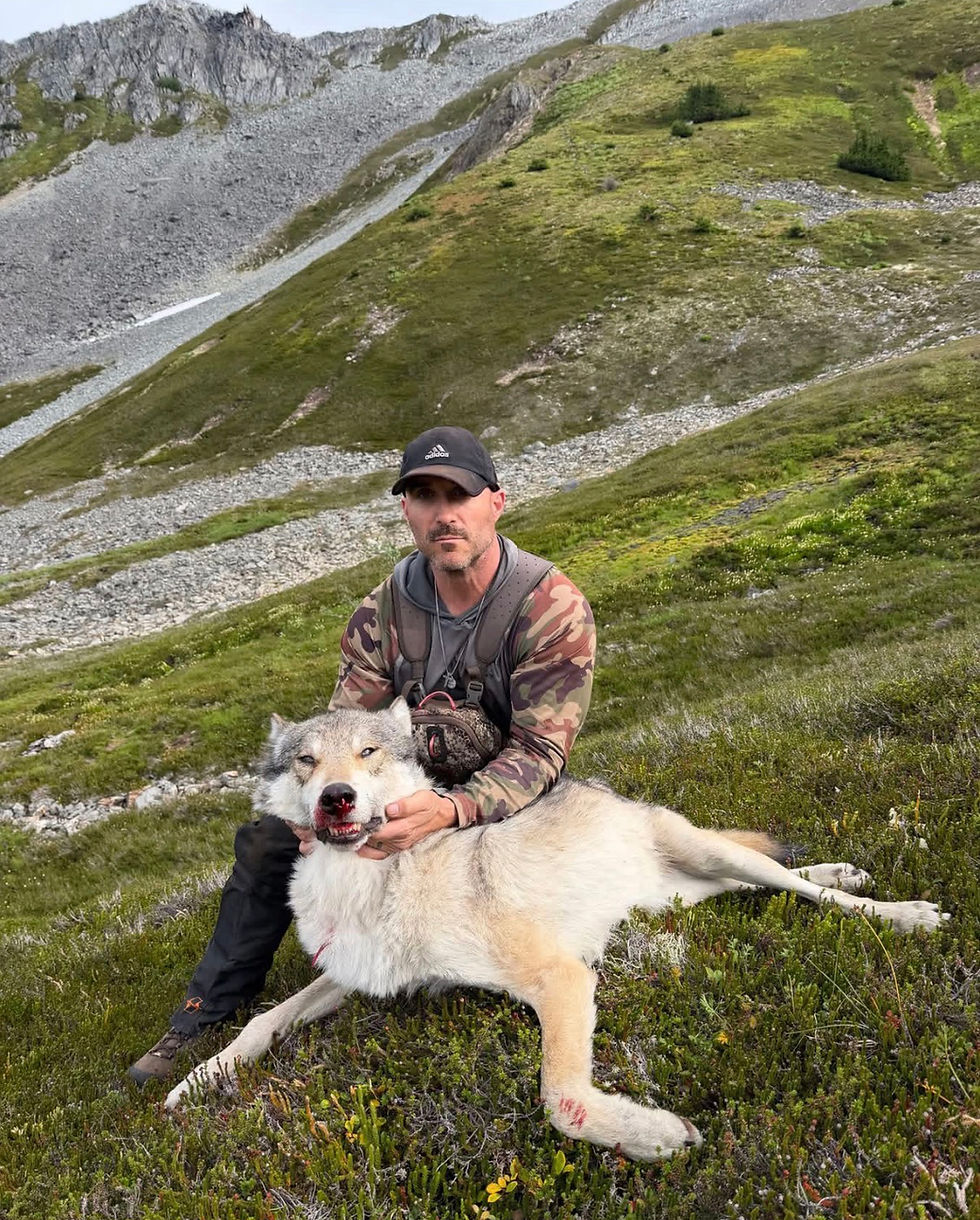
A weekend mountain goat hunting trip ended with two Haines residents packing out a dead grey wolf from a pack they encountered at the top of a mountain near Chilkat Lake.
Both Nate Motes and Jenn Walsh described heading up a mountain on Saturday Sept. 5 and encountering a pack of wolves that approached them as they were hiking along a ridgeline. Both have seen wolves before, but never behaving like they did that afternoon.
“Every time I see them it’s a blink of an eye and then they disappear,” Motes said. “I’ve never been able to get close to them because they’re really shy, and smart.”
Their day started with a 3,800-foot climb on a mountain between Kicking Horse and the Tsirku. They gained that elevation in about a mile in what Motes described as a swim through alders and devil’s club. But when the pair got out of the thick brush and came up into the alpine something felt different.
“The minute we stepped onto this old bear trail up in the valley, they started crying,” he said.
Motes said his first thought, which he did not say out loud, was “damn, there’s wolves up here. I know there’s not going to be any goats.”
As it turns out, that was a thought Walsh said she was thinking too but didn’t say it out loud.
“It’s a superstition thing, right? When it’s been a really quiet week at the fire hall, you don’t say ‘wow, it’s been really quiet,” she said. Motes and Walsh are colleagues at the Haines borough volunteer fire department.
They walked along the ridgeline, Walsh in front and Motes behind. When the first wolf came into view over the ridgeline, about 90 feet away, she was elated.
“I turned and looked back at Motes, like ‘ooh isn’t this neat?’” she said. “I didn’t yell, I really didn’t want to scare it away.”
Walsh said she had been approached by curious wolves a few times during a backpacking trip in the Arctic National Wildlife Refuge.
“We would be, like, packrafting a river and they would come and look over the edge of the river and they’d look at you,” she said. “Mostly then they would just run away. I just thought it was a neat thing to see.”
That first wolf let out a short howl, and four more wolves popped up.
“I swear they were equally spaced along the ridgeline,” Walsh said.
At some point, she had gotten her phone out and started recording. “I saw more movement. Then I panned to the left and I panned to the right and was like ‘Oh my god,’” she said.
She looked back at Motes and he was frantically motioning for her to get out of the way. Her video cuts short at this point, her camera pointing toward the ground as she runs.
When the first wolf appeared, Motes said he was thinking that he didn’t want to shoot a wolf because he didn’t want to scare away any goats in the area. But that calculation changed the minute four of them came into view. One of them, he said, was flanking Walsh, moving around the side and then behind her.
“Another started coming down right toward her. At that point, I was like ‘get out of the way,’” he said. “I shot the alpha male and then they all took off.”
As soon as the wolf went down, Motes said Walsh screamed “Does that mean I’m going to have to carry this down?” That startled both of them into laughing.
He described the dead wolf as 80-100 pounds, but probably 6 feet long laying out. A male, about the size of a malamute but with long legs. “His teeth were really worn, but they weren’t completely gone,” Motes said.
Looking back on it, Motes said he didn’t intend to shoot the wolf, but he’d never seen them behave in that way. “I saw him call for the others and then they had no intuition not to come toward us,” he said.
Walsh and Motes have theories about the encounter. Walsh was wearing a big white pack, and Motes wondered if the pack mistook her for a mountain goat. He speculated that perhaps they were hungry. Neither saw any goats on the mountain, but there were plenty of piles of wolf scat with white fur in them. Or, maybe, something is going on regionwide. Parks Canada recently closed trails in parts of the Kluane National Park and Reserve near Haines Junction, Yukon, due to aggressive behavior from a young, lone wolf. Those trails were reopened a few weeks later.
And, those are all theories. It’s really not clear why the pack would have approached Motes and Walsh.
Wolf aggression is extremely rare in Alaska. Wolves tend to avoid people, though there are several documented cases of wolves approaching people in the region. In his 2002 report of wolf-human encounters in Alaska and Canada, Mark McNay compiled a case history of 80 encounters in which wolves “showed little fear of people.”
That included one with a Haines man, Roy Lawrence, who landed with his 7-year-old son at a remote airstrip near the Salcha River in the interior in 1976. According to Lawrence, as his son was crouched along the edge of the river a wolf ran directly toward him, and Lawrence shot the wolf twice, killing it. Lawrence said he thought the wolf looked emaciated.
In nearly half of the cases McNay compiled, wolves showed signs of aggression. About a dozen of them were likely rabid, and another 29 of them involved fearless behavior among “non-aggressive” wolves.
In some cases, people were nipped or bitten and few of those were severe wounds. In some cases, people’s dogs prompted the chances of wolf aggression. In 2014, a wolf killed and ate a Haines woman’s dog during an attack near 40 Mile Haines Highway.
But fatal attacks on people are less likely. A few cases have involved Alaskans who died after being bitten by wolves who had rabies. Wolves also killed a 32-year-old woman jogging near the village of Chignik Lake on the Alaska Peninsula in 2010.
Alaska Department of Fish and Game wildlife biologist Gretchen Roffler, who studies wolves, said they are common in Southeast Alaska, but people don’t often see them.
Reviewing Walsh’s video, Roffler and local area management biologist Hannah Manninen said they couldn’t accurately interpret what the wolf pack was doing, or fully understand what Walsh and Motes experienced. “We’re glad they’re ok,” she said.
Motes said they counted maybe 13 or 14 wolves running back and forth on a nearby ridgeline at one point.
Roffler said it’s not unusual for a wolf pack to have a dozen wolves in it, including several adults and the pups of the year. Fish and Game has not done any data collection or observation of wolves in Haines, Roffler said. So, she’s not sure of the population size.
But, from other research in Berners Bay and on Revilla Island, she said it’s common for wolves to spend time in alpine environments hunting mountain goats.
“For example, 40% of the wolf kill sites that the [Fish and Game] research team investigated in Berners Bay were mountain goats, and 25% of the wolf kill sites near Ketchikan were mountain goats,” she wrote in an email.
Roffler is collecting samples from all of the wolves that get shot or trapped. Motes gave tissue and hair samples as part of the sealing process in the Haines Fish and Game office. She said she’s doing some analysis to learn more about their diets.
It’s possible that Motes and Walsh interrupted a hunt. When they first started hearing wolf vocalizations on the ridge, they couldn’t tell which direction the sound was coming from. Sometimes it sounded like it was up and to their right, sometimes down to the left.
“The way it echoed, it was like ‘is the pack over there? Are they all up on the ridgeline?” Walsh said. “We just decided it was echoing.”
Haines resident Erik Stevens remembers being on that mountain looking for goats several years ago. On the last day of his group’s hunt, Stevens said they started hearing wolves in the middle of the day as soon as they’d left their camp to go looking one more time.
The wolves were close, but across a small bowl from the group. When they saw the pack, Stevens said it was mostly black wolves though there might have been a few lighter-colored ones. There were about nine in the group .
And as the hunting party watched, the wolf pack split itself into two groups. The lower group stayed in the bowl and the upper group started traversing up the ridgeline to get to the top of the bowl.
“Once we saw them doing that, we realized there was a goat on the ridge above them,” he said.
But what sticks with him is that the lower group of wolves was howling, vocalizing and communicating with the upper group the entire time. It seemed the wolves that were climbing would have had a hard time keeping an eye on the goat, so the lower group was communicating where to go.
“You could tell their strategy was really well practiced,” Stevens said. “It was cool too because they weren’t just howling. It was like chatter, you could hear them talking almost.”
For about 20 minutes, the hunters watched the wolves herd the goat down the mountain.
“Eventually the goat realized what was happening and ran away,” he said. “We were so blown away. It was the most beautiful, magical moment in the mountains.”
It’s also possible that the wolves had no predatory intentions that day on the mountain. Motes said they never got close enough that he felt he was truly in danger. But the way the lead wolf called to the others, and the way one flanked them, was too aggressive for him to ignore.
“I wasn’t going to let it get that way,” he said.
And Walsh, who is a seasoned mountaineer, said the encounter changed the way she calculates safety in the back country.
Up until now, she has chosen what to carry with her based on its weight. So, her normal tool of choice for safety in the backcountry is bear spray.
But there was a stout wind blowing directly into her that day. Her bear spray would not have been an effective tool, she said.
“If I did another trip where I know that there’s wolves, I’m going to vote for the weight of a gun,” she said.
• This story originally appeared in the Chilkat Valley News.



_edited.jpg)




.png)

.png)