.png)

Annette Kreitzer highlights longtime state experience, resource development as District 3 challenger

Former state administration commissioner, chief of staff to lieutenant governor, and Haines borough manager seeks to become Juneau’s first Republican legislator since 2017
By Mark Sabbatini
Juneau Independent
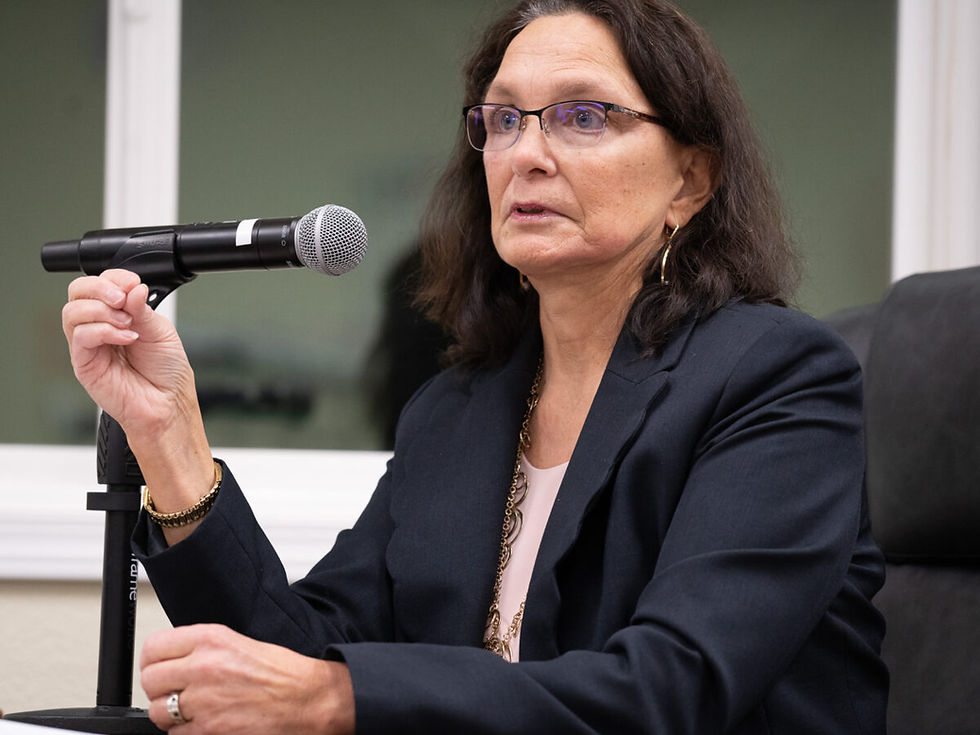
Juneau hasn’t been represented by a Republican legislator since 2017. Annette Kreitzer says it’s time for that to change, given the range of economic and other challenges the region is facing during the coming years.
Kreitzer, a former Haines borough manager, is seeking the District 3 seat held by four-term Democratic incumbent Andi Story. The challenger says she’s seen the Alaska Legislature take actions such as increasing education funding without doing enough to ensure the state can afford such spending.
"As I see the Legislature struggling with a dwindling economy, and a dwindling economy in Southeast, I believe that I can bring a broader public service perspective to the district," she said in an interview earlier this month.
District 3 represents Haines, Skagway, Gustavus and parts of North Juneau.
Kreitzer has a long career in state government in Juneau, including as a staff member beginning in 1992 for Republican Loren Leman when he was in the Legislature, his chief of staff when he was lieutenant governor, and then being named administration commissioner under governors Sarah Palin and Sean Parnell. She retired from state government in 2012, but was then named Haines’ borough manager in 2021 and served until stepping down in 2024.
Kreitzer said expanding natural resource industry activity is key to ensuring a stable economic future for the state, and it’s also important to "follow our constitution in determining if these projects are in the best interest of the state."
She told KHNS public radio in June there is an opportunity for the state under President Donald Trump because "the fact of the matter is that he is more interested in promoting resource development than I think the Biden administration was, especially on behalf of the state of Alaska.”
But while Trump has signed an executive order declaring regulations should be eliminated if they inhibit maximum utilization of Alaska resources, Kreitzer, in her interview with the Independent, said it’s important with such projects to "ensure that we're doing it properly and according to permitting."
"I know people are concerned that we have now an expedited permitting process that some operations could apply for, but I don't think it changes the requirements of that permitting," she said.
The permitting process is important to ensure concerns about the proposed New Amalga Gold Project north of Juneau are considered, Kreitzer said. She also said she has questions about the proposed Cascade Point Ferry Terminal, which the company that owns the Amalga mine site is hoping to access to ship ore.
"I haven't heard an argument yet that makes sense to me in terms of ferry users," she said.
Kreitzer said "I think the mining industry has a lot to offer" in helping develop a long-term solution for glacial flooding in the Mendenhall Valley. She said a lake tap appears to be the best approach, and a drill-and-blast drainage tunnel proposal by a local mining expert appears to be "a very compelling solution to this."
Education has been a primary issue for Story during her time in the Legislature, including serving as co-chair of the House Education Committee for the past two years, during which she advocated for higher per-student funding and other spending increases. Educators called the increases long overdue after more than a decade of nearly flat funding fell far behind the pace of inflation, resulting in school closures, layoffs and program cuts.
Kreitzer, noting Alaska’s test scores have dropped to some of the lowest in the U.S. in recent years, said lawmakers need to look beyond money and consider how schools are managed.
"I know everyone says, ‘Well, it hasn't kept up with inflation,’ and that may be true," she said. "But there have been increases to education funding over time. There have to be some changes in the results."
The Juneau School District’s student population has declined from a peak of 5,701 students in 1999 to fewer than 4,000 in recent years and a state study projects Southeast Alaska will see the state’s biggest population drop between now and 2050. Kreitzer said her range of experience in dealing with such issues in the past will offer guidance for the future.
"First of all, when I was commissioner of administration I worked with (the Office of Management and Budget) to not send state jobs out of Juneau. That's a very concrete thing that can be done," she said. "And secondly, it does go to trying to stabilize the industries that we have here."
She cited working with tourism officials to provide more consistent cruise traffic in Haines as an example, instead of current schedules that vary widely.
"I'm well aware that to reboot, for instance, a timber industry, even a localized timber industry — and I'm not talking about clearcutting, I'm talking about small operations to provide local wood for home building, hopefully to help bring down the cost of lumber in Southeast — I know that there are a lot of hurdles that would have to be overcome to do that," she said. "But hurdles you just have to either find a way around them, or you go over them."
This year’s legislative session ended in May with lawmakers unable to agree on a bill to advance the Alaska LNG Project. Gov. Mike Dunleavy then called three special sessions trying to break the deadlock, but last week acknowledged it no longer made sense to continue the sessions due to House and Senate leaders stating they would not consider his most recently proposed bill.
Kreitzer, who worked for the Senate Resources Committee during her time with Leman, said she believes it's important for lawmakers to "have the facts that they need to have to make decisions because this is a huge impact for the state of Alaska."
"I want our resource industries to be successful, but not at the expense necessarily of the ability of the state to move forward — or even be on the hook for more than it thought it was going to be on the hook for," she said.
One key political question in the District 3 race is which legislative coalition the winner will caucus with, since the current House makeup is a 21-member majority consisting mostly of Democrats and a 19-member Republican minority. Kreitzer said she is keeping her options open if similar alliances exist after the November election.
"If there is a coalition that's formed to focus on constitutional responsibilities (and) removing bureaucratic obstacles to small businesses, then I would consider having a role," she said.
• Contact Mark Sabbatini at editor@juneauindependent.com or (907) 957-2306.