


Cost concerns, subsistence rights highlighted by SHI president in AFN keynote address

Worl encourages Alaska Native leaders to take action as challenges mount for residents in rural communities
By Jasz Garrett
Juneau Independent
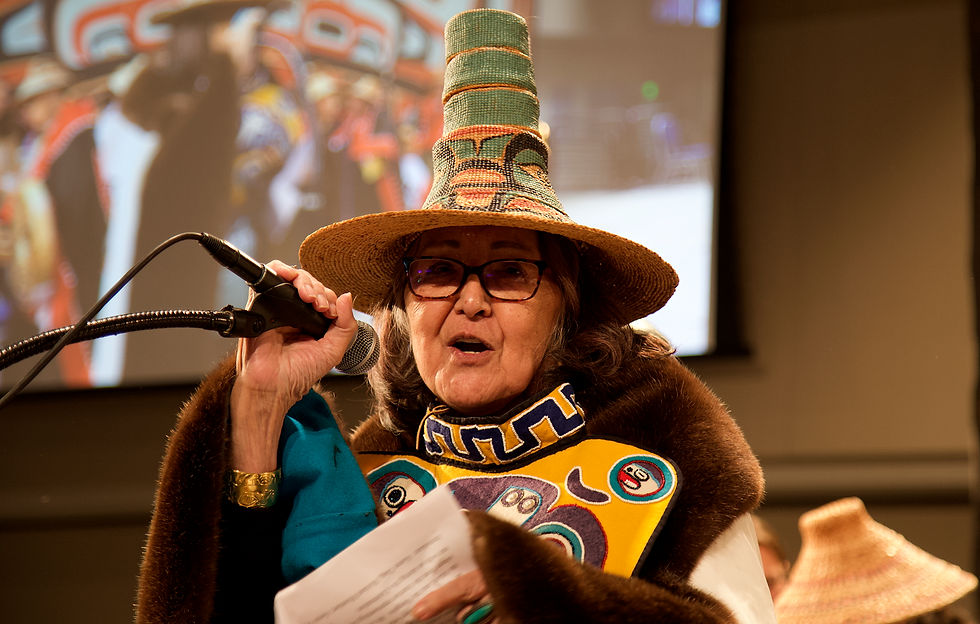
Rosita Kaaháni Worl, president of Sealaska Heritage Institute, urged Alaska Native leaders to advance solutions for subsistence challenges to state and federal governments during her keynote address Thursday at the Alaska Federation of Natives’ 60th annual conference.
The AFN convention began Thursday at the Dena’ina Center in Anchorage and ends Saturday. This year’s theme is “Rooted in Land and Tradition, Rising in Our Voices.”
Indigenous residents in rural Alaska are facing soaring fuel prices, food insecurity, lack of jobs and other hardships as they also confront uncertainties about sovereignty rights, Worl said. She shared the history of past leaders and their efforts to resolve aboriginal land claims as a model to address ongoing threats to cultural survival.
“As a student of Alaska Native history and culture, I believe we have come to another juncture in our history in which we must unite, as our historic leadership did, to address two major threats to our cultural survival: subsistence and the vitality and survival of our rural communities,” she said.
Worl, who also serves on the AFN Board of Directors and chairs the subsistence committee, said she was honored to be chosen to speak. AFN is the state's largest Native organization, representing more than 140,000 Native people.
Worl opened her speech by sharing a traditional lesson to address the challenges she said Alaska Native people currently face.
She recalled a 1980 peace ceremony held to memorialize the reconstruction of a sacred Peace Rock on the bank of the Chilkoot River. The state highway department destroyed the sacred rock while widening the road to improve access for sport fishers and tourists.
Worl said clan leaders chastised state officials in Lingít for “their continued transgressions against Native people,” and the peace ceremony was not carried out. Instead, elders at the 1980 ceremony encouraged young people to reflect on ongoing transformation and threats to their culture.
One elder attending the ceremony, George Davis, Kichnáalx̱, clan leader of the Deisheetaan, was a lead orator. Worl said he challenged Native youth to ponder “the significance of the waves of change surging across our homeland and revolutionizing our world.” He warned that ongoing forces of change threatened cultural survival.
“Just as the Peace Rock had been transformed from its original society, so had tribal cultures been altered from their original forms. Like the Peace Rock, which had been destroyed and then reconstructed piece by piece, the elder offered the promise that Native people can rebuild their traditional cultures on the knowledge and values of their traditional society,” Worl said.
Native leaders obtained the largest aboriginal land claim settlement in the nation in 1971 — the Alaska Native Claims Settlement Act (ANCSA). The settlement transferred 44 million acres of land to 12 regional corporations and over 200 village corporations. ANCSA is still the largest land claims settlement in United States history.
“Our Native leaders were adamant in their demand that we should have full control and ownership of our land and not be subject to federal control,” Worl said.
But she added leaders recognized flaws and dangers in ANCSA that conflicted with cultural values.
“It is rare that an entire society, let alone a society comprised of five different cultural groups speaking different languages, meet to identify their common values and to discuss legislative action to ensure a society’s cultural survival,” Worl said.
Several amendments to ANCSA, commonly known as the 1991 amendments, were signed into law in 1988. The historic provisions recognize values identified by Alaska Natives during a 1984 AFN leadership retreat.
“I cannot overemphasize how astonishing it was that Alaska Natives met in five leadership retreats and seven conventions to identify their common cultural values, to develop resolutions to identify their common cultural values to the identified problems, and then to formulate amendments to ANCSA, all to ensure Alaska Native cultural survival,” she said.
Year after year, Worl said, AFN resolutions are adopted in conventions that have identified actions to resolve subsistence challenges.
She said AFN proposals include repealing the extinguishment of Alaska Native aboriginal hunting and fishing rights in Section 4 of ANCSA and affirming those rights, amending the subsistence priority in the Alaska National Interest Land Conservation Act (ANILCA) to provide for a subsistence priority for all Alaska Natives and rural residents, and amending the Alaska State Constitution to recognize Native subsistence rights.
“We have consistently proposed co-management of fish and wildlife resources,” Worl continued. “We have also proposed amending the different definitions of Alaska Natives in ANCSA and ANILCA and the Marine Mammal Protection Act to create a unified definition of Alaska Natives without regard to the federally defined one-fourth Native blood quantum. We know what needs to be done, but we have yet to advance these measures to Alaska’s congressional delegation and Alaska’s governor and legislators.”
She said the current generation of AFN leaders must develop and implement strategies to accomplish the proposed resolutions to ANCSA, ANILCA, the Alaska constitution, and fish and wildlife management.
Worl said an observation by Senate candidate Mary Peltola, D-Alaska, “tragically highlights” challenges Alaska Natives face: choosing between feeding their family or keeping them warm.
“In one of my early papers, I described the dual economies, including subsistence and a cash economy, that characterize our rural communities. Today the interrelationship between these dual economies has become especially apparent,” Worl said, pointing to surging fuel prices in rural Alaska and a lack of jobs in villages.
The price of a gallon of gasoline in the northwest Alaska village of Shungnak was $26.82 in August, according to the Alaska Beacon. Rising prices for fuel and essential goods are hitting rural Alaska especially hard. The increases are largely attributed to the U.S. war against Iran that began in February and tariffs imposed by the Trump administration.
“We can assume that the productivity of hunters decline and the food security of villages is threatened with these high prices,” Worl said. “This reality demonstrates the need not only to focus on the resolution to subsistence challenges, but also the need to enhance and develop our cash economies in these villages.”
Alaska’s two Republican U.S. senators, Lisa Murkowski and Dan Sullivan, both acknowledged cost concerns during opening-day speeches to the convention.
Worl encouraged simultaneous action on subsistence challenges and economic depression, especially in rural communities. She said action is vital for the survival of Alaska Native culture and necessary to halt outmigration.
Worl added that even Juneau, as the capital city, is reporting a dramatic outmigration. She noted a consequence of outmigration is the potential closure of more schools across the state.
“Native people fought an aggressive battle to protect their land base and cultures,” Worl said. “Miraculously, they survived, but in the wake of the cultural encounters and disruption, their communities were left weakened with a host of both physical and social pathologies that ate away at the core of their culture and continue to
plague us today.”

She said she believes Alaska Native people have the capacity and strength to resolve subsistence challenges and ensure economic survival of rural villages. She told the younger generations attending the AFN conference to consider these lessons.
“We must remain vigilant and undaunted, and look to the lessons offered by our ancestors who spent centuries battling to protect our way of life,” Worl said.
“Natives, with the knowledge of their elders, the lessons of colonialism, and forced but failed assimilation, can envision new ideologies to control and channel the waves of change,” she said.
Worl said the task of AFN is to bring resolutions identifying solutions to subsistence challenges to the state and federal governments while developing sustainable village economies that do not harm the environment.
“This work is complex, requires dialogue, consensus building, and a deliberate process to ensure the best legislative language and strategies are utilized to achieve these goals,” she said in closing.
• Contact Jasz Garrett at jasz@juneauindependent.com or 907-723-9356.


