.png)

Bartlett has a $7M federal funding shortage — but not because of cuts in the ‘One Big Beautiful Bill’

$4M is lapse of 20-year-old rural funding program awaiting renewal by Congress, $3M is change to a reimbursement program that may be a glitch, hospital’s CEO says
By Mark Sabbatini
Juneau Independent
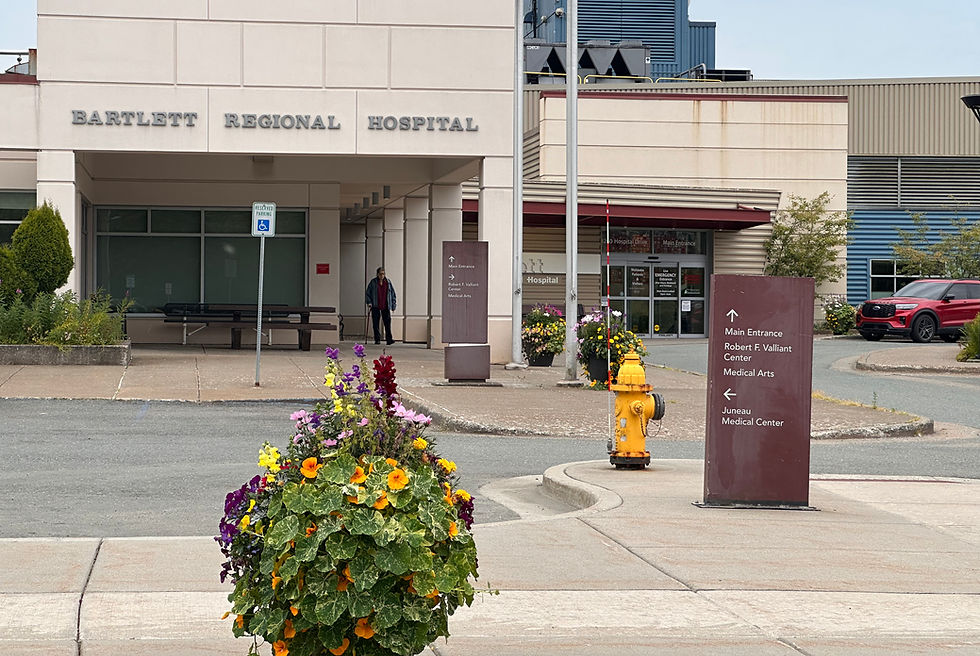
Bartlett Regional Hospital has $7 million less in federal funds than expected so far this year, but it’s not because of headline-grabbing hardships reported nationally in the wake of last year’s federal budget bill, according to the hospital’s CEO.
About $4 million depends on final congressional renewal of a 20-year-old rural funding program the Senate passed unanimously, Joe Wanner said in an interview Friday. The other $3 million involves the hospital getting a lower reimbursement rate this year from a different program for reasons not yet clear, but which Wanner said may simply be a federal agency miscalculation and something he expects will be favorably resolved.
"What we're dealing with isn't associated with the changes that are associated with the ‘One Big Beautiful Bill,’" he said.
However, Wanner noted, changes to Medicaid in that bill are expected to significantly affect Bartlett beginning in 2027. Also, an end this year to some Affordable Care Act subsidies resulted in hundreds of Juneau residents losing coverage, according to Wanner and state health officials.
The $7 million shortfall was raised during a Bartlett board of directors meeting Tuesday, following a discussion by the board’s Finance and Audit Committee on July 22. Wanner said it’s a matter of concern rather than alarm, with hospital officials ready to implement contingency plans at the end of this year if the discrepancies with the two programs aren’t resolved.
He also said the hospital’s overall financial situation is more stable than a couple of years ago when its leaders pleaded for help from the Juneau Assembly following four years of heavy operating losses, saying the hospital could run out of cash within three years. That resulted in a series of actions including program and staff cuts to make the city-owned hospital’s operations profitable again.
The hospital’s 13-month balance sheet through the end of June shows a net fund balance of about $172 million in June of 2025, $163 million in December of 2025 and $164 million in May of 2026 — but then a dropoff to about $151 million in June.
"I think the major inconvenience with this is the unknown of what happens on Jan. 1 with Medicaid," Wanner said.
Up for renewal by Congress is the Rural Community Hospital Demonstration Program, with the Senate passing a five-year extension May 20 that is now awaiting House committee action. The program established in 2005 provides funds for up to 30 hospitals in rural areas nationwide that are of limited size, yet provide certain essential services. Bartlett was enrolled in the program since its inception, but its participation lapsed on June 30, 2025, and the hospital is currently second on a waitlist to be restored to the program if funds are available.
Congress has renewed the program three times since it was launched. Wanner said that while nothing is a certainty when it comes to lawmakers in D.C., the current situation isn’t new and Alaska’s congressional delegation has indicated renewal is likely.
"I'm relatively confident it'll get extended again," he said. "I don't think this is the longest gap we've had. We've had gaps of 18 months in the past."
The other matter of $3 million is because Bartlett’s is getting a lower payment rate than anticipated for patient admissions under what’s known as a Diagnosis-Related Group (DRG) system, Wanner said. The payments are specific to Medicare and the dropoff began Jan. 1 of this year. He said an inquiry by the hospital to the U.S. Centers for Medicare and Medicaid Services in June about the lower rate hasn’t received a reply.
"My takeaway from that is they found an issue and they're trying to address it in their system," he said.
Each hospital has a specific rate, so it’s possible there is a discrepancy unique to Bartlett or a wider problem, Wanner said.
If one or both shortfalls persist until the end of the year there are contingency plans hospital officials drafted while it was going through its financial crisis a couple of years ago, he said. A primary one is Bartlett might switch from its designation from an Acute Care Hospital that provides short-term patient care to being a Critical Access Hospital providing more specific patient treatment in addition to 24/7 emergency room care.
Wanner said he doesn’t believe most local patients would notice or be affected by the change.
"We'd still be able to take care of the same people," he said. "All the programs would be open. We'd have to have more diligent management where those patients exist within the hospital, so there's more work on our side. And there might be a few more transfers (to other hospitals) of the critically ill patients."
An evaluation of options to address financial hardships at Bartlett due to Medicaid changes next year is also in progress. An Alaska Department of Health report estimates 9,400 to 13,600 residents will lose Medicaid access due to work requirements and other provisions in last year’s budget bill. In addition, Wanner noted during a May 26 Bartlett meeting that 200 to 400 Juneau residents were expected to lose health insurance because of the cutback in Affordable Health Care Act subsidies.
"The combined impact of Medicaid changes and marketplace contraction presents moderate-to-high financial and operational risk, particularly through coverage loss and payer mix deterioration," he wrote in a report to the board for that meeting.
The Medicaid and other health care cutbacks imposed since President Donald Trump began his second term in January 2025 are expected to be a major issue of debate in this year’s midterm elections. Alaska lawmakers and candidates supporting Trump are citing the budget bill’s establishment of a Rural Health Transformation Program, which is providing the state about $272 million annually for five years for projects and programs meeting certain specifications.
Wanner, echoing concerns expressed by numerous state health officials and policymakers, said the amount of funding in the new program and the limits on its use won’t replace the gap left by Medicaid and other cuts.
"While (Rural Health Transformation Program) funding could partially offset these pressures, organizational discipline and proactive planning will be critical regardless of funding outcomes," he wrote in his memo to the board.
• Contact Mark Sabbatini at editor@juneauindependent.com or (907) 957-2306.


_edited.jpg)




.png)

.png)