.png)

Global report highlights Mendenhall Glacier’s rapid retreat as a catalyst of climate change, warns impacts may speed up

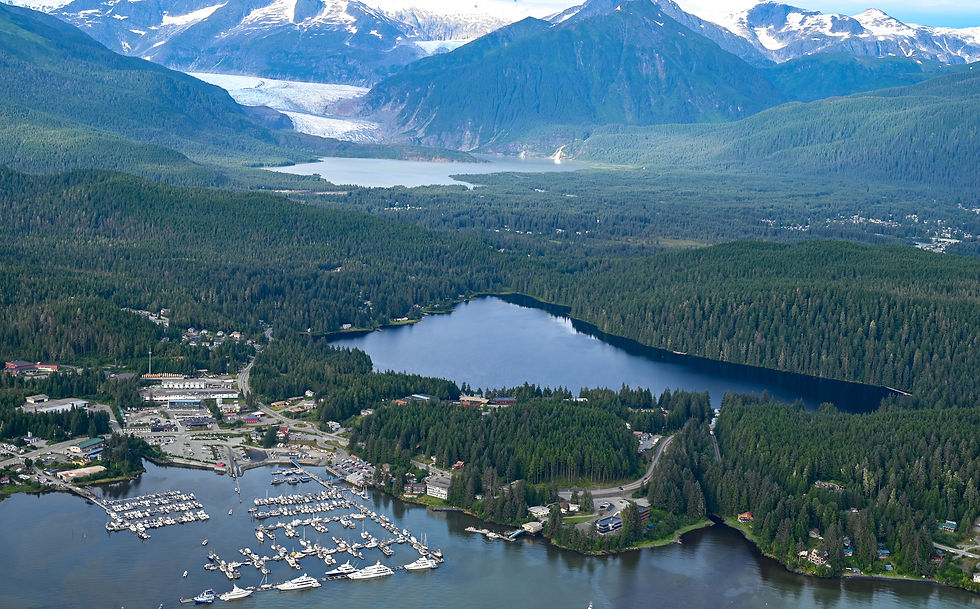
What does it mean for Juneau now that Áakʼw Tʼáak Sítʼ, the glacier behind the little lake, has receded from the icy water?

By Jasz Garrett
Juneau Independent
Local researchers know the future of glacial lake outburst floods largely depends on how quickly Mendenhall Glacier retreats. The magnitude of that change is serving as a case study in a global report released this fall, showing it may also have extensive economic and cultural impacts.
Many Juneau residents have watched the glacier’s rapid melt over the past two decades as it withdraws into the mountains. As early as 2002, scientists predicted that within two decades, the Mendenhall would transition from a lake-calving glacier to a mountain glacier. According to the case study, the glacier has retreated over four kilometers since its Little Ice Age maximum around 1760 and is now losing approximately 48 meters annually.
This October, researchers said the glacier could pull from Mendenhall Lake within the next few years. But in November, community members and scientists witnessed the transformation firsthand. Áakʼw Tʼáak Sítʼ — Tlingit for the glacier behind the little lake — has officially left its creation behind for the first time.

The glacier’s retreat also leaves a resounding message for climate change: local communities are feeling it first and must be included in conversations to combat it, according to the Global Tipping Points Report (GTPR). A total of 160 authors, from 23 countries and 87 institutions contributed on how to govern Earth system tipping points, the risks they pose, and the opportunities to reduce negative impacts. The Oct. 13 global report includes the case study “Mountain Glaciers: Áakʼw Tʼáak Sítʼ (Mendenhall Glacier)” and refers to the glacier by its Tlingit name throughout.
The study states the tipping point of the Juneau Icefield, the fifth-largest body of ice in North America, will be reached if it melts even faster.
But scientists are still trying to determine just how fast that could be and what the catalysts are.
According to the GTPR, a tipping point occurs when part of a system changes, such as the Juneau Icefield reaching a point of warming that triggers a self-sustaining, abrupt and often irreversible accelerated melt cycle. Regarding the Mendenhall, the case study notes that relatively limited research has investigated the capacity for mountain glaciers to respond non-linearly to climate change.
The GTPR says overshooting 1.5 degrees Celsius of global warming raises the risk of triggering irreversible events, such as the loss of the Greenland and West Antarctica ice sheets, with each 0.1 degree adding to the risk. The tipping point has already been reached for tropical coral reefs. A recent United Nations report states the planet will likely exceed 1.5 degrees Celsius within the next decade.
The specific temperature at which the Juneau Icefield will cross its threshold is not yet known. Mountain glacier tipping behavior depends on a complex interplay between topography and climate, with responses varying by local conditions. Still, with every 0.1 degree, more ice will melt and, if enough ice is lost, the retreat will occur even more rapidly.
The impacts of surpassing tipping points can be reduced by limiting the period of time that temperatures exceed the 1.5 degrees Celsius benchmark, reducing global warming below that level by 2100, and stabilizing below 1.0 degrees on longer timescales.
However, no single country is currently meeting all UN climate goals, despite nearly 200 countries agreeing at the 2015 UN climate summit in Paris to limit global temperature rise to 1.5 degrees Celsius.
Donovan Dennis, a scientist at the Potsdam Institute for Climate Impact Research, co-led the Mendenhall Glacier case study. His colleagues at the University of Alaska Southeast and the Alaska Climate Adaptation Science Center made major contributions.
“We’re interested in telling a scientific story as it relates to people,” Dennis said. “And that’s what makes it different than just another scientific paper is that here we’re trying to go from the science, but then how does this impact the everyday Juneau tourist, or the everyday Juneau shopper, or the everyday Indigenous community member?”
In 2015, Dennis was introduced to glaciology during a two-month research program that crossed the Juneau Icefield. He said the experience motivated him to study Earth science. For the GTPR, his research team was tasked with writing a case study on mountain glaciers. The other three mountain glacier studies included in the report are globally focused, while the Mendenhall Glacier team took a local approach.
Dennis said his team’s initial idea was to write a case study on all mountain glaciers, but they decided against it because rapid deglacierization can vary from glacier to glacier. He proposed studying the Mendenhall Glacier and the broader Juneau Icefield to the editorial team. He said his research team demonstrated how taking a local perspective could reveal the thought process policymakers globally will have to engage in as the effects of climate change are realized.
“Juneau, as we wrote in the case study, contributes very, very little to climate change as a community,” Dennis said. “It doesn’t have these major factories, major electrical production facilities that are putting carbon into the atmosphere at a rate that’s alarming or even globally significant.”
Despite this, he said Juneau is feeling the impacts of climate change, as are other local communities, through events such as record glacial flooding.
Dennis said the people who read the report, such as policymakers and journalists, may not be directly impacted by climate change in the same ways that others around the world are, “especially in Juneau.”
He pointed out that as the Mendenhall Glacier retreats, its icefield straddles the U.S.-Canadian border. He expects the area to become generally more accessible, although he acknowledged it will be a wild space. Still, he said, “it could mean in 300, 500 years, a much different border situation.”
He said if preserved wild spaces suddenly become accessible because of climate change and glacier retreat, it could also mean more natural space being opened for economic and resource development.
Dennis said governance and policymakers do not think in these long-term scales, but if the report can encourage them to do so it will have a useful outcome.
“We need to be moving from a reactive way of approaching climate change to proactive,” he said.

Understanding flood risks will deepen the understanding of tipping risks
The rapid retreat of a Mendenhall tributary glacier, Suicide Glacier, has led to annual outburst floods in Juneau since 2011. Over the last three years, the Mendenhall River has crested at record levels each August due to the release from Suicide Basin. Mendenhall’s icy wall currently acts as a natural dam for the deep, rocky basin carved into Bullard Mountain.
Dennis said the Mendenhall Glacier case study shows the state of what is already known for Juneau’s jökulhlaups. He said not a lot of modeling of the Juneau Icefield has been done, although both the Potsdam Institute and the University of Alaska Southeast are producing maps of the glacier’s underside with an ice-penetrating radar.
“All of this will contribute to us knowing how this tipping might unfold, if it’s as dramatic as early papers have already suggested it could be,” Dennis said.
The maps can help measure ice thickness, predict the lifespan of outburst floods and survey future basins still under the ice. Dennis said they can also help answer the question of how much faster the overall Juneau Icefield might retreat.
“That is the work that’s really going to inform what the future of those floods will look like because you need to do this very, very detailed mapping of what underneath the glacier looks like, and that will allow us to better anticipate how fast the glacier will retreat and how much water is expected to be released over time,” he said.
Dennis said local science is valuable and the case study would not have been possible without it.
Part of taking a local focus with the case study was understanding what the loss of the Mendenhall Glacier means for the Indigenous community. Through his research, Dennis learned the melting of Áakʼw Tʼáak Sítʼ is a death to the Tlingit community.
“That is a profoundly different kind of loss than just a tourist who no longer has a glacier to take a picture of,” he said.
Dennis said it was important to him to include Indigenous storytelling in the case study “because there’s a lot of different ways of knowing” and the research is about “a place that has been cared for and stewarded by the Tlingit people for thousands of years.” He also said no other mountain glacier case study included an Indigenous perspective like Áakʼw Tʼáak Sít’.
“It’s really important for me, as I think it should be for all scientists, to acknowledge and incorporate these different ways of knowing that are not as familiar to us,” he said.

Grieving glaciers
Anthropologist Judith Dax̱ootsú Ramos belongs to Kwáashk’ikwáan, the Pink Salmon Clan in Yakutat. She is a coauthor on the Áakʼw Tʼáak Sítʼ study and said she was brought into the project to provide her knowledge of Tlingit traditional beliefs around glaciers.
“We’re very attached to the environment where we believe that everything has a spirit,” she said. “In creation stories, the animals and humans are like one. The belief is that if you treat animals with respect, then it will give its life to you and you can eat it. Treat the salmon body’s with respect and then it will allow you to catch it and you can have food for your family. These are all beliefs in not only animals, but the environment around us – the glaciers have a spirit and the mountains have a spirit.”
The case study notes glaciers served as pathways for travel and trade, embodied sentience and engaged in dialogue with Tlingit people, acting as a driver of change in social, marine and terrestrial landscapes. Tlingit people teach respect and gratitude toward glacier spirits, which helped secure safe travel and passage, as illustrated in the oral histories of Glacier Bay.
The study of Áakʼw Tʼáak Sítʼ states rapid deglaciation “disrupts the relationship between Indigenous communities, glaciers and glacial landscapes, depriving future generations of this component of their identity and history, which are inseparable from the land.”
Ramos said grief is felt because climate change forces Tlingit people to adopt their culture.
For example, Tlingit carver Wayne Price recently told Ramos the yellow cedar used for traditional arts is dying out. Ramos teaches Northwest Coast Arts and Alaska Native studies at the University of Alaska Southeast.
“It’s really sad to hear Wayne Price say they can’t get the yellow cedar anymore,” she said. “And it’s really sad to hear that the salmon are going to maybe not show up because the water’s too hot in our rivers. We build our whole life around cedar and salmon. We’re going to have to adopt now to other things, but our whole culture was built around those. People are really scared too about flood events and all the landslides.”
Ramos said for the study, she also shared with her research colleagues that other communities, like Yakutat, are facing similar fears about possible flooding.
“We were talking about the Juneau reaction to the flooding, and then I knew that the tribes had a big role in providing support for people around that flooding event,” Ramos said. “Yakutat Hubbard Glacier has also been a very active glacier. Many times in the past, it has advanced, cut off the Russell Fjord, and Russell Fjord became a lake. And so people in Yakutat, they have a lot of fears about if Hubbard Glacier floods out, what would happen in the community?”
Ramos said the Hubbard Glacier closed off the fjord in 1984, causing its lake to fill. She said the community was concerned about the effect on the Situk River. The river supports the sports fishing industry and is Yakutat’s main subsistence fishing river. The case study notes the Tlingit have deep relationships to glaciers that stretch back for generations, shaping cultural identity and harvest practices.
“Just a short nine-mile drive from the village,” Ramos said. “People would go there and set net fishery during the week and then subsistence fish on the weekend. So if the Hubbard Glacier would flood out, it would ruin that river for years before we build up in stock.”
The case study states the Tlingit community in Yakutat has already felt the traumatic loss of Hubbard Glacier on the Alaska-Yukon border. Ramos said the Situk River is changing quickly – river outlets and the coast are moving north.
The community’s fish camps are built along a sandspit at the mouth of the Situk River. Rapid coastal erosion is changing the landscape, erasing berry-picking spots. While there are no fish camps Ramos is aware of on the Mendenhall River, she said she enjoys harvesting fireweed at its mouth. The case study notes the branched streams of the Mendenhall River have provided salmon spawning, fishing opportunities, and food resources since settlement by Indigenous peoples nearly 10,000 years ago.
“Our belief is based on respecting the land so it will continue to provide for us,” Ramos said.
She said she would like readers of the case study to consider a joint action plan that incorporates everyone’s concerns and voices through holding more community gatherings. Ramos is a Southeast Alaska Conservation Council board member and chair of its Indigenous Engagement Committee, as well as a member of the Central Council of the Tlingit and Haida Indian Tribes of Alaska. The case study recommends recognizing cultural heritage as central to adaptation.
“We’re dependent on the land and the waters, the air, and we need to protect it,” Ramos said. “Indigenous people have been stewarding this land for long and they could serve as examples of their knowledge. We have to work together as a society, because right now we have to encourage the governments to help us to keep our community going for the future generations. So I think the idea of working together with each other is real important.”
She said the joint approach the city and tribe took to respond to the 2025 glacial lake outburst flood in Juneau is an example of this. Tlingit and Haida partnered with the City and Borough of Juneau in a Unified Command to prepare for flooding. The tribe first initiated recovery efforts following the 2024 flood, which damaged more than 300 homes. The case study also notes the tribe's cultural ambassadors program “preserves and protects
historic and cultural resources in the region” and support Indigenous governance of traditional territory at the Mendenhall Glacier Recreation Area.

A vanishing attraction
Rapid loss of the Mendenhall Glacier could negatively impact tourism in Juneau as the glacier retreats from the Mendenhall Glacier Visitor Center viewshed, which is visited, on average, by every third visitor to Alaska. For the 2025 season, a total of 1,688,738 passengers from large cruise ships visited Juneau, a 0.6% increase from the previous record set in 2024. The case study states about 700,000 visitors visit the Mendenhall Glacier each year.
Projections by the University of Alaska Southeast estimate the glacier will no longer be visible from the visitor center by 2050.
The vanishing view prompted the U.S. Forest Service to explore new locations for glacier viewsheds in its Mendenhall Glacier Visitor Facility Improvements Project, which in a Notice of Decision in 2023 projected a potential capacity of 1 million annual visitors within 30 years.
However, the case study asserts such an increase in visitors to a vanishing glacier may defy reality.
“Managing the Áakʼw Tʼáak Sítʼ and other glacier viewsheds is a key management issue for Southeast Alaska, highlighted by the case of the Begich, Boggs Visitor Center near Portage Glacier in southcentral Alaska, which consistently lost visitors following the loss of its glacier viewshed due to retreat around 1994,” the case study notes.
The case study also notes the Forest Service’s expansion plan for the Mendenhall Glacier Visitor Center has been met with mixed responses by residents, some of whom have expressed concerns about environmental impacts.

(Infographics courtesy of Eran Hood et al.)

An unclear future for fish
The study says economic consequences of crossing a glaciological tipping point on fishing and salmon stocks in Juneau are less clear, given the complex interplay of water temperature, air temperature, nutrient availability and riverbed scouring in glacially influenced aquatic ecosystems. Tributaries of the Mendenhall River watershed provide salmon spawning and rearing habitat, fishing opportunities, and food resources, the report states, since Indigenous peoples settled the area nearly 10,000 years ago.
“We really tried to talk a little bit about this when it came to fisheries, not just fisheries, but just salmon in general, as a local community resource,” Dennis said. “This story of salmon and how they will change in the future is astoundingly complex, and it’s a beautiful but very complex story, and so I don’t think we could tell the full story in the report.”
Dennis said Jason Fellman at the University of Alaska Southeast, who peer-reviewed the case study, has been researching how ecosystems and salmon habitat will respond to both atmospheric warming and glacial loss. Dennis said the case study is not a way to predict how salmon and fishery stocks will respond in the future. In short, research has shown continued glacial retreat could create environmental conditions more suitable for fish growth, but greater uncertainty in environmental conditions could increase year-to-year variability in fish populations.

Next steps
The case study states Juneau community members “maintain a strong connection to the experiences and memories attached to the glacier, valuing its proximity to the city, the educational and recreational opportunities its presence affords, as well as the intangible connections across generations of Juneauites.”
“There’s very few glaciers that people have lived with like they’ve lived with the Mendenhall,” Dennis said. “And so I think its loss, when it comes, this will be a loss that is felt a lot – not just by people from Juneau, but anyone who’s ever come and visited this glacier.”
Scientists recommend that governance considerations involve multiple partners and rights holders, including Indigenous governments, state and federal agencies and local governments, with the inclusion of the community – particularly when it comes to resource management and the opening of navigable U.S.-Canada border crossings following the ice retreat.
Dennis encouraged Alaska’s lawmakers to take a two-pronged approach.
“The first is do as much as they can to reduce local and state emissions, so being really conscious of how Alaska is contributing to global change,” he said. “That's the first step, right? And the second is being aware of the problems that climate change will cause.”
Dennis used the Alaska Climate Science and Adaptation Center as an example for the second step. He said the center has made efforts to improve cooperation between the U.S. Geological Survey and state university systems, as well as to increase local collaboration.
He said other communities should look to Juneau’s strength and resilience for guidance on coming together amid drastic change, especially in the face of glacial lake outburst floods.
“It’s inspiring,” Dennis said. “It will be an example for other communities around the world how they need to respond to climate change, which is with solidarity, with compassion for neighbors, with care for and from Indigenous communities who are impacted.”
• Contact Jasz Garrett at jasz@juneauindependent.com or (907) 723-9356.


_edited.jpg)



.png)

.png)