.png)

Juneau Assembly set to vote on paying for View Drive appraisals Monday, with buyout project’s final fate unknown

Updated: May 19
‘Nothing has been done to protect View Drive homes from relentless flooding’

By Jasz Garrett
Juneau Independent
The Juneau Assembly is set to decide Monday whether to pay for View Drive appraisals so residents can determine their interest in participating in a federal buyout project.
The neighborhood’s eligibility for the federal program was confirmed by the Natural Resources Conservation Service last July and presented as the neighborhood’s only option against annual glacial lake outburst floods.
The Assembly is scheduled to take up an ordinance appropriating up to $558,000 to plan for the View Drive buyout project. The total includes $6,000 per parcel for appraisals and $25,000 per parcel for total project cost estimating. The funding would be provided by general funds or restricted budget reserves, according to a public hearing notice.
“The decision on Monday is to pay for the appraisals and the cost estimating of the project, so that the homeowners will know, and the city will know what the total cost of the project is,” said City Manager Katie Koester. “So every step we commit to doing the project, but we also have an ability to back out of it until the very last purchase and sale agreement of the property is made.”
The buyouts for the Mendenhall Valley neighborhood would be voluntary for homeowners through the Emergency Watershed Protection program. After a resident receives their cost estimate, they can back out of the project.
The project is supposed to be completed within 220 days of the project receiving federal funding, which was last November.
The city can request an extension of the timeline, but NRCS expects to see progress on the purchase of participating homes before this year’s glacial lake outburst flood. Suicide Basin has released in August the last three years, although it could drain earlier or later.
“I think that is going to be difficult, but they've been pretty good working with us, understanding unique circumstances,” Koester said about the timeline.
The City and Borough of Juneau entered a non-binding agreement with NRCS on March 9, indicating participation in the program, which allowed the federal government to set aside its 75% cost share. The other 25% is a local cost share. The total project cost is $25 million, which was determined through an NRCS damage survey report last summer.
Where the funds come from for the local cost share is flexible, as long as they do not come from federal sources.
“Based on previous Assembly direction, staff assume they will be part of future real estate transactions, paid for primarily by property owners and/or from other non-CBJ general fund sources,” a March 9 memo from Deputy City Manager Robert Barr states.
Monday’s choice comes after the Assembly informally asked the 18 homeowners in February if they would help pay for their own buyouts.
Eleven replied no, two with yes, and one had an unclear answer, requesting more information. Based on those results and confusion expressed to the Assembly, a decision was made then to postpone committing to the program and instead hold a neighborhood meeting with residents.
Mayor Beth Weldon, Assembly members Paul Kelly and Maureen Hall, and CBJ staff met with most of the View Drive neighborhood on March 3.
“From a bottom-line-up-front perspective, it became clear throughout the meeting that there may be more homeowners interested in a buyout than was indicated by the informal survey,” a summary of the neighborhood meeting notes.
Koester said by introducing this ordinance on Monday to appropriate funds for cost estimations, the Assembly is acknowledging the difficulty homeowners faced when asked if they could help pay the 25% cost share.
Assuming full participation, the current estimate of 25% of appraised property values is $3.38 million, according to CBJ.
The recovery buyouts are used to reduce threats from flooding and erosion when other options are not cost-effective or beneficial. Many View Drive homes have been subject to severe and repetitive flood damage.
“Due to View Drive’s unique location along the Mendenhall River, flood preventative measures, such as HESCO barriers and bank stabilization, would not be effective in protecting private properties from damage caused by glacial lake outburst floods,” Monday’s meeting agenda states.
The neighborhood hit the hardest has the fewest options
In its Aug. 13, 2025, flood report, the National Weather Service states the most severe flooding occurred in the View Drive area, where CBJ reported five homes sustained major damage after four to five feet of water entered living spaces.
The View Drive buyout program has not been included on a regular Assembly meeting agenda since October, meaning Monday is the first time in months Juneau residents are invited to provide testimony on the buyout project.
Testimonies can be emailed to city.clerk@juneau.gov or given at Monday’s 6 p.m. meeting at City Hall.
Although public testimony can be given on non-agenda items at every Assembly meeting and residents are encouraged to reach out with questions, Angela Smith said she has been waiting for a chance to give her formal statement.
On Saturday afternoon, she practiced reading her draft testimony on her upper back porch. She has lived on View Drive for the last 30 years and bought her house when it was mapped above the 100-year flood plain, with no flood insurance required.
“Nothing has been done to protect View Drive homes from relentless flooding,” Smith wrote in her draft testimony.
Other Mendenhall Valley and river homes “have hope not to get flooded. Hope in HESCOS, rocks and sandbags.”
“I have none,” she wrote. “Tall walls of sandbags and plastic cannot hold off the over 4 foot lake that engulfs my structure for hours.”
Last year, there was more than four feet of water inside her house.
“You try to plan for that plus more,” Smith told the Independent. “We haven’t been helped by the city or the Army Corps. That’s why it’s really important that they give us the opportunity of the buyout and people can choose.”
Smith said her household would consider contributing a large portion of the buyout value of their house (a preliminary estimate of $320,000) towards demolition and removal.
The March 9 decision indicated the city’s intent to continue the program at this point in time, but with appraisals only now potentially on their way, Smith said she worries about the practicality of moving out before the next flood.
“We’re just planning for both,” she said, explaining she and her husband are already setting up their belongings high and taking valuables to his office. “It’s always a mad rush to get ready for the flood, so we’re starting now.”
Smith said another stressor is if the buyout doesn’t go through, she needs to start finding contractors now for emergency flood situations.
“I imagine I’ll make calls anyway since we’re planning both ways,” she said.
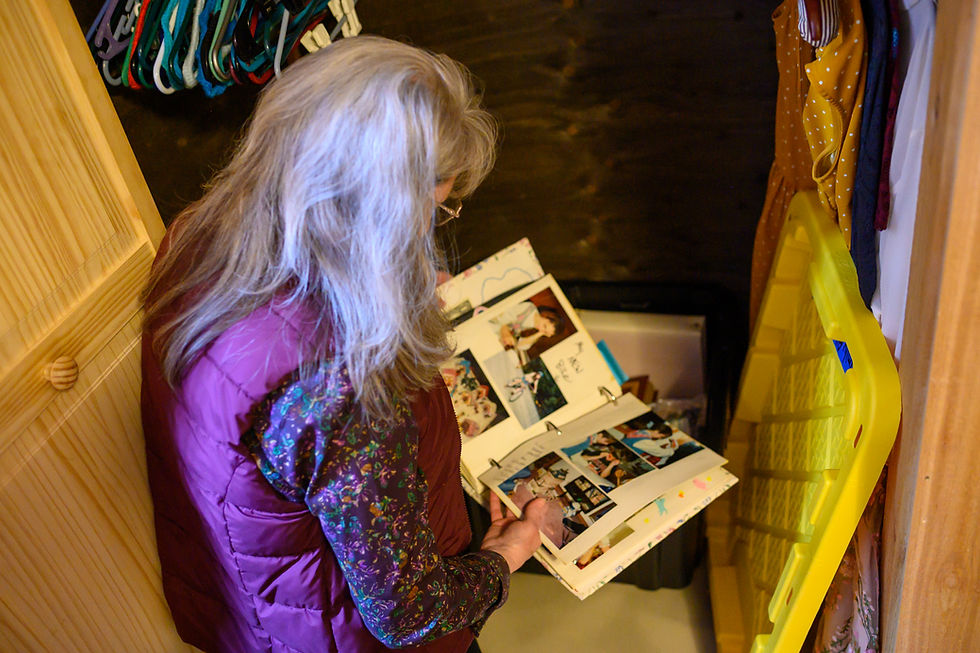
She said her nearly 90-year-old mother lives with her and evacuated last year. Her mother’s valuables, collected knickknacks, are left up high in bubble wrap year-round to keep them safe from the Mendenhall River. Smith looked at them while standing on a cement-covered floor. Her family chose not to replace part of their downstairs flooring a second time after 2025 flood damage.
“The floods have purged a lot the last three years,” she said. “Each time we think we’ve got it set, more stuff gets destroyed because it’s always different. It’s purged a lot for us downstairs.”

Ahead of Monday’s vote, View Drive residents also acknowledged the fiscal challenges the city faces due to tax cuts passed by voters last fall that are expected to cost roughly $12 million. The Assembly is required to pass a final budget by June 15.
Malachi Thorington’s household formally requested the city pursue the NRCS Emergency Watershed Protection Program last year. On Saturday, he said, “I’ve thrown in the towel.”
For one, he said he doesn’t understand how it’s possible with the city’s proposed cuts.
“I am a little bit torn from the standpoint that I think a half a million dollars to assess a dozen or so properties seems egregious,” he said. “The city manager’s office has been threatening residents with closing public infrastructure, so I do find it a little bit disingenuous.”
He said he thinks they asked too much of the Assembly “because of the number of other things they have on their plate.” Thorington added it’s not financially possible for his household to help pay the 25% local cost share.
“When the city sent out the ballots asking if we were willing to cut them a check for $200,000 completely out of left field with no information to back it up, that told me what the city’s true interests were and it’s not View Drive,” he said. “It would be much better if the city would just say no. It would be much cleaner, much simpler. I would love any genuine help and resources to resolve this issue, but I think it is a detriment to residents to be strung along, wasting their time and resources.”
He updated his flood insurance through the National Flood Insurance Program on Friday.
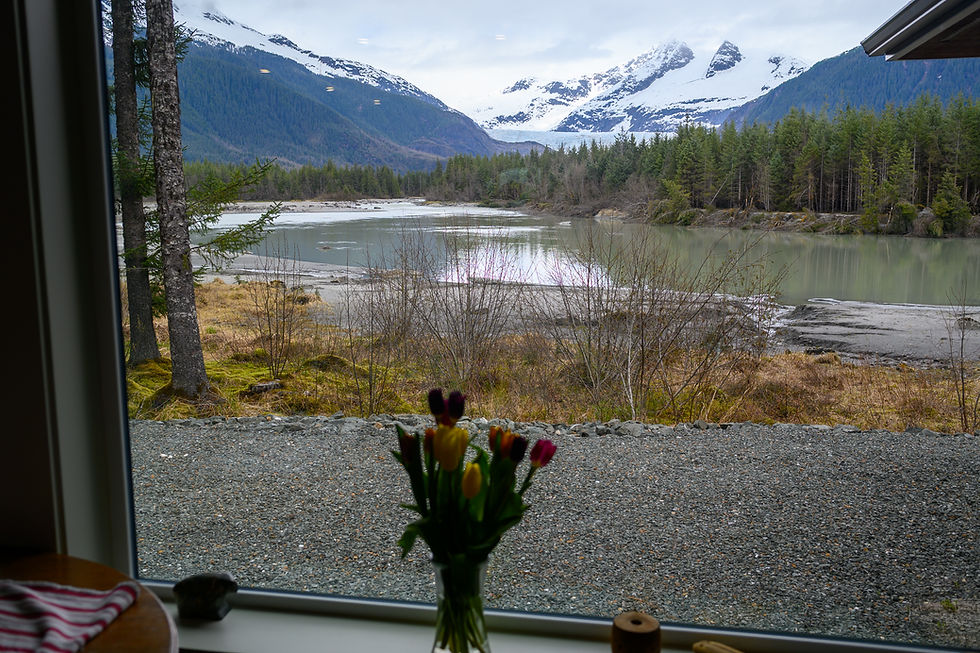
As HESCO barriers rise downstream to further block the view of the Mendenhall River, Kim Peterson looks out her window upstream at eroded banks. The Mendenhall Glacier peeks out from behind spruce trees.
“That’s why they call it View Drive,” she said with a smile.
Out of sight on the east side of the Mendenhall Glacier, tucked behind Bullard Mountain, is Suicide Basin. Trees are bent over the edge of the riverbank from the force of the 2025 glacial lake outburst flood, which crested at a record 16.65 feet.
Her German shepherd’s paws track mud on floors she replaced after the 2024 flood swamped her home. It left behind deep silt that was almost impossible to clean. In 2013, when she moved in, no flood insurance was required for her property.
Ten years later, the first catastrophic flood unleashed from the basin. The Mendenhall River crested at 14.97 feet, eroding riverbanks within hours. Large sections of two homes downstream collapsed into the river and were considered total losses, and a third was partially destroyed.
Portions of some other homes and two apartment buildings were left hanging precipitously over the edges of the riverbanks. Peterson said the 2023 flood filled her garage.
She said she is unsure if she will participate in the buyout project or not, but she still wants the Assembly to appropriate the funds on Monday to inform residents.
“I never thought I’d have to make a decision like that,” she said. “For this upcoming flood, we’re going to try to fight it, unless they give me an appraisal where I go, ‘Maybe I should just leave.’”
She has flooded three years in a row and said her house has been completely remodeled. In 2024, her household evacuated and installed sub-pumps, but it wasn’t enough. The flood that year crested at 15.99 feet, damaging nearly 300 homes in the Mendenhall Valley.
“We were literally on plywood for the whole winter, like a lot of people,” she said. “I think our loss was almost $179,000. In 2024 it got everything inside the whole house, some places a foot (of water), mostly six inches.”
Like Smith, she said she worries about it already being late May and is sympathetic to neighbors with worse flooding than hers.
“I don’t think it’s fair to them,” she said.
Peterson also noted Juneau “is in desperation right now” with a small Assembly taking on big tasks.
“Even if people don't decide to do it and they get the appraisal, it's not because they want a free appraisal,” Peterson said. “It would be really good information to know because I could know the value of my home. I fought the flood last year and won. It flooded the garage and crawlspace again, but we had like a half-inch in the kitchen and puddles.”
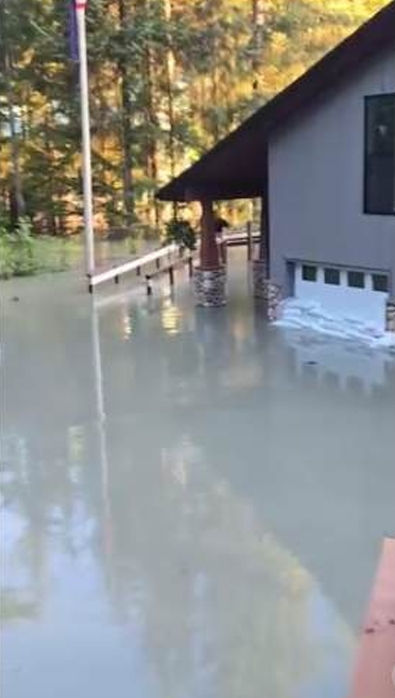
Her family ran a generator and pumps, and used “at least 400 sandbags.” For this year, they built a better drain in the garage and are getting another trash pump. They also have a camera in their crawlspace to monitor water levels.
The Emergency Watershed Protection program would use the appraised value before the 2024 flood. The rough estimations ranged from $200,000 to $500,000 per property.
Peterson said she is not upset with the city, but for View Drive to prepare for this year’s flood, they need to know more about both short-term and long-term solutions. She added it’s also difficult to plan while awaiting the U.S. Army Corps of Engineers’ enduring solution, which could be 10 years away.
“I think the City and Borough, and the tribes and all the people that are involved with trying to help the community, are doing the best that they can,” Peterson said. “Considering everything that the city's faced with right now, that's not an easy decision, because we’re 18 homes.”
• Contact Jasz Garrett at jasz@juneauindependent.com or (907) 723-9356.


_edited.jpg)



.png)

.png)