.png)

Juneau declares its earliest disaster declaration ahead of the expected 2026 glacial lake outburst flood

City 'anticipates operating under emergency declarations until the threat to life, safety, and property is mitigated'
By Jasz Garrett
Juneau Independent
The Juneau Assembly unanimously approved a local emergency declaration on Thursday afternoon in anticipation of this year’s glacial lake outburst flood.
The resolution acknowledges Suicide Basin has released outburst floods since 2011, with record flood events over the last three years causing repeated damage to public and private infrastructure.
Gov. Mike Dunleavy issued a state disaster declaration on Aug. 12, 2024, after nearly 300 homes in the Mendenhall Valley were damaged and the State of Alaska received a federal disaster declaration in October that same year.
This week’s resolution states the city has “operated under an ongoing emergency since August 2024 as flood events of this scale have caused riverbank collapse, major flooding, residential evacuations, property losses, damage to public utilities and infrastructure, and hazardous material releases.”
Last August, the city and the Central Council of the Tlingit and Haida Indian Tribes of Alaska issued a joint disaster declaration “to allow for timely protective actions, including the deployment of state resources and pre-positioning of equipment, emergency permitting, public alerts, and interagency coordination.” This move extended the local emergency through July 11, 2026.
The governor followed by issuing a preemptive disaster declaration last August.
While the city was able to protect hundreds of homes and city infrastructure in the Mendenhall Valley last year due to the emergency placement of HESCO flood barriers, the resolution notes the city “is committed to proactive, coordinated flood preparation and response.”
The resolution also recognizes the repair and fortification of Phase 1 of the HESCO barriers, along with the new installation of Phase 2 mitigation by the U.S. Army Corps of Engineers to protect against a 63,500 cubic foot per second flood in anticipation of this year’s release.
While the city notes its pursuit of mid- and long-term solutions, it “anticipates operating under emergency declarations until the threat to life, safety, and property is mitigated.”
By issuing the local disaster declaration on Thursday, the city is requesting the governor provide continued state public and individual assistance, and assistance with emergency permitting within and near the Mendenhall River.
Due to “the ongoing nature of the emergency,” the declaration will remain in effect until Dec. 15, 2026. Outbursts from Suicide Basin have occurred during the first two weeks of August the last three years, but could happen earlier or later.
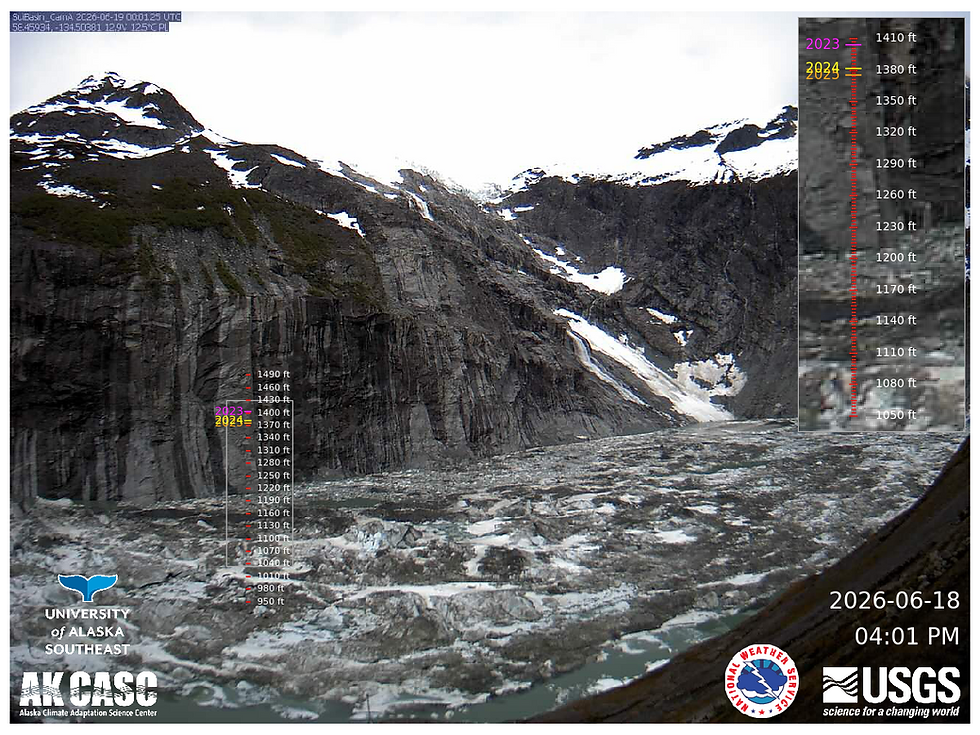
Suicide Basin’s status via the National Weather Service Juneau monitoring page was last updated on Monday. It states the basin’s water level is steadily rising slowly as seen on webcam imagery, with the current elevation around 1,190 feet.
“This time last year(2025), the water level elevation was around 1155ft, but in 2023 it was 1245ft,” the Monday update states. “As with the water levels of Mendenhall Lake, the amount of filling (input) into the basin will increase as temperatures rise to produce more runoff from the melting of snow and ice through the summer months. The estimated elevation of the overflow channel is around 1350ft.”
The weather service will continue to monitor the basin and release any new information at least once a week on Mondays. Flood preparations kicked off with a preseason open house last week, with more events scheduled for this month and July. Next Thursday, the Juneau Flood Solution Advocates group will host a community discussion with University of Alaska Southeast professor and researcher Eran Hood from 6-8 p.m. at Chapel by the Lake.
There were no comments or questions from the Assembly on any of Thursday’s special meeting agenda items.
• Contact Jasz Garrett at jasz@juneauindependent.com or (907) 723-9356.