.png)

Many plead against cuts to city’s recreational and cultural programs; few suggest what to cut instead

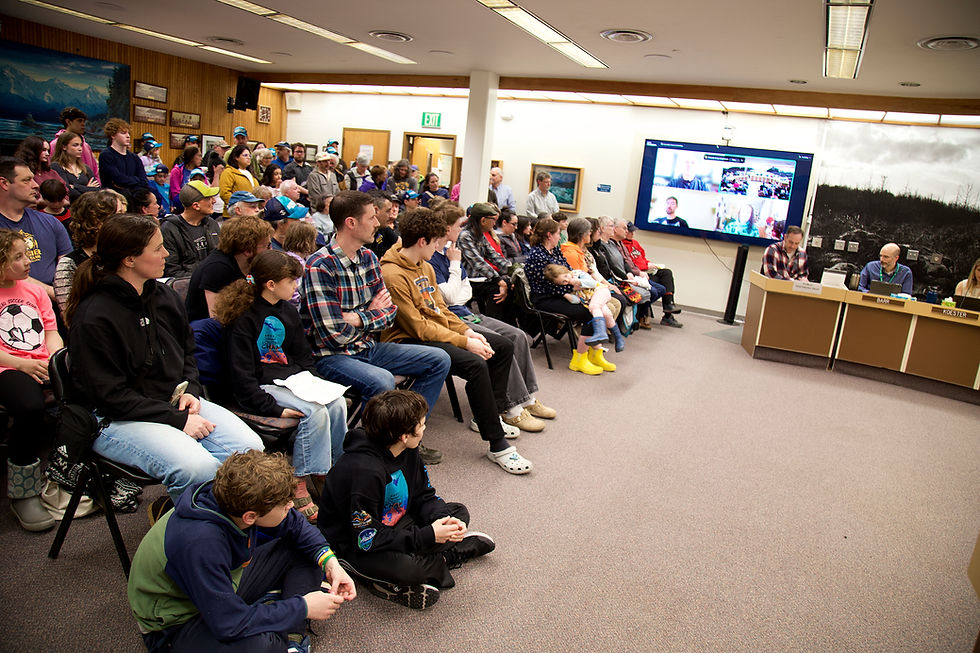
About 70 people cram into City Hall to express concerns to Juneau Assembly about proposed closure of public pools, museum and other reductions to patch revenue gap caused by tax cuts
By Mark Sabbatini
Juneau Independent
Emily Treston, 11, told Juneau Assembly members and a packed chamber at City Hall that she’s been going to the city’s two public pools since she was two months old. She mentioned the bonds she’s formed with other swimmers and coaches, and the opportunities swimming offers, including participating in statewide and out-of-state competitions.
She told city leaders closing one of the pools to help resolve a budget "would have a negative impact on my life."
"We live in a town of 30,000 people and it's already hard to get swim time," Treston said. "We cannot close a single pool. Too many people rely on the pool. It's a life sport. We are surrounded by water and everyone needs to know how to swim. Please don't close our pool."
Like the other dozens of people testifying about next year's proposed city budget during an Assembly meeting on Wednesday, Treston was given a two-minute time limit.
The nearly three hours of testimony was primarily a listening exercise for Assembly members, who will be shaping the budget for final passage during the next six weeks. But one of the few questions from them was asked as Treston finished her remarks and stepped away from the chair.
"I was just going to ask our testifier what her favorite pool is," Assembly Member Paul Kelly told Mayor Beth Weldon, who was presiding over the meeting.
Weldon obliged by asking: "Miss Emily, what’s your favorite pool?"
Treston returned to the chair, where she paused for a few seconds.
"Both of them," she replied, earning widespread laughter and applause from the audience as well as some of the Assembly members.
"That’s a future Assembly member right there," Weldon proclaimed as Treston stepped away from the chair for a second and final time.
The lighthearted moment during the marathon of anxious testimony also reflected a common mood among the people who signed up: considerable fervor in sparing favorite programs from cuts, but relatively few suggestions on what should be cut instead.

The abnormally large turnout for such a hearing was sparked in part by a lengthy list of proposed cuts to programs, services and grants — largely recreational and cultural — suggested by one or more Assembly members due to an expected $12 million in lost revenue for the coming year due to tax-cut measures passed by voters last fall.
Items mentioned by at least five of the nine Assembly members were the Dimond Park Field House (up to $600,000 in savings), the Juneau-Douglas City Museum (up to $790,000), the Mount Jumbo building ($191,000, plus $2.5 from selling it), and either the Augustus Brown Swimming Pool downtown ($600,000) or Dimond Park Aquatic Center in the Mendenhall Valley (about $1 million)
Among several people pleading not to close the museum was Janet McCallister, a Douglas resident who — like many others at the meeting — said the high public turnout showed Juneau’s desire for healthy recreational and cultural programs. She also said as a longtime Juneau resident, "memory is important to me, maybe more important than it is to some younger people."
"Once you remove memory it's gone," she said. "And that's what would happen if the city museum were shuttered…to save money. It would be like burning down the house for the insurance money with all your grandparents' love letters in the attic."
Another frequently mentioned possibility is reducing community grants to a multitude of organizations and individuals. Also being considered are staff-related cuts that could involve, for instance, the city’s law department turning over prosecution of local crimes to the state, with the acknowledgement not all cases might be pursued as a result.
The proposed budget entering Wednesday’s meeting includes about $551 million in spending and $528 million in revenue. The proposed budget thus uses about $23.7 million from city fund balance accounts to cover the deficit, although that figure is expected to be less after the Assembly imposes cuts and possibly new revenue measures such as higher fees for programs and services.
Of the total proposed spending, $141 million is for municipal government operations, which will be a primary place Assembly members look to impose cuts. Among other budget major components are Bartlett Regional Hospital, the Juneau School District and capital improvement projects.
Weldon, at the start of the meeting, emphasized the budget is in the draft stage and the public will get additional changes to weigh in, including during a meeting in June before the Assembly votes on a final draft.
"I know that people were not pleasantly surprised with the list of priorities that we marked for reductions," she said. "Be advised this is just a list that we're going to talk about."
An argument the broad range of suggested cuts isn’t just undesirable, but unnecessary as well, was offered by Tom Williams, a longtime Juneau accountant who’s worked for city and state government entities.
"I find for the CBJ to even consider closing facilities critical to the youth of our community — including our pools, the ice rink and the field house — to be unconscionable," he said. "CBJ has more than enough money. It has tens of millions of unobligated dollars in the bank, and it’s a result of very poor budgeting and the overcollection of taxes."
Williams criticized, as some other residents have over the past several months, plans by city leaders to spend some of those millions relocating City Hall offices to the Michael J. Burns Building, proceeding with (or more likely canceling) gondola plans at Eaglecrest Ski Area, and possibly demolishing homes to spur redevelopment of Telephone Hill.
One way the Assembly could save more than $10 million in costs, he suggested, is "to offload Eaglecrest" to Goldbelt Inc. in a deal that would absolve the city from having to pay back the $10 million the Alaska Native corporation provided for the gondola (which, with interest from the past three years, would exceed $12 million).
Assembly members are moving toward canceling the contract that gives the company a share of profits in exchange for that money, due to an estimate of installation costs that is far higher than expected and what city leaders say is affordable.
Eaglecrest has also operated at a loss for many years, with the Assembly subsidizing the city-owned ski area. Next year’s proposed budget includes a nearly $1 million base subsidy — matching that of recent years — plus reserving up to $2.3 million to cover additional shortfalls if necessary. However, the Assembly is asking Eaglecrest to evaluate scenarios that omit some or all of that latter funding.
City officials are also considering alternative agreements with Goldbelt — which could include providing land, a greater profit share, and/or having the company take over the ski area’s operations. They cannot sell the 640-acre resort outright because it resides on city-owned land surrounded by U.S. Forest Service and state land.
Eaglecrest was also targeted by John Wendel, a Mendenhall Valley resident, who said "alpine skiing is simply not an affordable activity for many households in our community, particularly when factoring in lift tickets, equipment and transportation."
"In contrast, many other recreational programs and facilities serve a broader and more economically diverse segment of Juneau," he said. "At the time when resources are limited public funding should be directed towards recreational opportunities that are inclusive, widely used and financially accessible."
Other people young and old defended the ski area, noting Eaglecrest offers ski club and other programs for hundreds of local students, among other community-oriented programs.
"Having a public ski hill that's accessible to children, families and all residents is a crown jewel of our community," said Shawn Eisele, executive director at Discovery Southeast, a nonprofit that provides outdoor recreation and education programs to children and families. "It's an admirable model that's generally worked well for 45 years and has only stumbled for the last five."
Privatizing recreational facilities elsewhere has generally meant "costs go up, accessibility goes down and participation goes down," he said.
For Assembly members who’ve been pondering since last October’s election how to make ends meet during the coming budget year, Wednesday’s testimonies largely reinforced the already considerable public input they’ve received from other meetings and surveys during the past few months.
"I think a lot of us Assembly members actually use the facilities," Kelly said in an interview Thursday. "I'm a pretty good regular at the field house myself, and so I heard a lot of the things that people were saying about how many people use the facilities and what they use it for. I'm in the facilities and I see that, and my kids go to all these facilities. And so I understand just how important these facilities are and it's really hard for me to even consider these cuts, but I feel like I'm in a position where I'm kind of forced to."
Among his goals during the upcoming budget debate is minimizing cuts with permanent impacts, Kelly said.
"I wouldn't want to close a pool permanently," he said.
• Contact Mark Sabbatini at editor@juneauindependent.com or (907) 957-2306.