


.png)

On The Trails: Dike trail observations and nuthatches

By Mary F. Willson
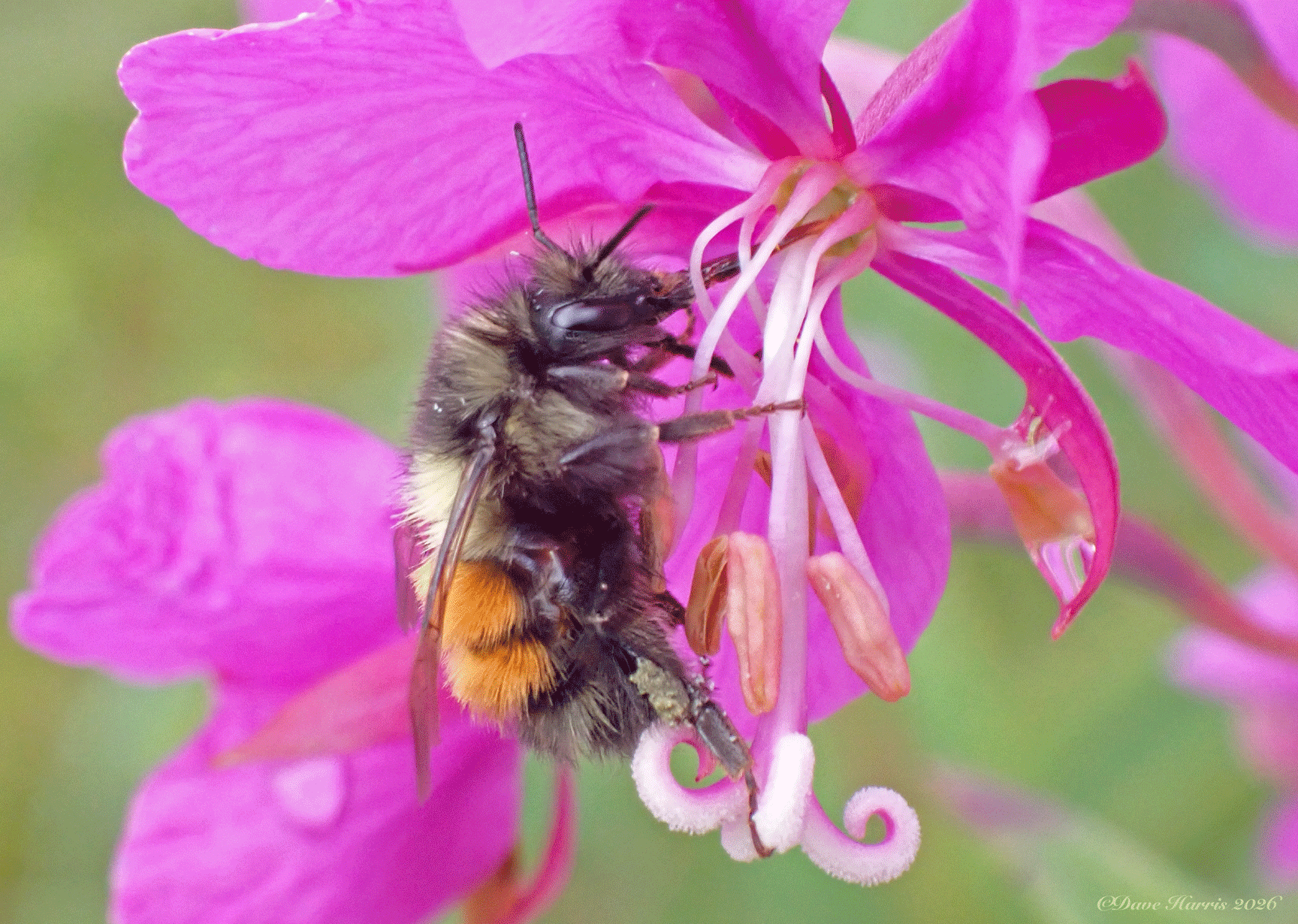
A stroll along the dike trail in late-mid July was replete with nice observations. As readers know, I’ve been concerned about our local bee populations, with just spotty reports of abundance. On that stroll, however, we found over 150 bees on fireweed, all along the trail, plus an occasional one on yellow rattle and fragrant white clover. Possibly encouraging news??
Small groups of Bonaparte’s gulls, both adult and juvenile, foraged busily at the edge of the low-tide pools. They were all foot-paddling (or tap-dancing, for some observers) steadily, stirring the sediments and grabbing some small organisms. A single dowitcher, probably a long-billed one, hung out in the middle of a shallow pool for a while, occasionally reaching into the water. A (?greater) yellowlegs across the lagoon yelled at something.
A kingfish hovered high up over the water, looking, but saw nothing worth diving for. Several songbirds vocalized — Lincoln’s sparrow, ruby-crowned kinglet, hermit thrush. In the meadow near the trailhead, a gang of juvenile crows called for food even though they were foraging for themselves, while the adults ignored them and explored stands of clover and grass.
Here on my home pond, the female mallard with five or six tiny chicks was brooding them on the bank one evening and again (?still) the next morning, and during the day they all went out over the pond to forage. Another brood of mallards with five or six very large ducklings "shared" the pond, not amicably, with the others.

There was also an occasional sighting of a female mallard with two chicks of very different ages, possibly adopted. On the deck, the peanut-butter junkies (juncos and yellow-rumped warblers of all ages) were busy, so I had to wait to fill those feeders until there was a time when tiny ducklings were off downstream, so as not to bother them. Compromises…The warblers also visited the hummingbird feeder for a sip. Chestnut-backed chickadees came for suet or peanut butter, and a pair of red-breasted nuthatches came not often but regularly, so they are probably nesting not far away.
Another pair of nuthatches is nesting in the Dredge Lake area, and a friend took me on a walk to see it. Nuthatches are cavity-nesters and this nest is in a tall snag bearing moss clumps and residual bark. The adults were nearby, calling. Red-breasted nuthatches have an unusual habit of putting sticky conifer resin around the nest entrance, a habit not shared with any of the other twenty-eight species of nuthatch. The nesting male reportedly puts the resin primarily on the outside of the hole, and the female does it mostly on the inside. Adult birds typically zip in and out very quickly, without getting stuck. Biologists speculated for many years about the possible function of this habit. Does it protect the nest from predators? Does it deter competition from other cavity-nesters that might claim that nest-hole?? At last, a recent publication presented the results of some experiments, in which researchers put resin around the nest holes of a series of nest boxes, to compare with those lacking the resin. Squirrels (a potential predator) were less likely to chew into the boxes with resin and wrens (a potential competitor) were less likely to move into boxes with resin. So the resin may indeed be protective, but how the habit arose in this one species is still mysterious.
Red-breasted nuthatches often excavate their own cavities, the female doing most of the digging while the male brings her food. The female lays five or six eggs and incubates them for almost two weeks. The male brings her food at times, and both parents add resin to rim the nest hole. Chicks are fed on insects; they fledge in about two weeks and are fed by both parents for another fortnight or so.
This species nests in conifer forests all across North America, wintering as far south as the Gulf Coast. Occasionally, the birds irrupt in large numbers, apparently in response to winter food shortages. Seeds (especially of conifers) are an important winter food, and the name of “nuthatch” comes from an old word meaning "nut-hacker," which refers to their habit of putting a big seed into a crack or crevice and whacking it with their bill; they often rear up on their legs and put a full body blow behind that sharp bill.
• Mary F. Willson is a retired professor of ecology. "On The Trails" appears periodically in the Juneau Independent. For a complete archive of Mary Willson’s “On the Trails” essays, go to https://onthetrailsjuneau.wordpress.com


